


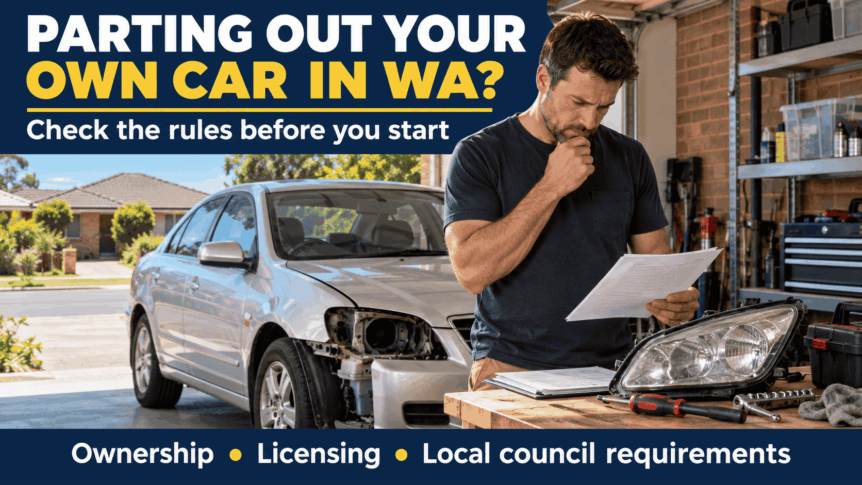
Can you part out your own car in WA? It can be possible, but owning the vehicle is not a blanket exemption from licensing requirements. Before dismantling it, check whether your proposed activity needs a licence, what happens to its registration and how you will deal with the shell. Then decide whether the likely return justifies the work.
For a mechanically broken car, the tempting calculation is to add up advertised prices for the engine, gearbox, panels and wheels. The useful calculation is what those parts will actually sell for, after removal, storage, collection and the pieces nobody wants.
Is it legal to part out your own car in WA?
WA Government guidance requires a motor vehicle dealer licence when you carry on a business of buying or selling vehicles. Its Category B licence covers buying vehicles to dismantle and sell their parts. Buying donor cars to strip for resale therefore needs a different assessment from disposing of components from a car you already own.
That business guidance does not establish a universal exemption for every one-car project. Before advertising parts, describe your plans to WA Consumer Protection: whether this is your own vehicle, whether you bought it to dismantle, and whether you intend to repeat the process. Ask which licensing requirements apply to your circumstances rather than treating “private sale” as automatic permission.
Also establish that you are entitled to dispose of the vehicle. If finance, shared ownership or an insurance claim is unresolved, get the relevant party’s written agreement before removing anything. Keep your purchase records and photographs of the vehicle’s identity and condition; these are useful if a buyer asks where a component came from.
What DIY parting out actually involves
Finding a buyer for every single part
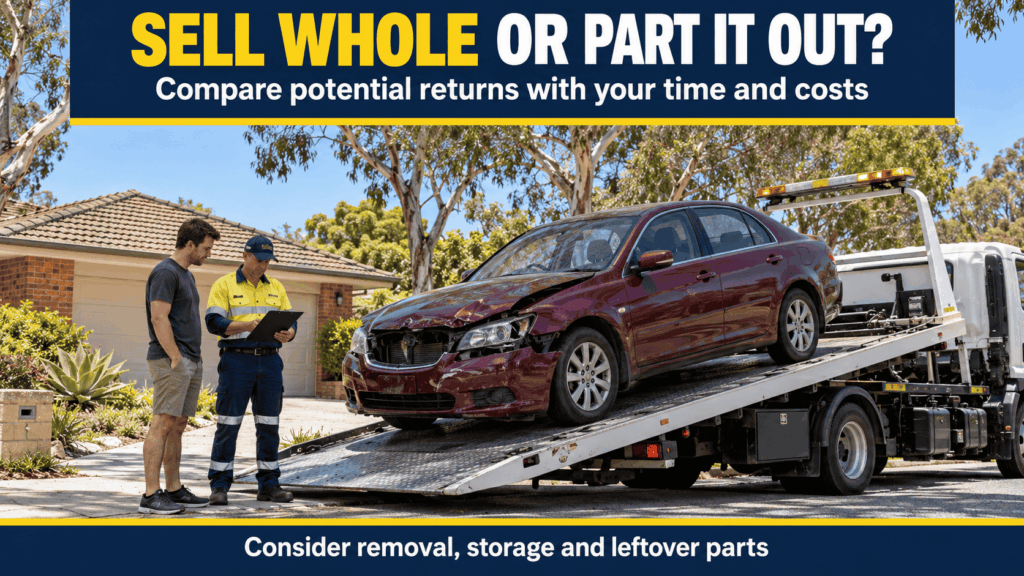
Selling a whole car is one transaction. Selling it in pieces might mean a dozen or more: an engine, gearbox, doors, wheels, electronics and interior trim, each needing a buyer and a collection arrangement. For a Mini hatchback’s spare parts, the exact generation, engine variant and part number matter more than the badge alone.
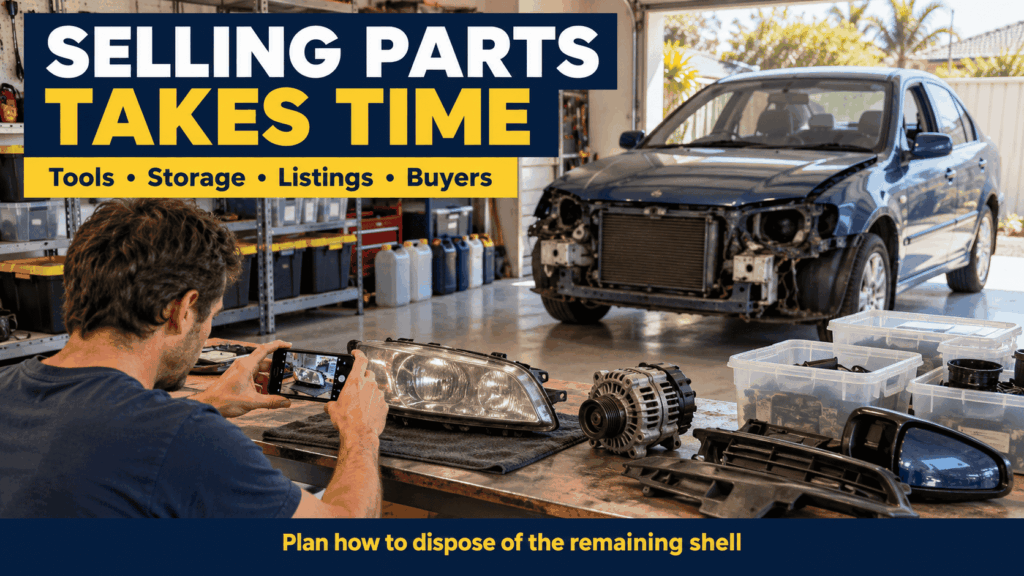
Photograph components before removal, record what you can demonstrate working and describe faults plainly. An engine that has not been tested is a different proposition from one a buyer can hear running. Asking prices in other listings are not evidence of completed sales, and several apparently valuable parts may sit unsold for months.
Dealing with fluids and hazardous materials properly
Plan for oil, coolant, fuel and the battery before disconnecting components. Contact your local council or receiving facility to confirm what it accepts and how each material should be contained. Automotive fluids and batteries need separate disposal arrangements; do not assume a facility accepting coolant also accepts motor oil or car batteries.
Removing heavy assemblies also needs suitable lifting equipment, support and experience. Airbags, air-conditioning systems and high-voltage components are reasons to use a qualified specialist rather than attempt every job at home. A list of saleable parts is not yet a safe dismantling plan.
What is left over at the end
Before stripping anything, separate personal belongings from components you plan to sell. A checklist of what to remove before collection helps with documents, keys and stored personal data. Emptying the glovebox is different from removing equipment that a collector expects to remain with the car.
Once the useful parts are gone, the shell still needs somewhere to go. Ask a recycler what it will accept before removing the wheels, suspension or drivetrain. Describe exactly what will remain and get collection terms agreed in advance; a complete rolling vehicle and a shell on stands present different loading problems.
A driveway in Perth’s Ashfield area may have enough room to store a car but limited space to load a stripped shell. Measure the access, consider gates and overhead clearance, and tell the collector if the remaining vehicle cannot roll or steer. Sorting this out first avoids rebuilding a movable vehicle just to get it off the property.
What actually affects value, parts or whole
Demand for the exact model, the condition of its components and evidence that they work matter more than a long inventory. A desirable gearbox may attract interest while damaged panels or worn trim do not. Newer electronics can also require matching or programming, so do not assume every component is a straightforward replacement.
Compare the likely proceeds with the cost of tools, lifting help, packaging, storage and final collection. Allow for unanswered messages, missed pickups and unsold stock. A few early sales can look promising while the remaining shell occupies the driveway and the slower-moving items fill the shed.
Registration and plates when dismantling
Selling a part is different from transferring a licensed vehicle. Transport WA says that when you sell, gift or dispose of a WA licensed vehicle, you must notify it within seven days that you have ceased to be the owner and provide the new owner’s name and address. Do not treat every individual parts sale as a whole-vehicle transfer.
If the vehicle is being permanently dismantled, check the cancellation process with Transport WA. Owners can voluntarily cancel a vehicle licence by surrendering its plates. Plates from a cancelled licence must be returned to a DTMI service centre or regional agent, or posted back as directed. They are not simply keepsakes to retain after cancellation.
Selling the whole car instead
Selling as-is avoids finding a buyer for every component and arranging separate shell disposal. Before accepting an offer, describe missing parts and agree what will be collected. Keep records of the handover and resolve the vehicle’s licence status through the appropriate Transport WA process.
Weighing it up
Parting out can make practical sense when you have confirmed the applicable requirements, identified real buyers and planned safe removal and disposal. Selling whole may suit you better if time, space or loading access is limited. Compare what you are likely to keep after the work, rather than the sum of optimistic listing prices.
If dismantling looks impractical, the scrap vehicle team at Cash for Cars Perth can help you assess selling the vehicle whole on 0420 262 651.