


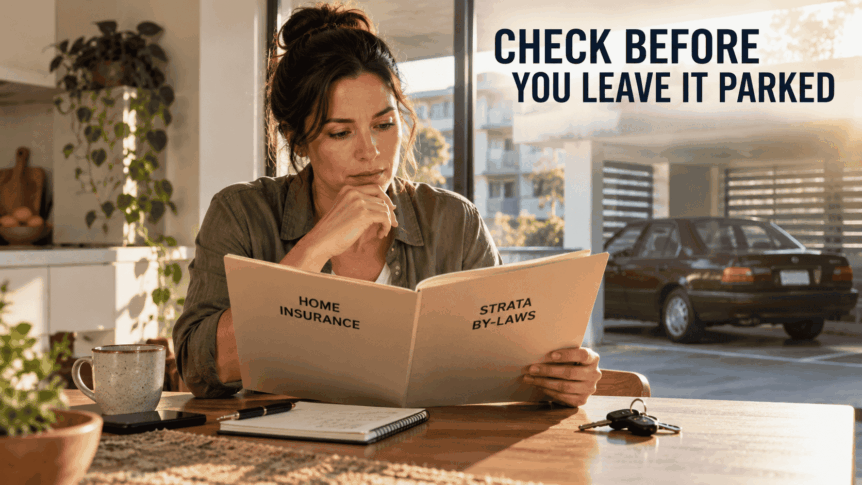
Does a broken car affect home insurance or strata rules in WA? There is no automatic answer for every property. Your insurance policy, the condition of the vehicle and the rules for its parking bay all matter. A car that will not start is a different concern from one leaking fuel or blocking shared access.
If you have a mechanically broken car sitting at home, start with two separate checks: ask your insurer about cover and ask your strata manager which parking rules apply. Permission to use a bay does not establish insurance cover, and an insurance policy does not grant parking permission.
Home Insurance and a Broken-Down Car
Home building insurance concerns the building and fixtures; contents insurance concerns belongings. Do not assume either policy insures the car itself. Check the vehicle exclusions in your Product Disclosure Statement (PDS), alongside any separate motor policy. Being unregistered does not, by itself, tell you whether a vehicle has insurance.
Damage to the car and damage caused by the car are also different questions. If oil stains a shared driveway or a vehicle fire damages a building, the relevant policy, exclusions and circumstances need to be assessed. A parked car does not automatically invalidate your home insurance, but neither can you assume every resulting loss is covered.
When It’s Worth a Phone Call to Your Insurer
Describe the actual situation, including where the car is stored, its known damage and any leaks. Ask:
- Does the policy exclude damage to motor vehicles or liability arising from them?
- Do I need to notify you about the vehicle’s condition or storage?
- If common property is damaged, should the strata company’s insurer also be contacted?
Request written confirmation and keep it with your policy documents. If a claim is already underway, check with the insurer before selling, dismantling or moving the vehicle in a way that could affect its assessment.

Strata By-Laws and Vehicles in WA
First establish whether the bay forms part of your lot, is common property or is common property subject to exclusive-use arrangements. A numbered bay beside your unit is not enough to settle that question. Landgate advises checking the scheme plan to identify lot boundaries and common property.
WA’s default conduct by-laws require written strata company approval to park or stand a vehicle on common property. Schemes can have different registered parking by-laws, so check the current rules for your scheme. Do not treat the default rule as a universal ban on every non-running car in every privately owned bay.
What This Looks Like in Practice
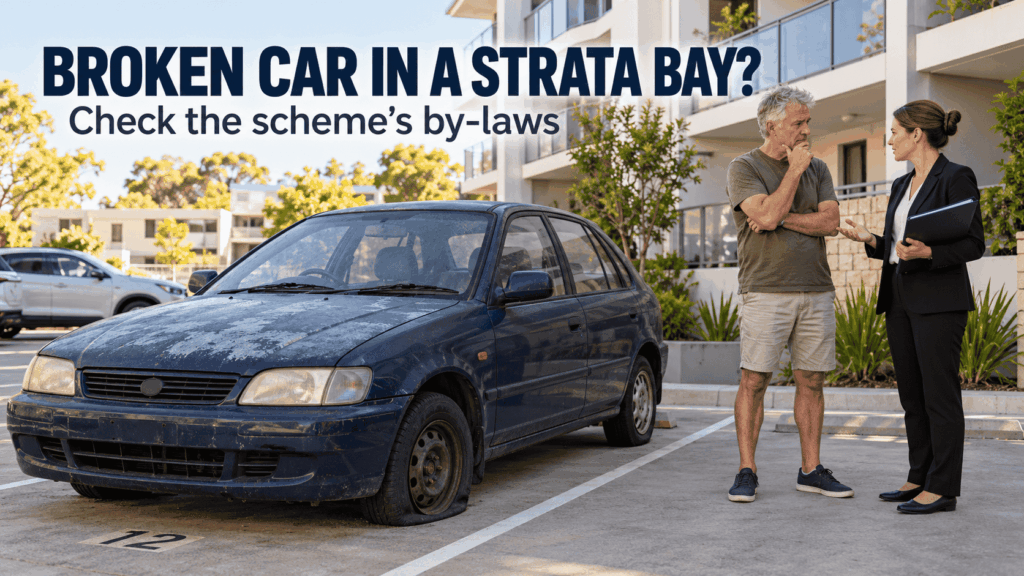
Ask the strata manager for the relevant by-law, any parking approval and any conditions affecting the bay. Check whether the rules address vehicle storage, visitor parking, leaks or obstruction. If you rent, involve your property manager so the owner can help clarify the scheme documents.
Moving the car outside the complex introduces a different question. The rules for broken car street parking need checking separately; a strata parking dispute is not solved simply by shifting the vehicle onto a verge.
If you receive a breach notice, keep a copy, check the by-law it identifies and respond to the strata company. Landgate describes an enforcement process involving written notice or, in specified circumstances, an application to the State Administrative Tribunal. Ask for clarification if you dispute the alleged breach; do not assume a notice itself authorises immediate towing.
Getting It Off Your Strata Property
Separate the immediate parking issue from the decision to repair or sell. You may need to arrange a suitable storage or workshop destination while you wait for an assessment. Agree on access with the strata manager before booking transport, particularly where the route crosses shared areas.
For example, collection from an apartment bay in East Perth needs planning around the building’s entrance height, ramp and loading area. Send the transporter photos and clearance details rather than assuming a tow truck can reach the bay. Confirm how the vehicle will get to an accessible loading point.
Tell the operator whether the wheels roll, the steering unlocks and the keys are available. Mention a steep ramp, tight turn or another car blocking the route. Avoid attempting to push a heavy vehicle down a basement ramp yourself.
Confirm who will open gates, move neighbouring vehicles and meet the driver. If the manager needs advance notice, allow time for that before accepting a booking. Keep the loading route available for the agreed time rather than relying on a visitor bay being empty. After collection, photograph the vacated bay and let the manager know the vehicle has gone. If there are stains or damage, discuss the next step instead of assuming removal has resolved everything.
Why It’s Worth Sorting the Car Out Sooner Rather Than Later
A clear plan helps prevent an open-ended wait. Set a date to obtain a diagnosis, review an insurer’s response or confirm a collection booking. That is more useful than letting the car sit while nobody knows who is taking the next step.
If you are comparing repair with disposal, describe the exact vehicle and fault. A Fiat hatchback with a failed gearbox may still have reusable components, but parts demand and condition vary. The badge alone does not establish its value or make a repair worthwhile.
Keep access clear and report fresh leaks promptly. Weather exposure can worsen existing damage, while a blocked bay can continue inconveniencing neighbours. These practical concerns are separate from whether the vehicle breaches a particular by-law or triggers an insurance exclusion.
Choosing Your Next Step
Keep the insurer’s advice, scheme by-laws, any notice and transport arrangements together. If repairs are practical, confirm when the workshop can receive the car. If they are not, check that any insurance assessment is complete before agreeing to disposal, and confirm collection access and timing.
If you need help exploring collection after those checks, Cash for Cars Perth’s undriveable car removal service can discuss your situation on 0420 262 651.