



Broken car street parking in Perth depends on where the vehicle sits, whether it is licensed and the rules of the local council. A car entirely inside your driveway is in a different position from one left on the verge or road. Moving it just beyond the property boundary can create a parking problem rather than solve a storage problem.
If you have an undrivable car with flat tyres, a dead battery or unresolved accident damage, start by checking its exact location and any notice already attached to it. Then speak to your council about the action required. There is no single waiting period you can safely apply to every Perth street.
Driveway vs Verge vs Street: Why It Matters
The verge outside your home is not an extension of your private driveway. The Town of Victoria Park explicitly describes the verge as council land and recommends storing a vehicle on private property if you do not use it daily. A familiar parking spot outside your house does not automatically become a long-term storage space.
Check which of these situations applies before deciding what to do:
- Entirely on private residential land: ask your council about your particular circumstances if someone has complained or you have received a notice.
- On a verge: check the local verge-parking rules, licence requirements and any restrictions that apply to that location.
- On the road: check parking signs and the council’s rules about vehicles left without moving.
Private property is not a blanket exemption from every parking arrangement. Victoria Park has agreements allowing parking enforcement on some private land. Canning, meanwhile, says its officers cannot remove vehicles from private residential properties through its abandoned-vehicle process. These examples are reasons to ask about your own property, rather than assume every council has identical powers.
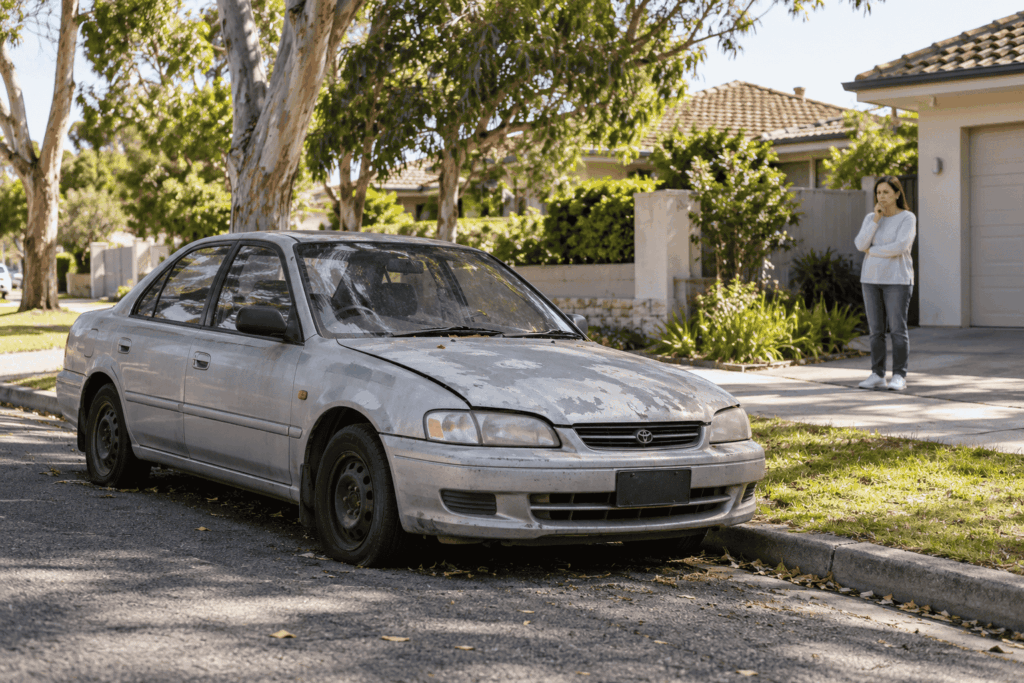
What Counts as Abandoned on the Street?
A vehicle does not have to be an empty shell to attract a council investigation. Where it is parked and how long it stays there matter, even if the owner intends to repair it. The council examples below show why a neighbour’s experience in another suburb may not tell you what applies to your car.
Victoria Park and Stirling
Victoria Park says vehicles left for more than 24 hours in a non-timed public parking area are subject to investigation and possible impounding. It advises street-parked vehicles to be used daily. That does not make the first 24 hours a guaranteed allowance: vehicles creating an obstruction or hazard may be impounded immediately if the owner cannot be contacted.
Stirling describes a different sequence. A ranger places a 24-hour notice on the vehicle to allow it to be moved to private property. If it remains after that notice period, it is considered abandoned and investigated. The City attempts to identify the owner, and the vehicle may eventually be towed if the owner fails to move it.
Gosnells: Road and Verge Rules Differ
For a vehicle outside a home in Gosnells, check whether it is on the carriageway or verge. The City’s reporting guidance permits a vehicle on the carriageway for up to 24 hours without moving, provided no other offence is committed. It also permits a licensed vehicle to remain longer on a verge with the adjoining owner or occupier’s permission, provided no other offence is committed.
That licensed-vehicle condition matters. Transport WA says leaving an unlicensed vehicle on a road reserve, carriageway, public roadway, footway or park is an offence, whether the vehicle works or not. Do not assume permission from a householder makes an unlicensed car acceptable on the verge.
What Happens If a Ranger Flags Your Car?
Read the notice carefully and contact the council named on it. Tell the ranger whether the car starts, whether it can roll and whether you are arranging transport. Ask what deadline applies and where the vehicle needs to be moved. Keep a copy of the notice and any written response so you can refer to the same instructions when booking help.
Moving the car onto your own land may address its street location, but it does not repair the vehicle or make outdoor storage practical. The problems associated with junk cars on your lawn are a separate consideration when deciding whether to keep it there. Choose a storage position you can actually access again, rather than somewhere the car will become harder to retrieve.
If it has already been impounded, contact the council before arranging collection. South Perth requires photo identification and proof of ownership, with towage fees paid before release approval; impound and storage charges are payable to the impound agent. It also requires vehicles to be towed from that agent. A booking with a private collector does not itself arrange release from a council impound.
Moving a Car That Will Not Drive
Give the transporter useful details before they attend. Describe the surface the car sits on, the available driveway width, any overhead clearance and whether the wheels turn freely. A vehicle behind another car, on a steep driveway or with seized brakes may need a different collection approach from one parked on level ground with clear access.
Record the make, model, colour and registration details when discussing the vehicle with a ranger or transporter. Describing a Mitsubishi Lancer sedan with locked wheels is more useful than saying there is an old car out the front. Explain the fault as well: an engine that will not start and a vehicle that cannot roll present different transport problems.
Do not treat a short drive around the block as a solution to an unlicensed vehicle’s parking position. Transport WA’s temporary movement permits apply to specified purposes and conditions; they do not authorise leaving an unlicensed vehicle parked on public land. Discuss the appropriate transport method before trying to move it yourself.
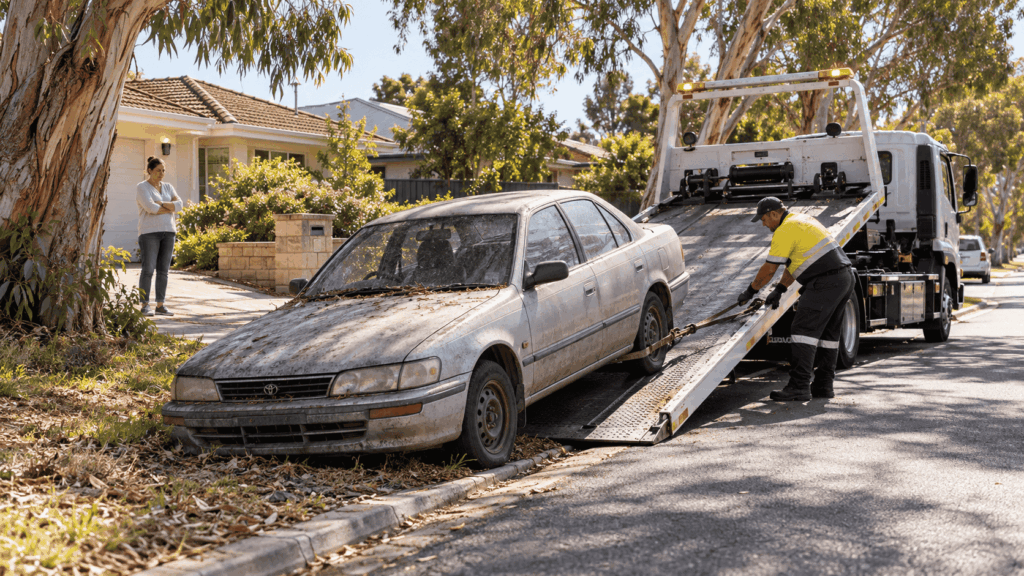
Decide Where the Car Goes Next
Separate the immediate parking issue from the longer-term decision. A council notice needs a response even if you have not decided whether to repair or sell. Establish a suitable destination, arrange transport and confirm the council’s instructions; then decide whether keeping the vehicle still makes sense.
If you are repairing it, speak to the workshop about when it can accept the car. If you are keeping it on your property, plan for access when it eventually needs to move again. If it is already impounded, deal with the release requirements first. None of these decisions needs to depend on an advertised maximum vehicle price or a promised collection time.
If repair is no longer practical, our broken car removal service can help you explore collection as an alternative to continued storage; call Cash for Cars Perth on 0420 262 651 to discuss your situation.