


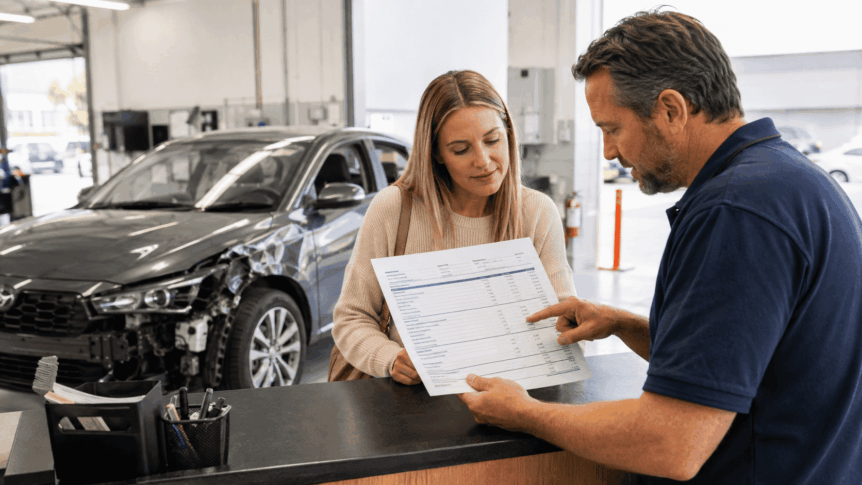
A smash repair quote is one of those documents that looks straightforward until you actually try to read it. It’s usually a page or two of trade terms, part numbers, and labour hours, with a total at the bottom that either seems reasonable or makes your stomach drop. If you’ve just received one and you’re trying to decide whether to go ahead or walk away, here’s how to make sense of what you’re looking at — and when the numbers are quietly telling you the car isn’t worth fixing.
What’s Actually in the Quote
Most repair quotes are broken into the same broad categories. Once you know what each one covers, the total is far less mysterious.
Parts
This is usually the biggest line item, especially for newer or less common vehicles — panels for a mainstream Toyota are cheaper and quicker to source than for a low-volume import. A quote should say whether parts are genuine (from the manufacturer), aftermarket, or reconditioned. Genuine parts cost more but are the safest choice for anything structural or safety-related. If the quote doesn’t specify, ask — the difference in both price and quality can be significant.
Labour
Charged by the hour, and the rate varies between repairers. A good quote splits the hours into panel work, mechanical work, and reassembly, so you can see where the time is actually going instead of staring at one lump figure.
Paint and materials
Covers prepping, blending, and clear-coating the repaired panels so they match the rest of the car. Paint work across a full panel or several adjoining panels adds up quickly, and colour-matching an older or faded finish takes extra time.
Sublet work
Some jobs — wheel alignments, auto electrical, windscreen and glass replacement — get sent to a specialist rather than done in-house. These usually appear as a single sublet amount rather than an itemised breakdown, which is normal, but it’s fair to ask what’s included.
The Comparison That Actually Matters
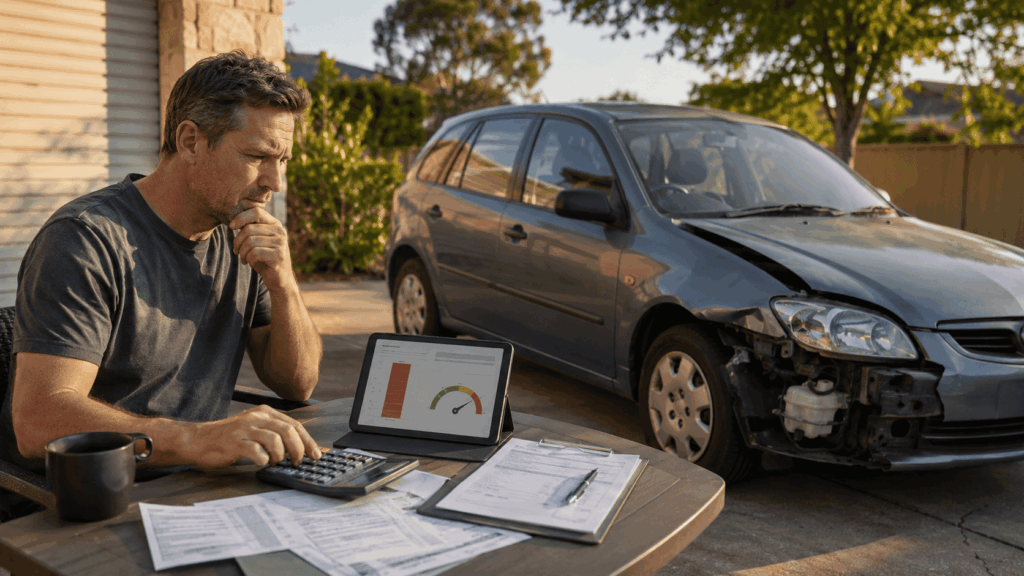
The quote total on its own doesn’t tell you much. What matters is how that figure compares to what the car was worth in its pre-damage condition. Insurers use roughly this ratio to decide whether to declare a write-off, and it’s a useful test even when there’s no insurance claim involved.
A rough way to think about it: if the repair cost is approaching — or past — what the car would sell for in good condition, you’re paying to restore something that still won’t be worth what you spent. On top of that, a repaired car carries an accident history from then on, and that usually makes it worth less on resale than an equivalent car with a clean record.
What decides the car’s actual value
- Age and odometer reading
- Make and model, and how much demand there is for it right now
- Service history and mechanical condition before the damage
- Whether it’s licensed (registered), and how much time is left on it
- Condition of tyres, interior, and anything else a buyer would notice
It helps to get an honest sense of this figure before you look at the repair quote again, rather than after. It’s easy to anchor on the number the repairer gives you and lose sight of what the car is genuinely worth.
Signs the Quote Is Telling You to Sell, Not Repair
A few things in a quote — or in the assessment behind it — usually point toward selling rather than repairing:
- Structural or chassis damage. Repairs involving the frame, chassis rails, or structural pillars are expensive, and depending on severity they can affect how the car handles or protects you in a future crash even after a proper repair.
- The quote is a large share of the car’s value. There’s no fixed percentage, but the closer the repair cost gets to what the car is worth, the harder it is to justify.
- Hidden damage turns up mid-repair. It’s common for a repairer to find more once panels come off — bent mounts, damaged wiring, a cracked rail. Ask whether the quote you’re holding is final or provisional.
- Flood or fire damage. Even when the outside looks fixable, water and heat affect wiring, electronics, and corrosion protection in ways that keep causing faults long after the visible repair is done.
- You’ve already spent money on this car. A run of repairs is worth factoring in — the smash might be the trigger, but it’s not always the only problem.
Selling an Unrepaired Car in WA: What’s Involved
If the numbers point toward selling — and especially if the accident only happened recently — there are a few WA-specific steps worth knowing before you hand the car over.
- Lodge a notification of change of ownership. When you dispose of a vehicle in WA, you complete the Notification of Change of Ownership (form MR9) with the buyer and lodge the seller’s copy with the Department of Transport within seven days. Missing that window can attract a $100 infringement.
- Deal with the plates. Standard WA number plates don’t automatically stay yours. If you want to keep them, remove them before the sale and ask the Department of Transport for replacements; otherwise the buyer is issued new plates.
- Have your ID and ownership details ready. The transfer paperwork asks both parties to confirm their identity, so sort proof of ownership and identification before pickup.
Getting a Second Opinion Before You Decide
If you’re not sure whether a repair is worth it, it costs nothing to compare. Ask the repairer for a written, itemised quote if you don’t already have one, get a rough sense of the car’s pre-damage value, and then see what selling it unrepaired would bring instead. Sometimes the repair genuinely stacks up. Other times the smarter move is to sell the car as-is and put the money toward something that isn’t starting out with a repair bill already attached.
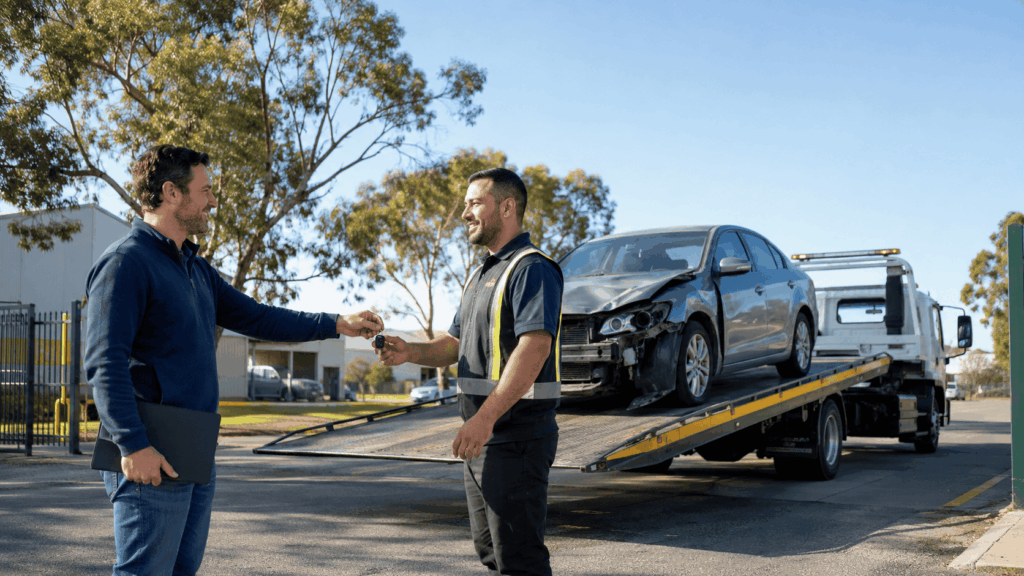
Every vehicle is different, so the fairest way to find out what yours is worth is to give us a call — we’ll price it on the details and confirm it before pickup. For a straightforward, no-obligation figure on your car, ute, truck, van, or 4WD in any condition, call Cash for Cars Perth on 0420 262 651. We can talk through what the vehicle is likely worth and arrange free pickup right across the Perth metro area — from our Welshpool yard out to the outer suburbs — usually the same day.
Frequently Asked Questions
Can I get my own smash repair quote instead of using the insurer’s?
Yes. You’re entitled to get your own quotes, and it’s worth having at least one itemised written quote to compare against the insurer’s assessment. If you aren’t making a claim at all, the choice of repairer is entirely yours.
What’s the difference between a repairable write-off and a statutory write-off in WA?
A repairable write-off can be repaired and re-licensed once it passes the required written-off vehicle inspection and meets repair standards. A statutory write-off has damage severe enough that it can never be re-licensed for road use in WA — it can only be used for parts or scrap. Either way, the classification is recorded permanently against the vehicle.
Should I go ahead with the repair if hidden damage is found partway through?
Ask for a revised quote before agreeing to any extra work. Damage found once panels are removed can push a borderline job well past the point where repairing makes financial sense, so it’s worth pausing to re-run the comparison.
Can I sell a car that’s partway through being repaired?
Yes, as long as you own it and it isn’t under finance. You’ll need the paperwork to transfer ownership, and it’s worth collecting any parts or paid-for items from the repairer first.