


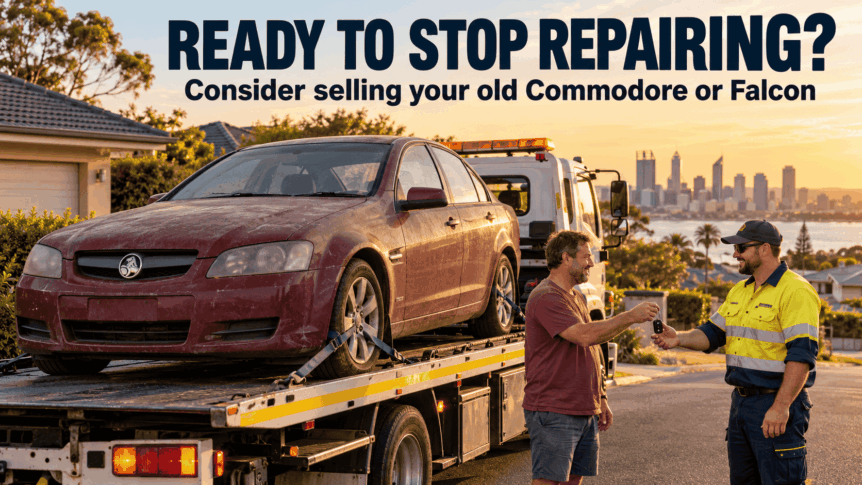
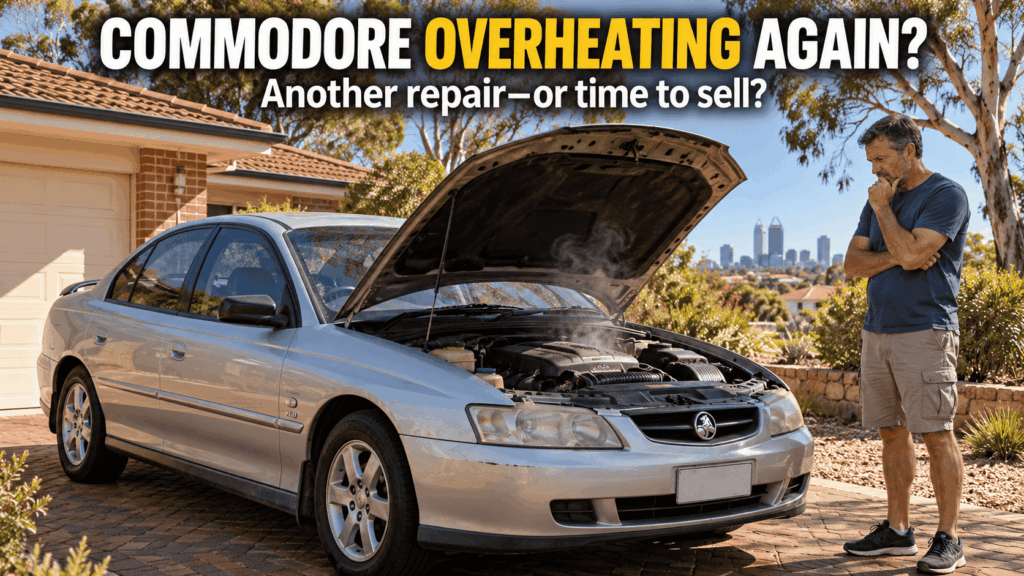
If your old Commodore or Falcon is overheating again, the next decision should start with a diagnosis, not another round of replacement parts. A clearly identified cooling fault can be worth fixing when the rest of the car is sound. Recurring overheating, uncertain engine damage and other overdue repairs make selling as-is a more reasonable option.
Whether it is a Commodore wagon or a Ford Falcon sedan, the badge alone cannot tell you which choice makes sense. Compare the likely result of a complete repair with the car’s overall condition, your transport needs and what a buyer would offer with the fault disclosed.
Why Commodores and Falcons Start Overheating as They Age
Ageing cooling systems can develop several faults, but repeated overheating does not prove that every component needs replacing. Ask a mechanic to establish where coolant, circulation or cooling capacity is being lost. Useful checks depend on the model and engine:
- Coolant leaks: hoses, radiator seams, the reservoir and water pump can leak. Repeated top-ups call for investigation rather than becoming a routine.
- Restricted flow: a blocked radiator, faulty thermostat or worn pump can interfere with circulation.
- Airflow and fans: radiator obstruction or a fan fault can reduce cooling, particularly at low road speeds.
- Internal engine trouble: a damaged head gasket is one possibility after overheating, but it needs testing rather than a diagnosis based on age alone.
Tell the workshop when the temperature rises: idling in traffic, climbing a hill, using the air conditioning or driving at highway speed. Bring previous invoices so the mechanic can distinguish a recurring fault from a different problem. A new radiator does not rule out a leak elsewhere.
What to Do When the Temperature Rises
If the temperature warning appears or the gauge climbs into the hot zone, stop somewhere safe and switch the engine off. Continuing to drive to see whether it settles can turn a cooling fault into a much larger repair. Arrange roadside assistance if you cannot safely continue.
Never remove a radiator or coolant reservoir cap while the engine is running or hot. Keep clear of steam and cooling fans, and follow the vehicle’s handbook before checking coolant once the engine has cooled. A top-up does not establish that the car is safe to drive or explain why coolant was lost.
When Repairs Stop Making Sense
There is no fixed number of breakdowns that makes a car uneconomic to repair. A second overheating episode is a reason to reassess the diagnosis and the whole vehicle, rather than an automatic instruction to scrap it.
Overheating is only part of that assessment. A car may be approaching the end of its repairable life when cooling problems arrive alongside transmission trouble, serious rust or repeated failures in other systems. One repair may restore a dependable car; several uncertain repairs may still leave you without reliable transport.
Signs it might be time to stop repairing
- The overheating returns after repairs and nobody has established the underlying cause.
- The complete repair estimate approaches the car’s realistic value in repaired condition.
- The engine needs further investigation, with substantial extra work possible once dismantled.
- Other major repairs are due, and breakdowns are disrupting work or family travel.
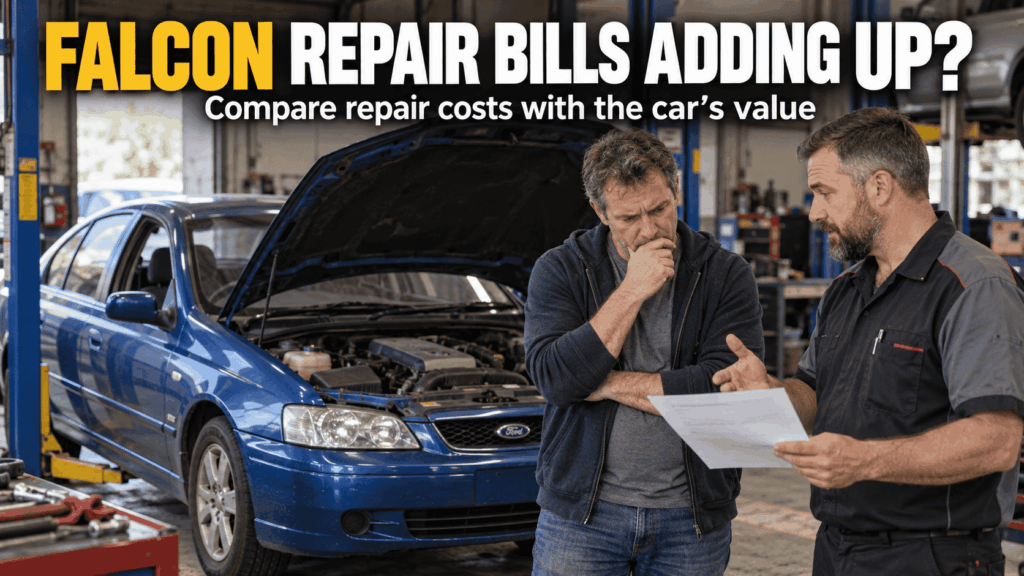
Ask for a written estimate that separates diagnosis, the confirmed repair and possible additional work. Find out how the workshop will check that the overheating has been resolved. Money already spent cannot be recovered by authorising another repair; judge the next expense on what it is likely to achieve.
For otherwise serviceable older cars with mechanical wear, a specific, repairable fault can still justify the work. Service history, sound bodywork and a dependable transmission strengthen that case. A distinctive variant or well-kept example also deserves an individual assessment rather than a blanket decision based on kilometres.
What Actually Affects What an Old Commodore or Falcon Is Worth
Compare like with like. Advertised prices for running cars are asking prices, not proof of what an overheating vehicle will sell for. Get an as-is offer with the symptoms disclosed, then compare it with a realistic repaired value after allowing for the repair and the time involved.
Model, engine, body style and completeness all matter. Reusable panels, interior parts and a sound gearbox may still interest a buyer even if the engine needs work. Do not describe an overheated engine as healthy simply because it starts, and do not assume every remaining component has resale value.
Keep the description factual: when the problem began, which parts were replaced, whether coolant disappears and whether a mechanic has confirmed internal damage. That information is more useful than guessing at a head gasket failure or promising that the car only needs a thermostat.
Planning Collection Without Another Overheating Trip
If you decide to sell as-is, explain that the vehicle overheats before agreeing to collection arrangements. Starting briefly is different from being safe to drive onto a truck. Tell the operator whether it rolls, steers and brakes, and mention locked wheels or missing keys.
For a car parked in a driveway in Cloverdale, for example, access through a narrow gate or behind another vehicle can affect how it is loaded. Describe the space available, any slope and the car’s position before collection. Clear loose belongings and leave access available without running the engine to move it unnecessarily.
Deciding What’s Right for Your Car
Another repair makes sense when the fault is established, the likely total is manageable and the car should meet your needs afterwards. Selling becomes more attractive when the repair remains uncertain, other expensive work is pending or you no longer trust the car for everyday travel.
Take time to compare both options before committing. You do not need to fix the car just to obtain an as-is assessment, and a buyer’s offer does not oblige you to accept it.
If an as-is assessment would help, our information on selling a broken car explains that option, or you can call Cash For Cars Perth on 0420 262 651 to discuss the fault.