


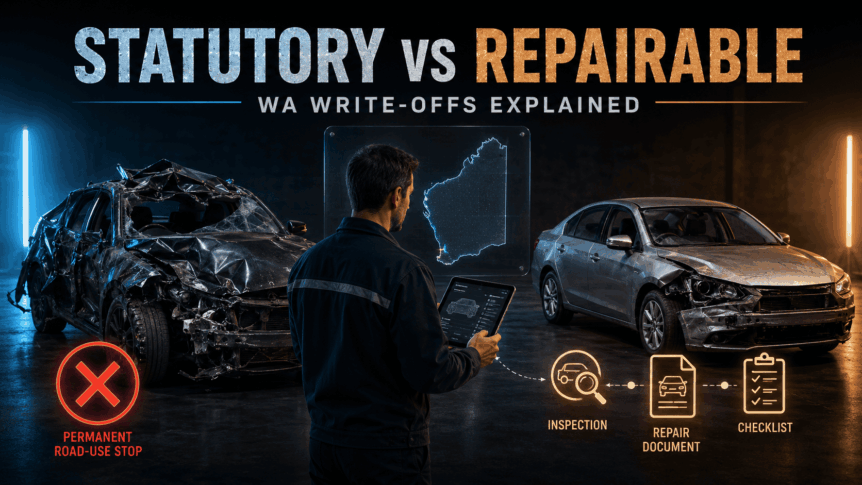
If your insurer has declared your car a write-off after a crash, the next question is which kind. In Western Australia every written-off vehicle is recorded as either a statutory write-off or a repairable write-off, and the difference is not a technicality. One category can, in the right circumstances, be repaired and put back on the road. The other can never be registered again. Knowing which one applies to your car tells you whether repairing it is even legal, and who you are allowed to sell it to.
How WA classifies a written-off vehicle
When an insurer, self-insurer or licensed assessor decides a vehicle is a total loss, they must report it to the Department of Transport, which records it on the Written-Off Vehicle Register (WOVR). This applies to a motor vehicle, motorcycle, trailer or semi-trailer with a Maximum Rated Capacity of 4,500 kg or less that was manufactured within the last 15 years, measured to the date the damage happened. Older or heavier vehicles fall outside the scheme.
Once a car is on the WOVR its licence is cancelled. The registered owner is notified in writing, and the number plates have to be returned to the Department of Transport within 28 days. From that point the classification, statutory or repairable, decides what can happen next.
Statutory write-off
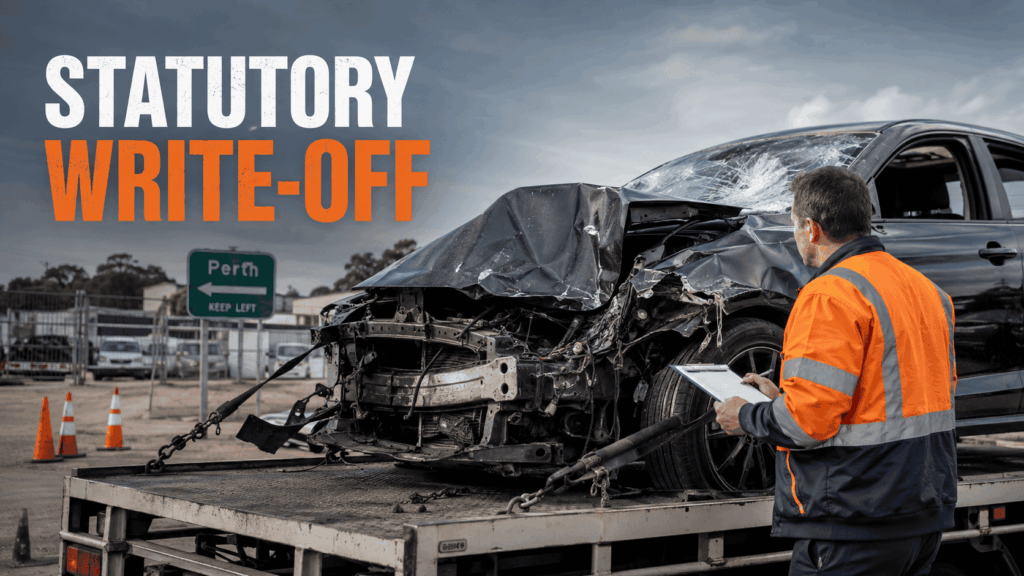
A statutory write-off is a vehicle damaged so badly it can never be made safe or roadworthy again. This is not a judgement about cost. It is a classification triggered by the nature and extent of the damage, and it is permanent: a statutory write-off can never be re-licensed or driven on a public road again in WA, no matter what repairs are carried out.
From that point the car may only be sold under a statutory restriction that limits it to parts or scrap through a licensed dismantler or wrecker. A written-off label is fixed to the vehicle in a conspicuous spot near the Vehicle Identification Number, the identifier itself is defaced, and it is an offence to remove or deface that label.
Repairable write-off
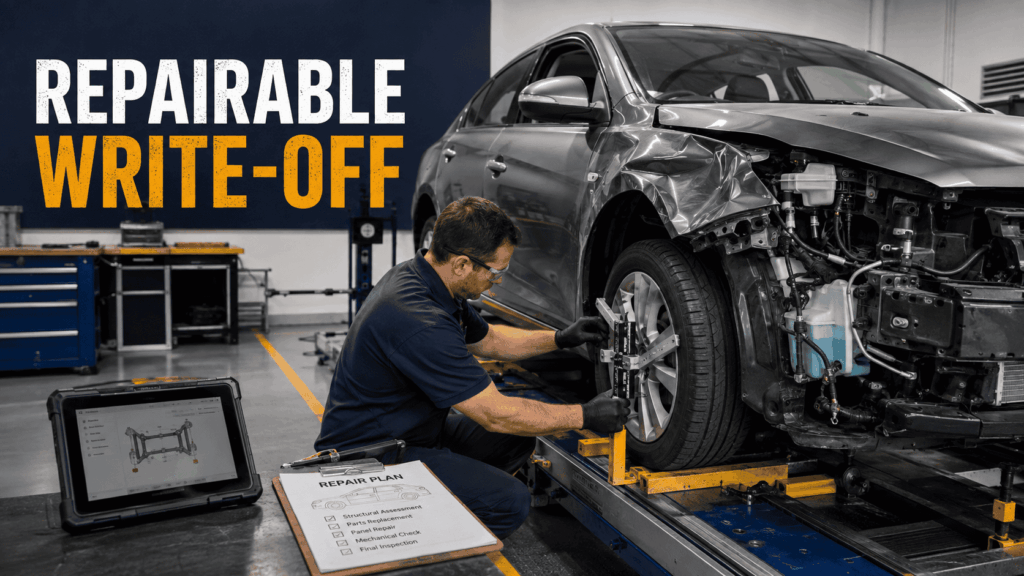
A repairable write-off is also a total loss, but for financial reasons rather than safety ones. It usually means the cost of repairs plus the salvage value adds up to more than the car was worth before the damage, while the damage itself stays below the statutory threshold. A car written off as a total loss on cost alone generally falls into this group.
These vehicles can be repaired and re-licensed, but the process is deliberately strict. The car must pass an inspection by an authorised written-off vehicle business before any final filler, trim or paint goes on, then an identity and roadworthy inspection at an Authorised Inspection Station once the work is finished. You need to keep receipts for all major parts and repairs, photograph the work as it goes, and provide airbag certification if the airbags were replaced. Even after a successful re-licensing, the write-off stays on the car’s history permanently and remains visible on a Personal Property Securities Register (PPSR) check. Our guide to whether you can still drive a written-off car covers what that means day to day.
How the classification is decided
The assessor is not just looking at panel damage. If the repair cost plus salvage value is higher than the car’s pre-accident market value, and the damage does not automatically qualify as statutory, the vehicle is recorded as repairable. Some damage forces a statutory classification on its own, regardless of cost, including severe structural damage and serious fire or flood damage.
What it means when you sell
The classification on the record controls who can buy the car and what they can do with it.
- Statutory write-offs can only go to a licensed dismantler or wrecker for parts and scrap. You cannot sell one to a private buyer as a car they intend to register, because that is not legally possible.
- Repairable write-offs have more options. A buyer with the time, skill and budget can repair and re-license the car, or you can sell it as it stands to a wrecker and skip the inspections and the parts hunting.
Either way, a buyer is entitled to know the car’s history. Anyone can check a vehicle’s write-off status with a PPSR search for a small fee, and being upfront about the classification avoids arguments later.
What a written-off car is worth
Two write-offs of the same make and model rarely fetch the same amount. The main factors are:
- Extent of the damage and how much of the car is still usable.
- Make, model and age — a popular model such as a Jeep or similar 4WD tends to have parts that stay in demand longer.
- What is salvageable — an engine, gearbox and straight panels are worth far more than a stripped shell.
- Scrap metal prices, which move up and down over time.
Every vehicle is different, so the fairest way to find out what yours is worth is to give a buyer the details and let them price it before pickup.
Paperwork when you sell in WA
A few WA rules catch sellers out, whether the car is a statutory or repairable write-off:
- Notify the Department of Transport within 7 days that you are no longer the owner, and give the buyer’s name and address. Miss the deadline and a $100 infringement can apply.
- Standard number plates stay with the vehicle. Only personalised or optional plates can be kept, and you have to exchange them at a Department of Transport centre for ordinary plates before the car is collected.
- Photo ID is needed to complete the sale. It does not have to be the registered owner’s, but someone has to produce one.
If you would rather not take on the inspections and paperwork, a licensed wrecking yard can take the car where it sits, from Bedfordale to the coast and across the Perth metro area. Cash For Cars Perth buys both statutory and repairable write-offs on 0420 262 651.
Frequently asked questions
Can a statutory write-off ever go back on the road?
No. A statutory write-off can never be re-licensed or driven on a public road again in WA, regardless of what repairs are done. It can only be used for parts or scrap.
Can I repair a repairable write-off myself and re-register it?
Yes, in principle. The car has to pass an inspection by an authorised written-off vehicle business before final paint and trim, then an identity and roadworthy inspection at an Authorised Inspection Station. You also need to keep parts receipts, photos of the repair, and airbag certification where relevant.
Does the write-off stay on the car’s record after it is repaired?
Yes. The write-off history is permanent and shows on a PPSR check for the life of the vehicle, even after a repairable write-off has been re-licensed.
What happens to my number plates?
When the car is written off, the plates must be returned to the Department of Transport within 28 days. On a normal sale, standard plates stay with the vehicle; only personalised or optional plates can be retained, by exchanging them before the sale.