


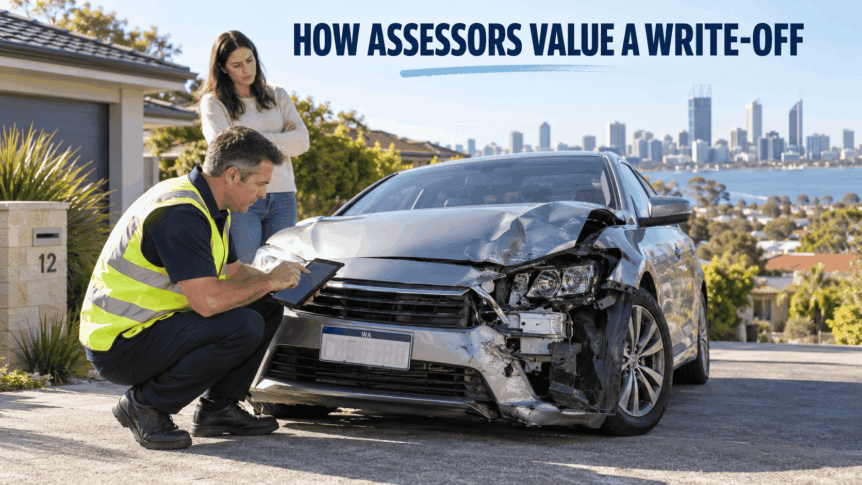
If your car has been written off after an accident in Perth, the number your insurer puts on it can feel like it came out of nowhere. Knowing how the figure is built – and where it tends to fall short – makes it easier to decide whether to accept the payout, negotiate, or look at what an accident-damaged car is actually worth to a buyer instead.
How insurance assessors calculate your payout
When a car is written off, most WA insurers settle on either an agreed value or a market value basis, depending on the policy you hold. The two produce very different numbers, so it is worth checking your policy schedule first.
Agreed value
If you nominated an agreed value when you took out the policy, that is generally what you are paid, regardless of what the car would sell for at the time of the claim. The figure is locked in when the policy is written or renewed, so it can sit above or below the current market. Agreed value is more common on newer, modified, or higher-value vehicles.
Market value
Most everyday comprehensive policies use market value. The assessor estimates what your car would have sold for, second-hand, in the Perth market, the day before the accident. To land on that figure they usually look at:
- Comparable listings and recent sales for the same make, model, year, and variant
- Odometer reading and overall condition
- Service history, where you can produce it
- Modifications and aftermarket parts, which are often valued separately or not counted at all
- Industry valuation guides such as Redbook or Glass’s Guide
From that market value the insurer then deducts any excess, and if you keep the wreck rather than hand it over, it also subtracts what it reckons the salvage is worth.

Why the assessor’s number often feels low
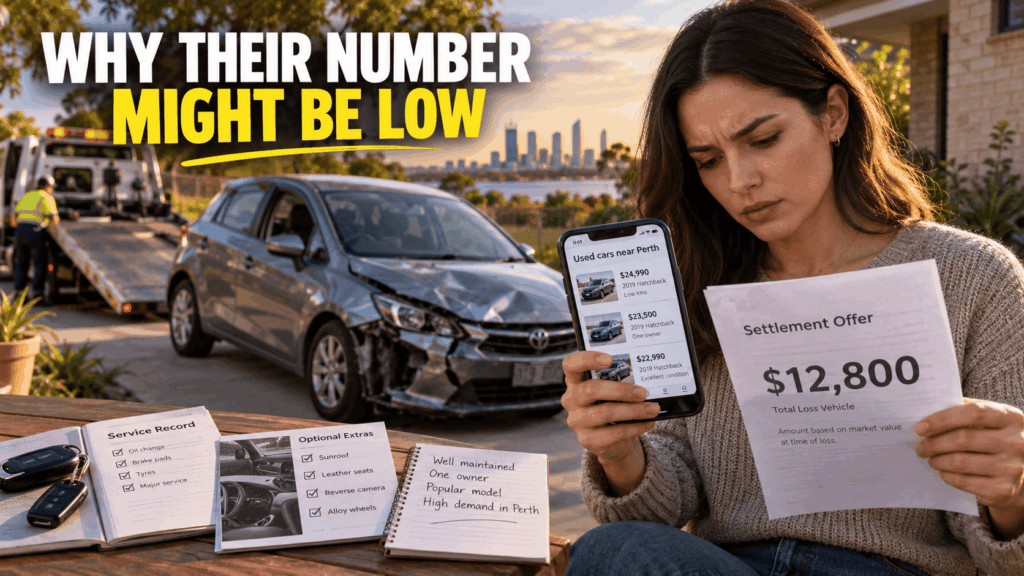
There are a few predictable reasons a settlement offer can undershoot what you believe the car was worth:
- Valuation guides lag the market. They are refreshed periodically rather than in real time, so a model that has climbed in demand over the past year can still be priced on older data.
- Comparable sales are chosen conservatively. Assessors tend to work off the middle of the range rather than the top asking prices, and private-sale ads are not always weighted the same as dealer listings.
- Recent spending is not automatically counted. New tyres, a fresh battery, a recent service – none of it lifts the offer unless you produce the receipts and ask for it to be reconsidered.
- Salvage is deducted up front. If you keep the car, the insurer reduces the payout by what it estimates a salvage buyer would pay for the wreck, and that estimate is rarely generous.
You are generally entitled to challenge a market value assessment. Gather comparable ads for the same car, get a written valuation if the amount justifies the cost, and put your case in writing. The insurer does not have to accept your figure, but a reasoned case backed by evidence is often enough to move the offer.
What happens to the car after a total loss in WA
In Western Australia a written-off vehicle is recorded by the Department of Transport on the Written-Off Vehicles Register as either a statutory write-off – damage severe enough that it can never be made safe and roadworthy again – or a repairable write-off, which is a total loss on cost but can, in principle, be repaired and re-licensed after passing the required inspections. That call is made by the assessor, and the distinction between a statutory and a repairable write-off decides what the car can ever be used for again.
Once a vehicle is listed on the register its licence is cancelled, so a few things follow if you keep it rather than signing it over:
- Standard WA number plates normally stay with a vehicle and pass to the next owner, but a write-off is the exception. With the licence cancelled there is nothing to transfer, so the plates should be removed and returned to a Department of Transport centre, where any unused portion of the registration may be refunded.
- Personalised or custom plates are handled separately – you keep the right to them, but you need to lodge the relevant retention or transfer form with the Department of Transport.
- If you sell or dispose of the car, notify the Department of Transport that you are no longer the owner within seven days, recording the buyer’s name and address on the change-of-ownership form (MR9). Failing to do so can result in a penalty.
- A statutory write-off cannot be re-registered under any circumstances, which leaves wrecking or parting it out as the only real options.
Insurer payout versus cash from a wrecker
If the settlement leaves you holding the wreck – or the car was never insured, or the damage was not quite enough to claim on but still is not worth fixing – the alternative is selling it directly to a licensed wrecker.
A wrecker is not working from the same valuation guides as an insurer. The offer is built from what the car is worth broken down rather than driven away:
- Usable parts still in demand: engine, gearbox, panels, lights, electronics, wheels
- The weight and scrap-metal content of the shell once it is stripped
- How complete the car is, and whether it has already been picked over
- Make and model, because used-parts demand varies a lot between brands
That last point cuts both ways. Holden is the clearest example: with the brand gone from the local market, new panels are harder to source, which is part of why an insurer writes these cars off sooner, yet the same scarcity means a wrecker pays well for clean used parts. For many older or written-off cars sitting in a driveway, a wrecker’s figure is simpler to act on than chasing a top-up from the insurer – and for a statutory write-off, often the more realistic measure of what the car is worth now.
What you need to sell a written-off or damaged car in WA
Selling a written-off car does not take much paperwork. Have photo ID ready – you do not have to be the registered owner, but the buyer needs to sight it to complete the sale – along with any registration papers or write-off documentation you still have, though a sale can usually proceed without them. Take the plates off before the car is collected and set them aside for the Department of Transport, and lodge the change-of-ownership notification once it is gone.
Weighing the payout against a cash offer
If the insurer’s figure still looks light once you have checked comparable sales and the excess and salvage deductions, it is worth getting a second number to compare rather than accepting the first offer by default. A wrecker prices the car on parts and scrap rather than a guide, so the two measure the same car in different ways.
Cash For Cars Perth buys written-off and accident-damaged cars across the Perth metro area, from Maddington through to the northern suburbs, and can give you a no-obligation figure to compare against the insurer’s offer – call 0420 262 651.
Frequently asked questions
How do insurers decide what a written-off car is worth in WA?
On an agreed-value policy the payout is the figure set when you took out or renewed the cover. On a market-value policy the assessor estimates what the car would have sold for second-hand in Perth just before the accident, using comparable listings, condition, service history and industry guides, then subtracts your excess and any salvage value if you keep the car.
Can I dispute the insurer’s valuation?
Yes. You can challenge a market-value assessment by supplying evidence – comparable advertisements for the same make, model and year, or a written valuation – that supports a higher figure. The insurer does not have to accept it, but a documented case often moves the offer.
What is the difference between a statutory and a repairable write-off?
A statutory write-off is too badly damaged to ever be made roadworthy again and can never be re-registered. A repairable write-off is a total loss on cost, but it can be repaired and re-licensed if it passes the inspections the Department of Transport requires. The assessor assigns the category.
Do the number plates stay with a written-off car when I sell it?
No. Standard plates normally stay with a vehicle, but a write-off has its licence cancelled, so there is nothing to transfer. Take the plates off and return them to a Department of Transport centre, where any unused registration may be refunded. Personalised plates are kept or transferred using a separate form.
Is a wrecker’s offer usually higher or lower than the insurer’s payout?
It depends on the car. A wrecker prices it on usable parts and scrap value rather than market value, so for a late-model car with a small agreed-value gap the insurer may pay more, while for an older car or a statutory write-off the wrecker’s figure is often closer to what the vehicle is actually worth. Getting both numbers is the only way to know.