


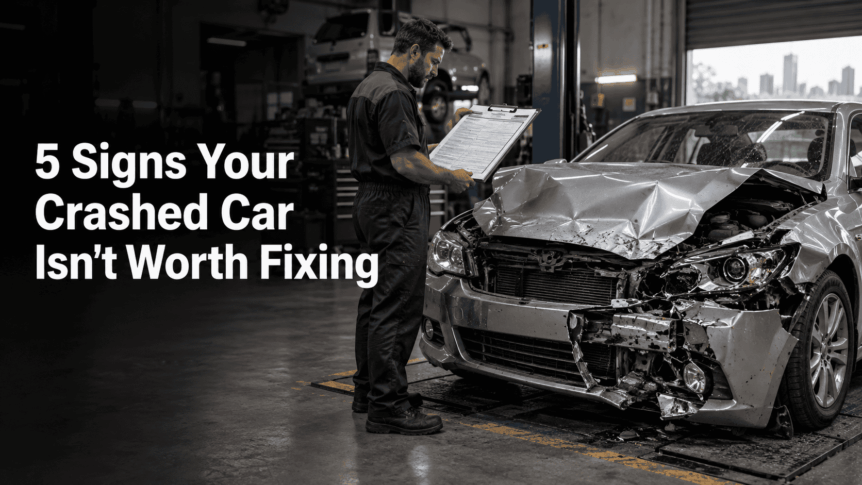
A crash doesn’t always total a car in the way people expect. Sometimes the damage looks alarming but the repair is straightforward. Other times a minor-looking knock turns into a repair quote that makes no financial sense at all. Working out which situation you’re in — before you commit to fixing the car — can save you weeks of back-and-forth with a panel beater and money you won’t get back.
If you’re a Perth car owner staring down a repair estimate right now, here are five signs worth paying attention to, along with what actually drives the value of an accident-damaged car and what your options look like if you decide fixing it isn’t worth it.
1. The repair quote is close to (or higher than) the car’s value
This is the most common reason a car gets written off, and it’s the simplest thing to check yourself. Get a repair quote, then work out what the car would realistically sell for in its pre-accident condition — not what you paid for it, not what you feel it’s worth, but what a buyer would actually hand over. If the quote comes in above roughly 60–70% of that figure, most insurers will write the car off as uneconomical to repair. If your insurer doesn’t, it’s still worth asking yourself the same question they would.
Why this matters more on older cars
A newer car can absorb a big repair bill and still be worth fixing, because there’s plenty of market value underneath it. An older car with the same dollar amount of damage often isn’t — there’s simply less value left to recover, so the repair eats most or all of what the car is worth.
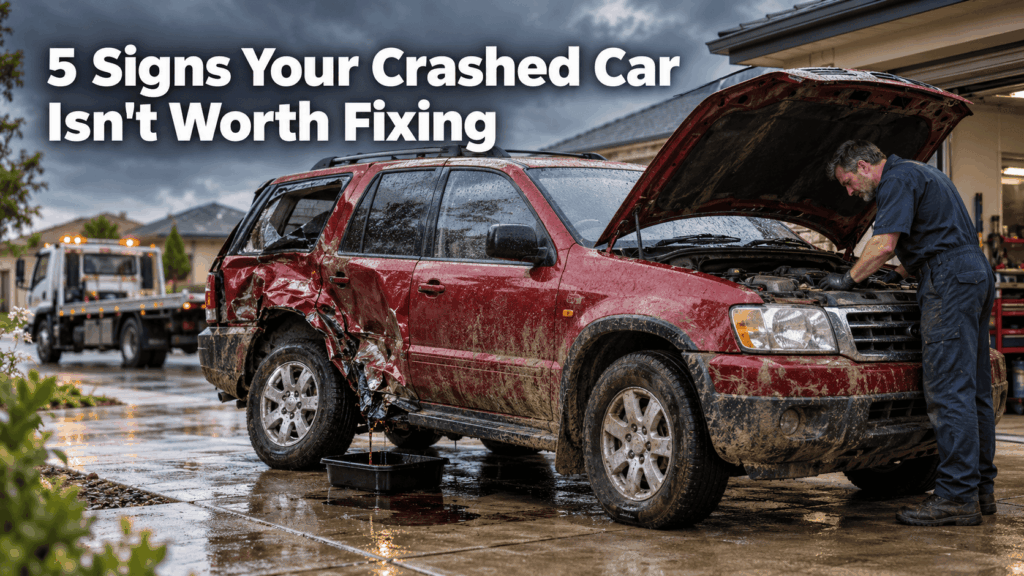
2. The damage reaches the chassis or structural frame
Panel damage is largely cosmetic. Chassis or structural damage is a different problem. Once the frame is bent, twisted or cracked, the repair isn’t about panels and paint any more — it’s about realigning the structure that the suspension, steering and safety systems all bolt to. That work is expensive and slow, and even when it’s done properly, some buyers and insurers treat the car differently for the rest of its life once a structural repair is on its record.
3. Your insurer has already written it off
If your insurer has assessed the car and declared it a total loss, that’s a strong signal on its own — the call is made on repair cost versus market value, not sentiment. In WA, a written-off vehicle is recorded as either repairable or statutory (non-repairable), and that classification decides what you’re allowed to do with the car afterwards: a statutory write-off can never be registered again, while a repairable write-off can be, but only after specific inspections. Either way, once that call is made the practical question becomes how to sell the car as-is rather than whether to fix it.
4. Parts are hard to source, or prices have jumped
Some models — older ones, grey imports, low-volume variants — have parts supply that thins out over time. If your panel beater is quoting weeks of delay waiting on a part, or pricing panels and components well above what you’d expect, that adds real cost and time on top of the base repair. It also helps to know how to read the repair quote itself, so you can see which line items are driving the total and whether the shop has quoted new, used or aftermarket parts.
5. You’ve lost confidence in the car’s safety
This one isn’t financial, but it counts. If you’re hesitant to put your kids in the car, or you’re not convinced the repair fully addressed what happened in the crash, that hesitation is worth listening to. A car you don’t trust isn’t doing its main job, whatever the numbers say.
What actually affects a damaged car’s value
Once you’ve decided fixing isn’t the right move, it helps to understand what a damaged car is actually worth to a buyer. A common, high-volume make — a Subaru, for instance — with a strong local parts following will usually draw more interest damaged than a rare model that no one stocks parts for. Beyond the badge, these are the things that move the figure:
- Make and model demand — some vehicles hold parts and resale value far better than others, even damaged.
- Extent and location of the damage — a hit to the rear with a healthy engine and gearbox is worth more than the same damage that’s taken out the drivetrain.
- Whether it still runs and drives — a running car is generally worth more than one that has to be towed, though non-runners are still bought and sold every day.
- Completeness — missing parts, a stripped interior or a body with no chassis all pull the value down, and some buyers won’t take a chassis-less body at all.
- Scrap and parts market conditions — metal and used-parts prices move around, so it’s worth getting a current quote rather than relying on a figure from a year ago.
What to expect if you sell an unrepairable car in Perth
If the checklist points toward selling rather than repairing, the process for a damaged or written-off car in Perth is usually simpler than people expect. A removal service will ask a few questions about the make, model and extent of the damage, give you a price over the phone, and — if you accept — arrange to tow the car away, often the same day. Payment is normally made on collection.
This covers running and non-running cars, accident damage, flood and fire damage, deregistered cars and write-offs. It generally doesn’t cover stolen vehicles, cars still under finance, or a body with no chassis — those need to be sorted out before a sale can go ahead.

A few WA rules to sort out first
Before the car leaves, two WA rules are worth knowing so there are no surprises:
- Number plates. Standard WA plates normally stay with the vehicle when it’s sold. If you want to keep yours, you have to remove them before the sale and arrange replacement plates through the Department of Transport. If the car is a write-off headed for a wrecker, take the plates off before pickup and return them to a Department of Transport centre — any unused portion of the licence fee may be refunded.
- Change of ownership. Once you’ve handed the car over, lodge a notification of change of ownership with the Department of Transport within seven days, recording the buyer’s name and address. The Department’s guidance puts it plainly: “Failure to do so will result in a penalty being applied.”
You’ll also need valid photo ID to complete the sale. It doesn’t have to be the registered owner’s ID, but whoever is selling the car has to be able to produce one.
The bottom line
Any one of these signs is a reason to pause; two or more together usually means the car isn’t worth fixing. If you’ve worked through them and repairing doesn’t stack up, Cash For Cars Perth buys accident-damaged, written-off and non-running vehicles across Thornlie and the wider Perth metro area. Every car is different, so the fairest way to find out what yours is worth is to call the team on 0420 262 651 and get a price on the details.
Frequently asked questions
How do I know if my car is a write-off?
Compare the repair quote with what the car would sell for in good condition. If the repair is more than about 60–70% of that value, an insurer will usually write it off, and it’s a fair rule of thumb even if you’re not claiming. An insurer’s total-loss assessment is the clearest confirmation you’ll get.
Is a car with structural damage ever worth repairing?
Sometimes, but the bar is high. Structural repairs are costly and slow, they need specialist equipment to get right, and the car carries the repair on its history afterwards, which affects resale. On an older or mid-value car, structural damage usually tips it past the point of being worth fixing.
Can I sell a car the insurer has written off?
Yes. Once the insurer has settled the total loss, the payout is yours, and so is the wreck if you chose to retain it. A repairable or statutory write-off can be sold to a wrecker or removal service as-is — the write-off classification stays on the vehicle’s record and passes to the next owner.
Do the number plates stay with a written-off car when I sell it?
Standard WA plates normally stay with a vehicle, but a write-off is the exception: the licence is cancelled once the car is recorded as written off, so there’s nothing to transfer. Take the plates off before pickup and return them to a Department of Transport centre. A personalised or custom plate needs a separate transfer or retention request.
What is a crashed car worth if it’s not worth fixing?
It depends on the make and model, how bad the damage is, whether it still runs, and current scrap and parts prices. A late-model car with rear-end damage and a good drivetrain can still be worth a reasonable amount; a stripped or structurally damaged older car much less. Get a current quote rather than working from an old figure.