


Every car owner with an ageing vehicle hits the same fork in the road eventually: the mechanic calls with a quote, and you have to decide whether it’s worth spending the money or whether it’s time to let the car go. It’s rarely an obvious call, especially when the vehicle still runs and has some sentimental value attached. The good news is that the decision doesn’t have to be a guess – it can be worked out with a few numbers and a bit of honesty about what the car is actually worth.
When Repair Costs Start Outweighing the Car’s Value
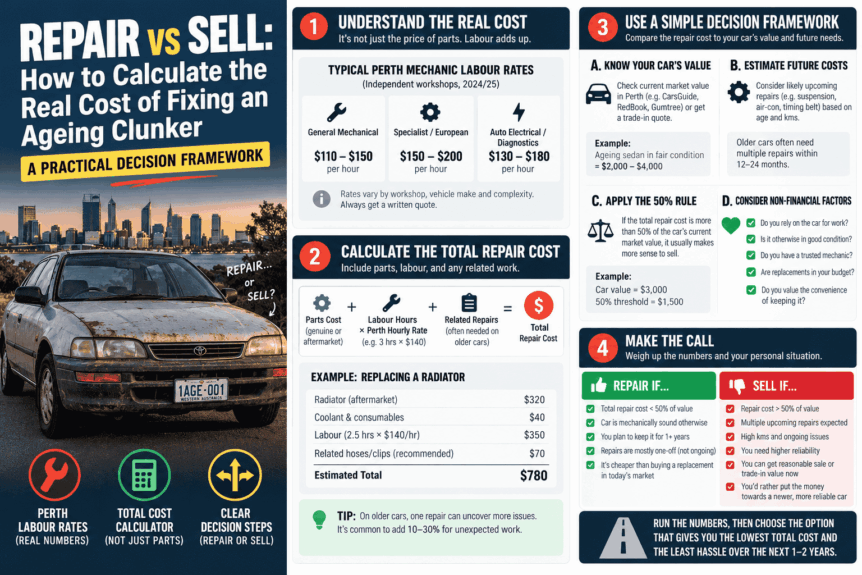
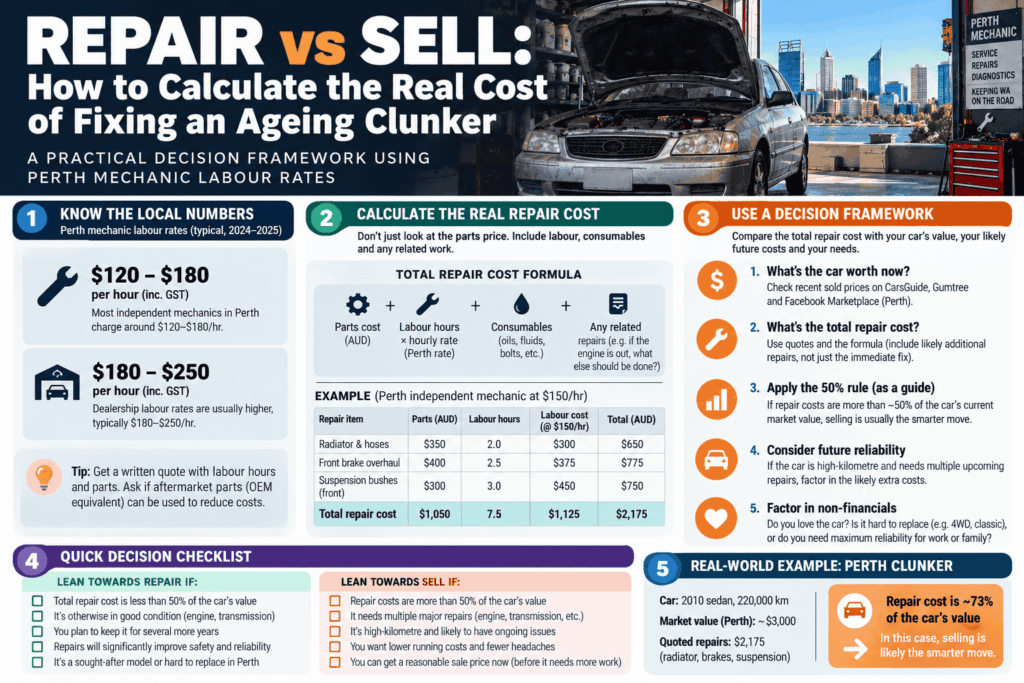
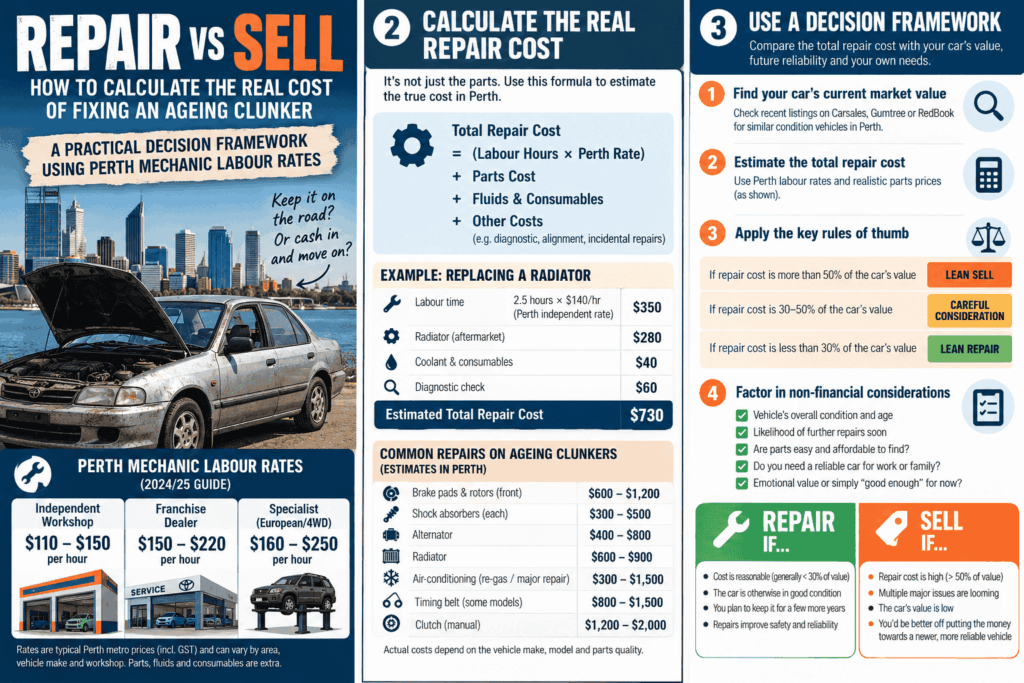
As a rough rule, if a single repair quote comes in above roughly a third of what the car would sell for in its current condition, it’s worth pausing before you approve the work. That threshold gets more urgent if the car has already had two or three repairs in the past year, because ageing vehicles rarely fail in isolation – one part going tends to put strain on the next.
The trap most owners fall into is judging each repair on its own. A $600 water pump feels manageable. So does a $450 set of brake components a few months later. Add them up over twelve months and you can end up spending more than the car is worth, without ever facing one big decision that would have made the maths obvious.
Build Your Own Repair-vs-Sell Calculation
Step 1: Get a Real Repair Quote
Ask your mechanic for an itemised quote that separates parts from labour. Perth workshop labour rates vary by shop and specialisation, so it’s worth getting this in writing rather than working from memory of what a service cost a year or two ago. If the quote includes diagnostic time, ask whether that fee is deducted from the final bill if you go ahead with the repair.
Step 2: Know the Car’s Actual Value
Look up recent sale prices for the same make, model, and year in similar condition – not the price of a well-kept example, but one with comparable kilometres, cosmetic wear, and mechanical history. If the car has accident damage, has been written off, or isn’t currently registered, its value is based on what it is now, not what a repaired version would fetch.
Step 3: Factor in Ongoing Costs
A repair fixes one problem, but it doesn’t reset the car’s age. Registration, insurance, and the likelihood of the next fault are all still there. If the vehicle has been needing attention every few months, it’s reasonable to expect that pattern to continue, even after this particular repair is done.
Step 4: Compare the Numbers
Put the repair cost next to the car’s current value and next to what you could get for it as-is, unrepaired. If the repair cost is close to or higher than either figure, selling is usually the more sensible option financially, even if the car is otherwise fine to drive.
What Actually Affects a Car’s Sale Value in Perth
A few practical factors tend to move the number more than people expect:
- Whether it runs or not – a non-running car is still worth something, but the figure reflects the cost of recovery and parts recycling rather than a working vehicle.
- Completeness – a car missing its engine, gearbox, or other major components is worth considerably less than one that’s intact, even if it doesn’t run.
- Damage type – accident damage, flood damage, and fire damage each affect value differently depending on what’s salvageable.
- Registration status – deregistered and written-off vehicles can still be sold; buyers who deal in wrecking and dismantling account for this in their offer.
Signs It’s Time to Sell Rather Than Repair
A few patterns are worth paying attention to:
- The same system (electrical, transmission, cooling) has failed more than once in the past year.
- The repair quote is close to what you’d get selling the car in its current state.
- The car has failed, or would likely fail, a roadworthy inspection on more than one item.
- You’re weighing up a repair mainly because you feel you’ve already spent too much to stop now – a natural reaction, but not a financial argument on its own.
What to Expect When You Sell Instead
If you decide selling makes more sense, there are a couple of Western Australia’s specific rules worth knowing. Number plates stay with the seller, not the vehicle – you keep them or return them to the Department of Transport, they don’t go with the car. After the sale, you’re required to lodge a Notification of Disposal with the WA Department of Transport, which formally removes the vehicle from your name.
You’ll also need valid photo ID to sell the car – it doesn’t have to be the person listed as the registered owner, but the seller does need to produce identification. Vehicles that are stolen, still under finance, or are just a body shell without a chassis generally can’t be sold through a wrecking or removal service.
Get a Straightforward Answer
If the numbers are pointing toward selling, Cash For Cars Perth buys cars, utes, trucks, vans, and 4WDs across the Perth metro area, in any condition – running, non-running, accident-damaged, or written-off. Offers go up to $9,999 depending on the vehicle, and payment is made in cash or instant OSKO bank transfer before the car leaves your property, so there’s no waiting around for funds to clear.
Same-day towing is included at no charge, and cars are often collected within two to three hours if you call before midday. The yard is based at 5 Hantke Place, Welshpool, and is open Monday to Saturday, 7:30 AM to 6:00 PM. Note that the service covers Perth metro only and doesn’t extend to Bunbury or areas further south.
If you’d rather sell than sink more money into an ageing repair, call 0420 262 651 for a quote, or get in touch online to arrange free same-day collection.