


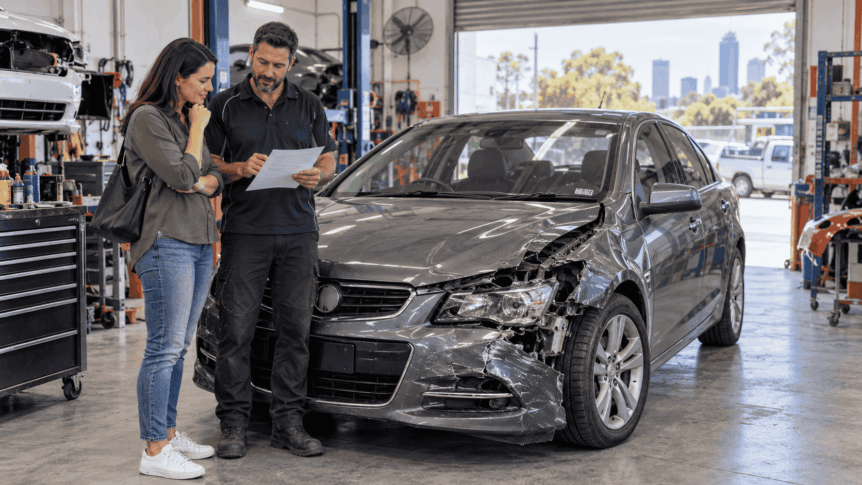
If your car has been sitting at a Perth smash repairer since an accident, you’re probably weighing up two costs at once — the price of fixing it, and the daily fee the repairer is quietly charging to keep it on their premises. For a lot of owners, the second cost is what tips the decision on whether to repair, sell, or scrap an accident-damaged vehicle in Perth.
Storage Fees Can Add Up Faster Than You’d Expect
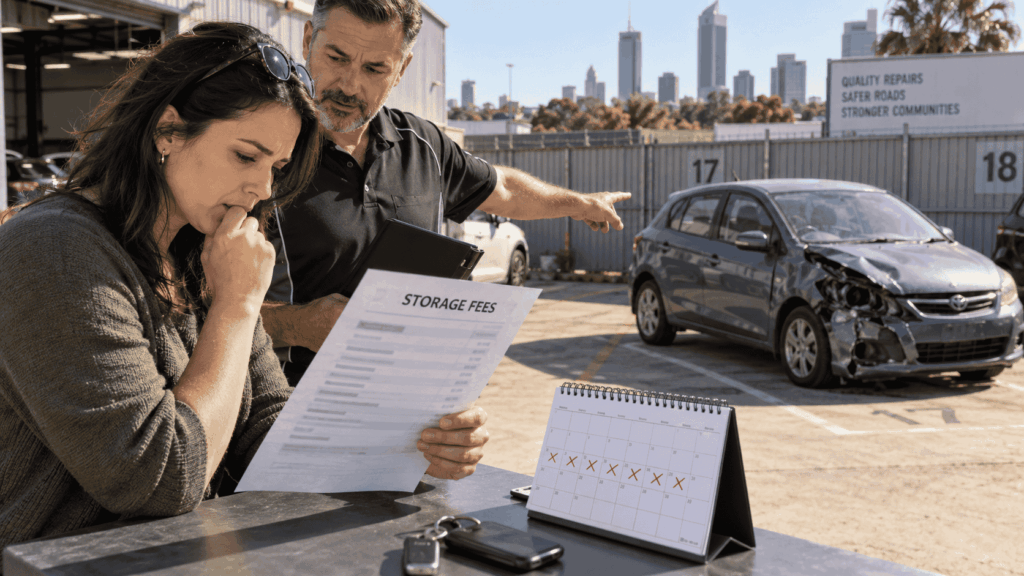
Most smash repair yards charge a daily storage rate once a vehicle has been assessed and a decision is pending — whether that’s waiting on an insurance assessor, a parts quote, or simply your own decision on whether repairs are worth it. The very first stage is actually regulated: under WA’s towing industry reforms, a crash-tow operator holding a light vehicle towed from an accident scene in Perth or Peel can charge no more than $27 a day (including GST) in storage, plus a one-off release fee. Once the car has moved on to the repairer’s own yard for assessment or repair, storage is a private arrangement between you and the repairer and isn’t capped the same way, so it pays to ask early what they’re charging and from what date.
Either way, leave a decision for a few weeks while you shop around for quotes or wait on insurance paperwork, and the storage bill can eat into — or exceed — whatever the car is actually worth. That’s the main reason owners end up selling a car for parts or scrap sooner than they planned rather than holding out for a slightly better offer. It’s not that the car isn’t worth fixing; it’s that every extra day of indecision has a real dollar cost attached, and that cost keeps running whether or not you’ve made up your mind yet, which is worth factoring into how long you let a decision drag on before you commit either way.
Write-Off or Not, You Still Have Options
If your insurer declares it a total loss
If the insurer declares your car a total loss, they’ll usually offer you a settlement based on the car’s pre-accident value, and in most cases they take ownership of the wreck. But if you’re under-insured, uninsured, or the damage happened off a claim entirely, the car — and the decision about what to do with it — stays with you.
If you’re covering the repair yourself
Sometimes the repair quote comes back higher than the car is worth on the road. In that situation, most Perth owners either sell the vehicle as-is to a wrecker or parts buyer, or accept the loss and keep paying for repairs on a car that may never be worth what went into it. There’s no obligation to fix a car just because it’s driveable in theory — plenty of accident-damaged vehicles are sold exactly as they sit, panel damage and all.
What Affects the Price You’ll Be Offered
Every accident car is different, but a few factors consistently move the number up or down:
- Extent of the damage — whether it’s cosmetic panel damage or structural/chassis damage affects both resale and parts value.
- Make and model — vehicles with strong demand for used parts, such as a common Japanese make like Mazda or a popular Australian-market model, tend to attract better offers than rare or unpopular ones.
- Completeness — a car with the engine, transmission, and major components intact is worth more than one that’s already been picked over.
- Age and mechanical condition before the accident — a well-maintained car with damage is often worth more than an older, run-down car with the same damage.
- Whether it’s registered or deregistered — this affects paperwork but generally not whether it can be sold.
Running or not, accident-damaged, flood or fire affected, deregistered, or already declared a write-off — all of these are still sellable in most cases. What generally can’t be bought are stolen vehicles, cars still under finance, and bodies without a chassis.
What Perth Sellers Need to Know Before Signing Anything
Number plates usually go with the car
Standard WA number plates stay attached to the vehicle and normally pass to the new owner as part of the sale — they aren’t automatically yours to keep. If you want to hang on to your plates, remove them and arrange replacements from the Department of Transport before the car is collected; only personalised or optional plates can be retained by exchanging them at a DoT centre first.
You need to lodge a change-of-ownership notification
After selling any vehicle in WA, you’re required to lodge a Notification of Change of Ownership – Vehicle Licence Transfer (MR9) with the Department of Transport within 7 days, including the buyer’s name and address. Failure to do so will result in a penalty being applied.
Bring valid photo ID
Whoever is selling the car needs valid photo ID on the day. It doesn’t have to be the person the vehicle is registered to, but ID is required to complete the sale.
Getting the Car Out From Under Storage Fees
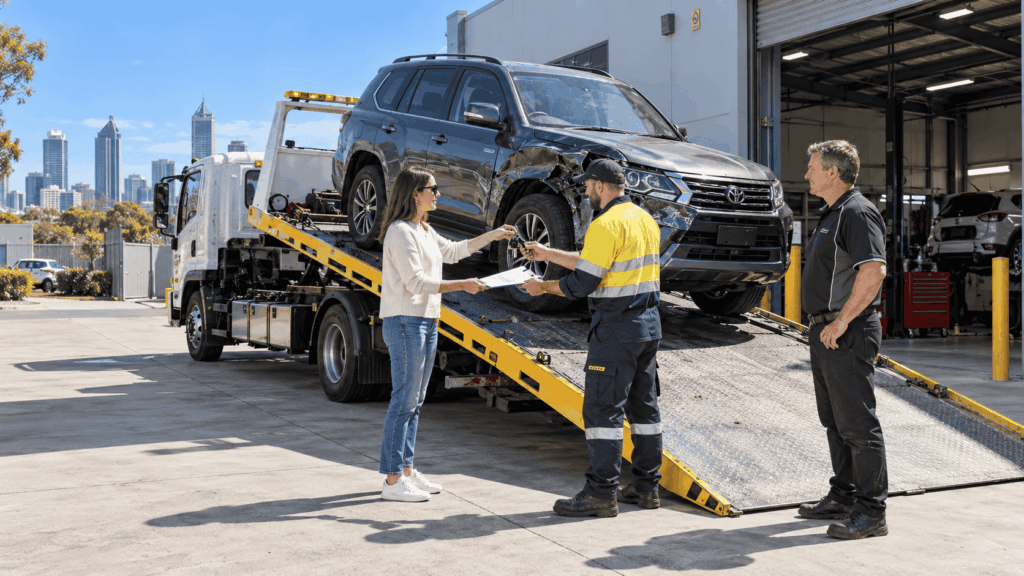
Once you’ve decided to sell, the main thing that matters is how quickly the car can actually be collected — every extra day it sits at the repairer is another day on the storage invoice. Whether you end up going with a private sale or a wrecker, or letting the insurer handle it, the same principle applies: the faster it’s gone, the less it costs you in the meantime.
Most car-removal services cover the Perth metro area but few extend south to Bunbury and beyond, so it’s worth checking that before you commit to a buyer if you’re near the edge of the service area.
Ready to Move It On?
If your accident-damaged car is racking up storage fees at a Perth smash repairer, it’s worth getting a quote before those costs eat further into what it’s worth. Cash For Cars Perth is based at 5 Hantke Place, Welshpool, and offers free same-day collection across the Perth metro area. Call 0420 262 651 Monday to Friday 7:30am–5pm or Saturday 7:30am–2pm for a free, no-obligation quote.
Frequently Asked Questions
How much does it cost to store a car at a Perth smash repairer?
It depends on the stage. The initial crash-tow storage is capped by WA law at $27 a day (including GST) for a light vehicle in Perth and Peel. Once the car is at the repairer’s own yard for assessment or repair, storage is a private arrangement and rates vary, so ask the repairer directly what they charge and from when.
Do I have to repair an accident-damaged car before I can sell it?
No. Cars are commonly sold exactly as they sit — running or not, with cosmetic or structural damage, deregistered or already written off. What generally can’t be sold are stolen vehicles, cars still under finance, and bodies without a chassis.
What happens to my number plates when I sell a car in WA?
Standard plates stay with the vehicle and pass to the new owner. If you want to keep them, remove them and arrange replacement plates from the Department of Transport before the car is collected.
Do I still need to notify the Department of Transport if the car is a total loss?
Yes. Any change of ownership in WA — including a sale to an insurer or a wrecker — needs a Notification of Change of Ownership (MR9) lodged within 7 days, with the buyer’s name and address, or a penalty can apply.
Can I sell a car that’s already been declared a write-off?
Yes. Statutory and repairable write-offs are both routinely bought for parts or scrap by Perth wreckers — the write-off status affects what it’s worth, not whether it can be sold.