


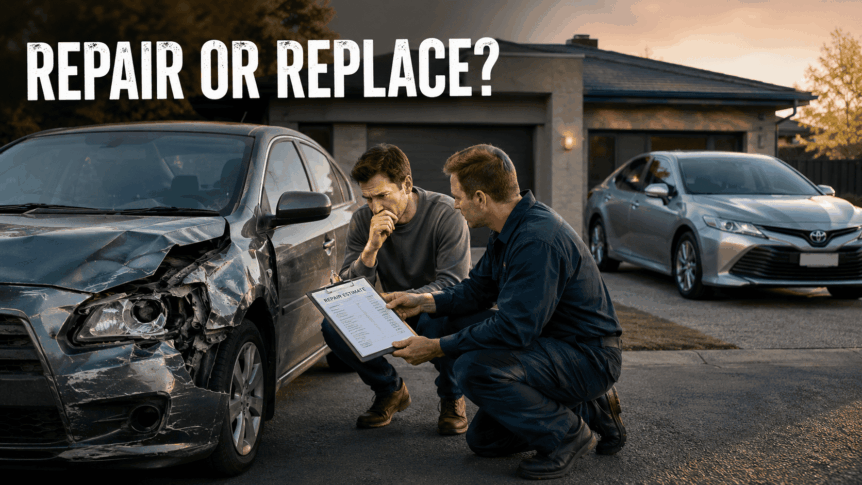
If your car has just come out of a smash, you’re probably staring down two quotes: one from the panel beater, and one from your own gut telling you the car might not be worth fixing. Repairing or replacing it is a decision a lot of Perth drivers face, and the right answer isn’t always obvious — it depends on the car’s age, what it’s worth, and how bad the damage really is under the panels. Here’s a practical way to work it out.
What Actually Determines Whether Repair Makes Sense
Before the repair quote even lands, it helps to know what pushes that number up or down.
Age and kilometres
Older cars with high kilometres are worth less to begin with, so a smaller repair bill is enough to tip them into “not worth it” territory. A quote that comes to a small fraction of the car’s value is an easy yes. The same quote against a car worth only a little more than the repair itself is a much harder call.
Type and extent of damage
Cosmetic panel damage is usually straightforward to price. Structural damage — a bent chassis rail, a damaged firewall, airbag deployment, or anything affecting the crumple zones — is where costs climb quickly, and where an insurer is more likely to write the car off rather than approve repairs.
Parts availability
Common makes with parts readily available in WA — a Hyundai or similar mainstream model — tend to be cheaper and quicker to repair. Less common imports, older models, or cars where parts have to come from interstate or overseas can blow out both the cost and the timeframe, even when the repair is technically possible.

A Simple Decision Framework
A rule of thumb used by a lot of insurers and mechanics: once the repair cost reaches around 50–70% or more of the car’s current market value, replacing it usually makes more financial sense than repairing it. It’s not a hard rule, but it’s a reasonable place to start.
Working through an example
Say the repair quote comes back at roughly two-thirds of what the car is currently worth on the used market. That’s right in the zone where it’s worth pausing. Now add the things that usually get left out of the mental maths:
- Time off the road while it’s being repaired
- The risk of hidden damage once the panels come off
- Whether the repaired car’s resale value fully recovers, or carries a damage history
- Rental or alternative transport in the meantime
Weigh those in and a repair that looked borderline on paper can turn out to be the more expensive option. If that same quote were only a quarter of the car’s value, it would clearly be worth doing. The maths only works if you’re honest about what the car is actually worth now — not what you paid for it, or what it’s worth to you.
What Happens If Your Car Is Written Off in WA
If your insurer declares the car a total loss, or you decide to walk away from repairs yourself, a few WA-specific things are worth knowing.
A statutory write-off is a vehicle “damaged so severely it can never be made safe or roadworthy” — it can’t be re-licensed and is only good for parts and scrap. A repairable write-off is a total loss on cost rather than safety, and “may be repaired and relicensed, provided [it meets] all inspection, repair, and licensing requirements”. Either way, the write-off stays on the car’s history and shows up on a vehicle history check, which drags on resale value.
On the paperwork side:
- Standard number plates stay with the vehicle and pass to the new owner during the licence transfer — you don’t take them off. If you have personalised or custom plates you want to keep, arrange that with the Department of Transport before the sale.
- Lodge a notification of disposal. Once you’ve sold or disposed of the car, you have to tell the Department of Transport within seven days and give the new owner’s name and address. A penalty applies if you don’t.
These steps apply whether the car goes to a private buyer, back to the insurer, or to a wrecker.
If Replacement Wins Out
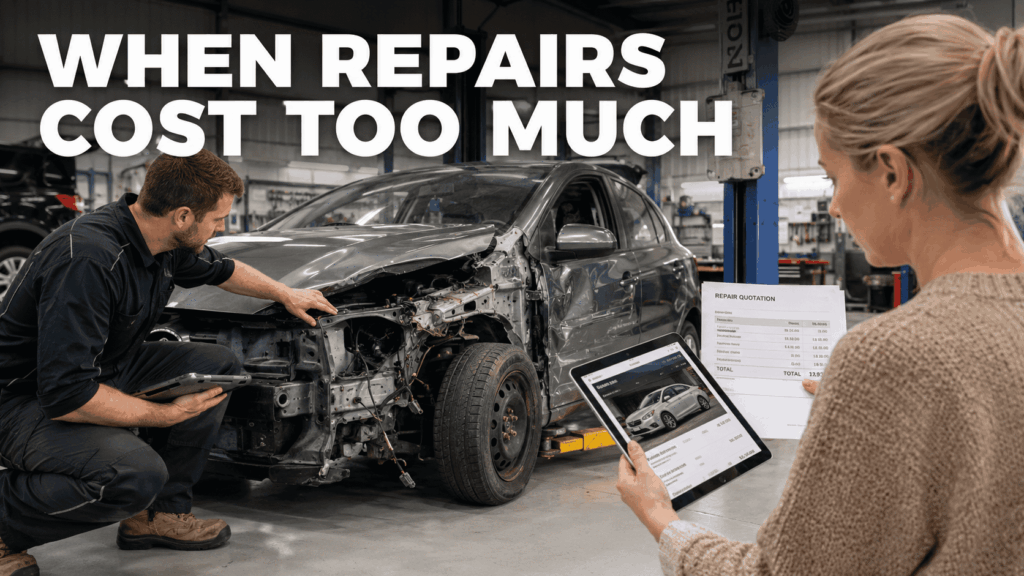
Once you’ve decided repair isn’t worth it, the question becomes what to do with the accident-damaged car. Selling it as-is to a car removal service is usually faster and less hassle than a private sale, especially if it isn’t driveable. What you’re offered depends on:
- The make, model and age of the vehicle
- How extensive the damage is, and whether it still runs
- Whether it’s complete — missing parts reduce the value
- Current scrap metal and used-parts market conditions, which move over time
A removal service will generally take accident or storm-damaged cars, utes, vans, trucks and 4WDs in any condition, running or not, including cars that are already written off. Stolen vehicles, cars still under finance, and bodies without a chassis are the main things that can’t be taken, and you’ll need photo ID to complete the sale.
Removal is free and usually available the same day if you call before midday, right across the Perth metro area — from Alkimos and Two Rocks in the north down to the southern coastal suburbs.
Common Questions
What repair-cost percentage means a car isn’t worth fixing?
There’s no fixed threshold for a private decision, but once the repair quote reaches roughly 50–70% of the car’s current market value, replacing it usually makes more sense. Factor in hidden damage, time off the road, and the damage history the car carries afterwards.
Does a repaired car lose value even after a proper repair?
Usually, yes. A car with a recorded accident or repair history tends to sell for less than an equivalent car with a clean history, even when the work is done well. That gap is part of the real cost of repairing.
Can I sell the car myself if the insurer has written it off?
If you take the payout, the insurer normally keeps the wreck and handles disposal. If you keep the car instead, it can only be sold as a written-off vehicle and the write-off stays on its history, so expect that to affect the price.
Is it worth repairing a car just to sell it?
Rarely. The extra you’d get on the sale has to beat the repair cost plus the value still lost to the damage history. Most people come out ahead selling the car damaged and letting the buyer decide.
Working Out Where You Stand
There’s no single number that settles it — you’re weighing the repair quote against a realistic value for the car, the risk of hidden damage, and how long you can go without it. If the numbers are close and you’re leaning towards replacing it, it’s worth finding out what the car is worth as-is first. Cash For Cars Perth gives free valuations over the phone on 0420 262 651, Monday to Friday 7:30 AM to 5:00 PM and Saturday 7:30 AM to 2:00 PM.