



If your car has been in an accident, dealing with the vehicle itself is usually the straightforward part. The paperwork that follows — what happens to your registration (rego) and your Compulsory Third Party cover — catches a lot of Perth owners out, mainly because the rules aren’t spelled out anywhere obvious. This is separate from lodging a Notification of Disposal, which only comes into play once you’ve actually sold or handed the vehicle over. Before that point there’s a different set of steps to work through, and getting them right can put money back in your pocket.
Rego and CTP Are Bundled Together in WA
Unlike states where registration and CTP are billed separately by different providers, Western Australia rolls them into a single vehicle licence fee. The CTP component is called Motor Injury Insurance, and it’s a compulsory condition of licensing a vehicle. It’s managed by the Insurance Commission of Western Australia, while the Department of Transport and Major Infrastructure (DTMI) collects the premium as part of each licence renewal, whether you pay for 3, 6 or 12 months. Because the two are paid together, cancelling your vehicle licence cancels the Motor Injury Insurance at the same time — there’s nothing separate to close off.
What Happens to the Licence After a Write-Off
A vehicle licence doesn’t always cancel itself after a crash, and which path applies depends on how the write-off is handled.
If the car is written off through insurance
When an insurer or self-insurer reports a vehicle as written off, it’s recorded on the Written-off Vehicle Register. Once that happens, DTMI cancels the vehicle licence and sends the registered owner written notice, and the number plates have to be returned within 28 days. Your insurer or the wrecker taking the vehicle will often return the plates on your behalf, so it’s worth confirming who’s doing that before the car is collected.
If you’re not going through insurance
If the car is uninsured, or you’ve simply decided it isn’t worth repairing, nothing happens automatically. You need to cancel the licence yourself to stop it renewing and to claim back what you’ve already paid.
Cancelling the vehicle licence
To cancel a WA vehicle licence you either surrender the number plates at a DTMI service centre or regional agent, or post them back to DTMI with a note explaining why they’re being returned.
Claiming a refund on the unused portion
Once the licence is cancelled you can apply for a pro-rata refund of the licence fees for the balance of the remaining licence period, using an Application for Refund (Form C2). The Motor Injury Insurance portion is refunded on the same pro-rata basis.
Here’s the detail that catches people out: the refund is normally calculated from the date the plates are returned, not the date of the accident. If weeks pass between the crash and the paperwork, that gap can cost you. The fix is simple — submit a copy of the accident report, or a letter from your insurer confirming the date of loss, and the refund can be backdated to that date instead. It’s worth asking your insurer for that letter as a matter of course when a car is written off, even before you’ve decided what to do with it. A refund can also be held up by an unpaid transfer fee, a plate penalty or a fine suspension on the licence, so clear those first.
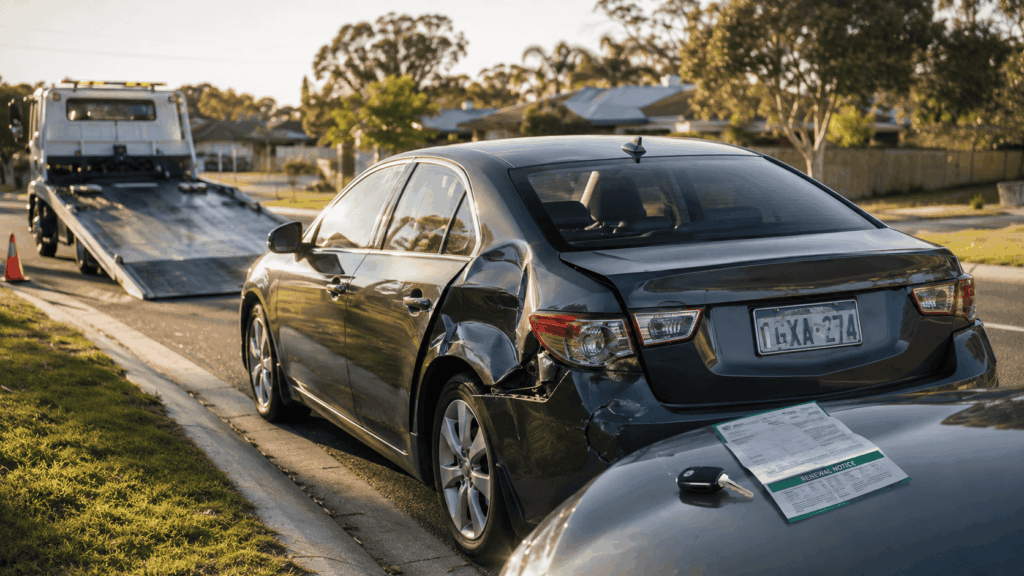
This Is Not the Same as a Notification of Disposal
It’s easy to run these two together, but cancelling your licence and notifying DTMI that you’ve disposed of the vehicle are separate obligations. Cancelling the licence and claiming a refund deals with your rego and Motor Injury Insurance. A Notification of Disposal is lodged once you’ve actually sold, traded or handed the vehicle to someone else — including a wrecker — and it’s required whether or not you claimed a refund. If you’re not sure how that part works, our step-by-step guide to lodging a Notification of Disposal covers it.
There’s also a common myth worth clearing up: number plates don’t “stay with you” when a car changes hands. On a write-off, the licence is cancelled and standard WA plates are surrendered to DTMI, as above. On an ordinary sale of a car that’s still licensed, standard state or district plates stay with the vehicle and pass to the new owner in the transfer — you don’t remove them. The only plates you take off and keep are personalised or custom plates, and those need to be booked in with DTMI before the sale if you want to hold onto them.
What Affects a Written-Off Car’s Value
Once the paperwork is sorted, the practical question is what the car is actually worth. A few things matter most:
- Extent of the damage — whether the chassis and structural rails are straight, or the damage is mostly cosmetic and mechanical.
- Write-off category — a repairable write-off usually holds more value than a statutory write-off, because more panels and parts stay usable and the car may still be economically repairable.
- Make and model — common makes with strong used-parts demand, like a Jeep, Toyota or Holden, tend to attract better offers than a rare model nobody is breaking for spares.
- Clear ownership — the vehicle can’t be stolen or still under finance, and it needs an intact chassis for a buyer to take it on legally.
Even a statutory write-off that will never drive again is worth something as parts and recyclable metal, and that’s what a licensed wrecker is paying for.

Selling an Accident-Damaged Car in Perth
With the licence and refund sorted, moving the car on is usually the simple part. A repairable write-off in good structural shape might be worth advertising privately; a statutory write-off, or anything non-running, is generally quicker to sell to a yard that buys accident-damaged cars and handles the tow. A buyer like that will take utes, trucks, vans and 4WDs in any condition — running or not, flood or fire affected, deregistered or written off — though not stolen cars, cars still under finance, or a body with no chassis.
Removal usually covers the Perth metro area, from the northern suburbs down through Applecross and the southern councils, though not as far as Bunbury, with free towing and often same-day pickup if you call before midday. Payment is sorted before the vehicle leaves your property, and all you need on hand is valid photo ID, which doesn’t have to belong to the registered owner.
Getting a Quote
If you’d rather the car was gone than deal with it any further, Cash For Cars Perth gives free quotes over the phone on 0420 262 651. Every vehicle is different, so the fairest way to find out what yours is worth is to talk through the details and have the figure confirmed before pickup.
Common Questions
Does my rego cancel automatically if my car is written off?
If the write-off goes through insurance and the vehicle is recorded on the Written-off Vehicle Register, DTMI cancels the licence and notifies you in writing — you don’t have to lodge anything. If you’re not claiming on insurance, the licence keeps running until you cancel it yourself.
How do I get back the unused part of my licence fee?
Cancel the licence by surrendering the plates, then lodge an Application for Refund (Form C2). You’re refunded on a pro-rata basis for the full remaining licence period, including the Motor Injury Insurance portion.
Can the refund be backdated to the day of the accident?
Yes. It’s normally calculated from the date the plates are returned, but if you include a copy of the accident report or a letter from your insurer confirming the date of loss, it can be backdated to that date.
Do I keep the number plates after a write-off?
No. Standard WA plates are surrendered to DTMI within 28 days of the licence being cancelled, and your insurer or the wrecker will often return them for you. Only personalised or custom plates are removed and kept, and that has to be arranged with DTMI before the vehicle goes.