


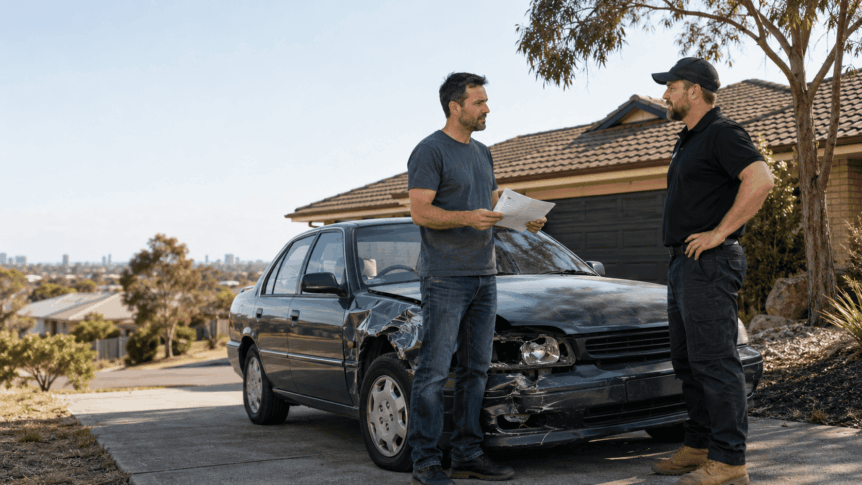
If you’ve got a damaged, unregistered or barely-running car sitting in the driveway due to an accident, it’s fair to wonder whether you need to get it inspected before you can legally sell it. In some states the answer is yes, and it can be an expensive step for a car that’s already on its way to the wreckers. In Western Australia, the rules work differently.
The Short Answer: No, WA Doesn’t Require One
Unlike Victoria, Queensland, the ACT and the Northern Territory, Western Australia does not require a roadworthy certificate — sometimes called a safety certificate — before a private sale can go ahead. If the vehicle is already licensed in WA, the licence can be transferred to the new owner without any inspection. There’s no mechanic’s sign-off to arrange and nothing extra to attach to the paperwork. The Department of Transport puts the responsibility for checking a car’s condition on the buyer, not the seller, and that applies whether the car runs perfectly, has accident, flood or fire damage, or doesn’t start at all.
An inspection only comes into it in specific cases: vehicles brought in from interstate, licences that have lapsed by more than three months, and vehicles coming off a written-off record. A straightforward private sale of a currently licensed car isn’t one of them.
The one thing worth doing is being upfront. If you’re advertising to a private buyer, describe the damage honestly — private sales carry no statutory warranty, but a misleading ad can still land you in a dispute.
What You Still Need to Do When Selling
Not needing a roadworthy certificate doesn’t mean there’s no paperwork. A few things apply to every sale in WA, damaged or not:
- Lodge a notification of disposal. Within seven days of the sale you have to tell the Department of Transport you’re no longer the owner and give the buyer’s name and address, either online through DoTDirect or by lodging the seller’s copy of the vehicle transfer form (MR9). This is what takes the car out of your name — miss it and you can still be linked to the new owner’s fines or infringements, and late lodgement can attract a penalty.
- Have photo ID ready. Whoever hands the car over needs to prove who they are. It doesn’t have to be the registered owner, but ID is expected as part of a proper handover.
- Clear any finance first. Money still owing on the car has to be paid out before it can be sold. A quick Personal Property Securities Register (PPSR) check, using the VIN, will show any finance owing and whether the car is recorded as written off.
What Happens to the Number Plates
This is the detail people most often get wrong. Standard WA number plates stay with the vehicle and pass to the new owner as part of the licence transfer — you don’t take them off. The only time plates come off is when they’re personalised or custom plates you want to keep, and then you have to remove them and arrange replacement plates with the Department of Transport before the sale goes through.
What If the Car Is Written Off, Deregistered or Barely in One Piece?
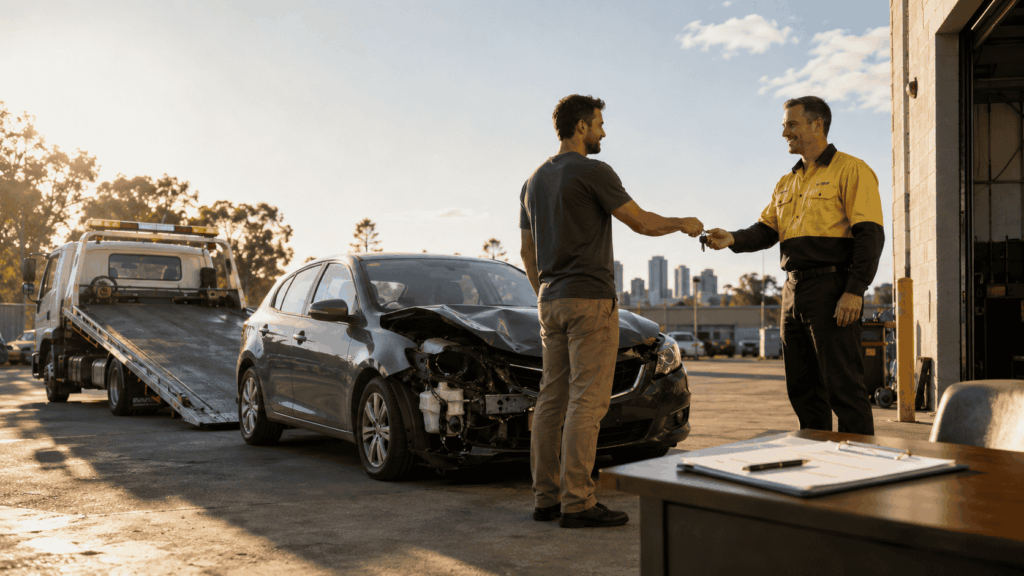
This is where a lot of Perth owners get stuck. A private buyer usually wants something they can drive away and register, not a car with fire damage, a written-off history or missing panels. That narrows the market a long way, even though nothing in the law stops you from selling it.
That’s usually where a licensed car removal or wrecking yard comes in. They’re set up to buy exactly what private buyers won’t touch: running or not, accident-damaged, flood or fire-damaged, deregistered, or headed to the wreckers. A few categories are off-limits everywhere, though — stolen vehicles, cars still under finance, and bare bodies without a chassis generally can’t be sold until those issues are sorted.
What Affects a Damaged Car’s Value
If you’re trying to work out what a damaged car is worth, a few things matter more than others:
- Make and model. A common car or work ute — an Isuzu D-Max, a Corolla, a Hilux — is worth more for parts alone, because the demand for those parts is still there.
- How complete it is. A car missing its engine or transmission is worth less than one that’s all there, even if neither runs.
- Extent of the damage. Cosmetic damage costs less value than structural, fire or flood damage.
- Weight and metal content. Most badly damaged cars are recycled for parts and scrap steel, so the weight of recoverable metal plays a part in what a yard can offer.
Selling to a Licensed Wrecker vs a Private Sale
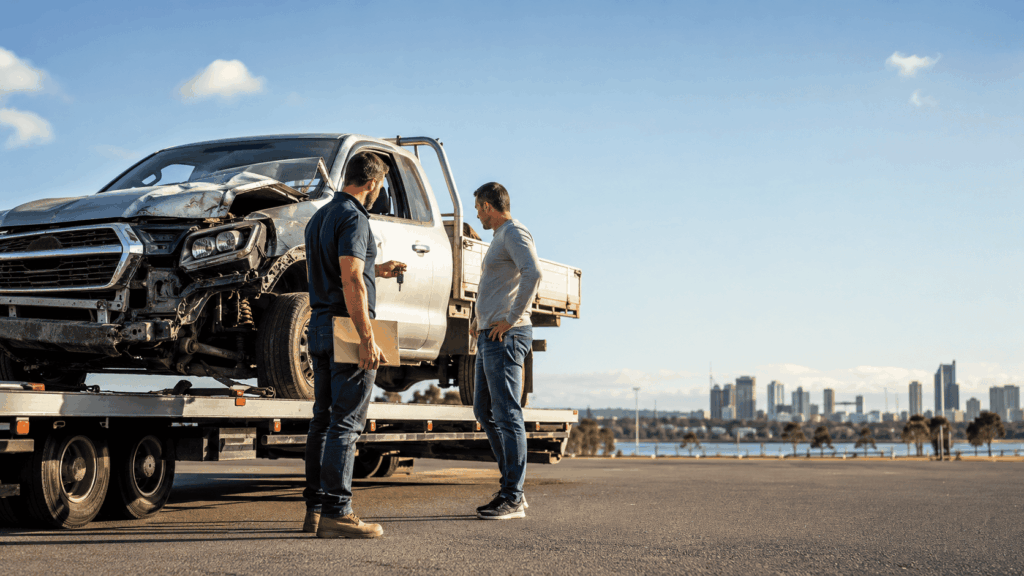
For a car in good working order, a private sale usually fetches more, as long as you have time to advertise and field calls. For a damaged, non-running or written-off vehicle it rarely works out — the pool of buyers is small, and the notification of disposal still has to be lodged either way. Many Perth owners in that situation use a licensed car removal or wrecking yard instead: the car’s condition isn’t a barrier to the sale, and the yard handles the tow, usually free and same-day, right across the metro area from the northern suburbs out to Success in the south.
If you’d rather skip the private-sale hassle, Cash For Cars Perth buys damaged, written-off and non-running vehicles in any make across the Perth metro area — call 0420 262 651 for a condition-based quote.
Common Questions
Do you need a roadworthy certificate to sell a car privately in WA?
No. WA doesn’t require a roadworthy or safety certificate to transfer a vehicle that’s already licensed in the state. The buyer is responsible for checking the car’s condition before purchase.
When does a car need an inspection in WA?
When it’s being licensed here from interstate, when the licence has lapsed by more than three months, and when it’s coming off a written-off record. A normal private sale of a currently licensed car doesn’t need one.
What paperwork do I need to sell a damaged car in WA?
Lodge a notification of disposal within seven days of the sale with the buyer’s name and address, have photo ID ready at the handover, and clear any finance owing. A PPSR check on the VIN confirms the finance and written-off status.
Do the number plates stay with the car when I sell it in WA?
Standard WA plates stay on the vehicle and transfer to the new owner, so you don’t remove them. To keep a personalised or custom plate, arrange replacement plates with the Department of Transport before the sale.