


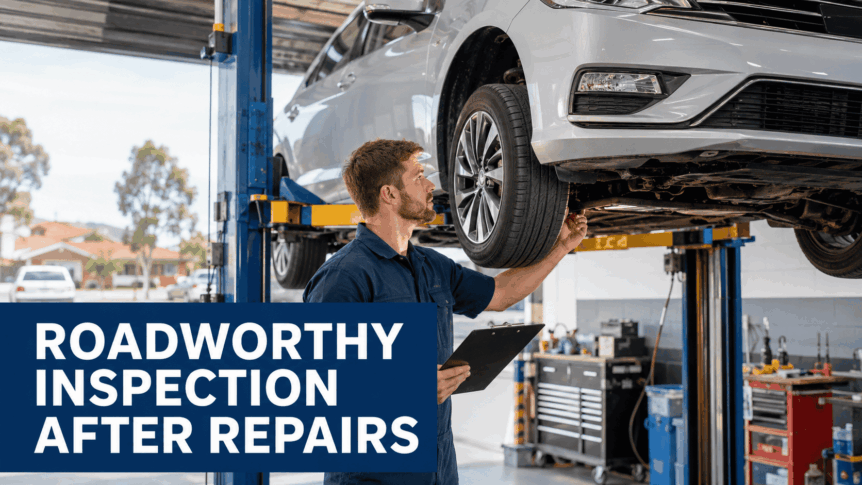
If your car has just come out of repairs after an accident, storm damage, or a WA Police yellow sticker, getting it road-legal again usually means one more step: a vehicle inspection. In WA this is officially a vehicle examination, and it confirms a repaired car is safe to drive and can be licensed again. Here’s what it involves, what it costs, and when it makes more sense to sell the car than keep paying for inspections.
What WA Calls a “Roadworthy” (And When You Need One)
Western Australia doesn’t use the term “roadworthy certificate” the way some eastern states do. Here it’s a vehicle examination, carried out by an authorised inspector at an Authorised Inspection Station (AIS) — a private business working on behalf of the Department of Transport and Major Infrastructure (DTMI). Highly modified, oversized or high-risk vehicles go to the DTMI examination centre at Kelmscott instead.
You’ll generally need one if:
- Your car has been given a yellow sticker (vehicle defect notice) for a safety defect
- You’re re-licensing a repairable write-off
- You’ve modified the engine, body or structural components
- You’re licensing a vehicle in WA for the first time, or bringing an unlicensed car back onto the road
Passing the examination is what restores your licence — finishing the repairs alone doesn’t. A repairable write-off actually needs two checks: first with an authorised written-off vehicle inspector, then an identity and roadworthy inspection at an AIS.
What Does It Cost After Repairs?
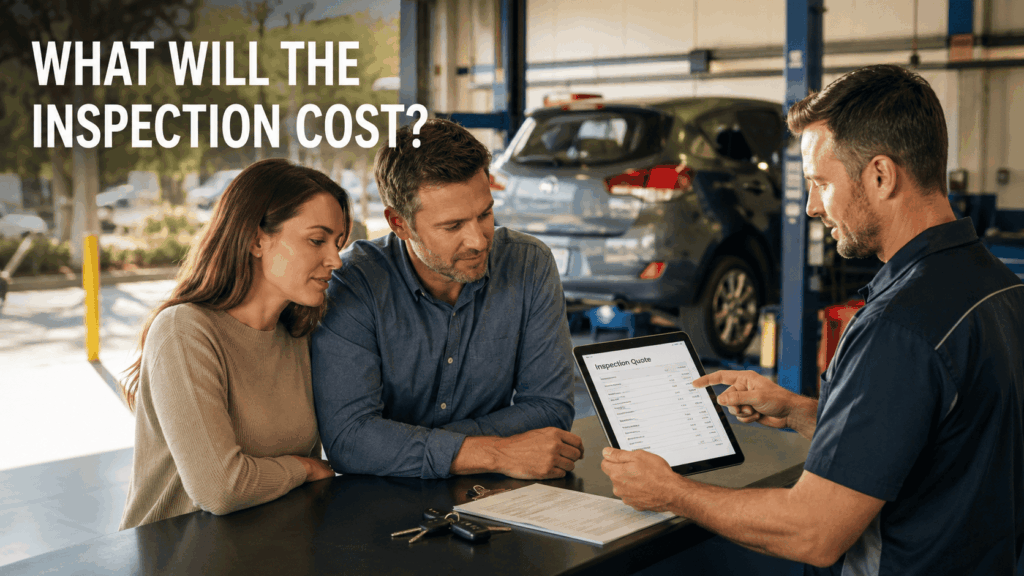
There’s no single government-set price. AIS inspection fees aren’t regulated by DTMI — each station sets its own, benchmarked to a regional price index, so what you pay depends on the station, its location and the type of vehicle. A re-inspection after a failed check is charged separately, on top of the first fee. The practical move is to ring a few stations near you and compare before booking.
What affects the price
- Vehicle type and weight — heavier vehicles and light trucks cost more to inspect than a standard passenger car
- Extent of the repairs — structural or chassis work needs a more thorough look than cosmetic panel repairs
- Which station you use — AIS providers set their own fees
- Re-inspection vs first attempt — a second visit is a separate charge
If the Car Doesn’t Pass
If your vehicle fails, you’ll get a notice listing what needs fixing and a limited window to repair it and return before the result lapses. An inspection pass is only valid for about three months, so there’s no point doing it long before you’re ready to license the car. For a vehicle that’s already had one repair bill, a second round of work plus another inspection fee can turn a quick fix into an expensive exercise — especially on an older car.
When It’s Not Worth Fixing
This is where a lot of Perth owners do the maths: repair quote, inspection fee and likely re-inspection fee against what the car is worth once it’s back on the road. On an older vehicle, or one with a history of mechanical trouble, the cost of a fresh pass can come close to — or beyond — what an accident-damaged car would sell for anyway.
What it’s worth as-is depends heavily on the make. A common Perth vehicle like an Isuzu D-Max or a mainstream sedan holds better salvage value because there’s steady demand for the parts; a rare model can be worth less broken than you’d expect.
You don’t need a roadworthy to sell for wrecking
Sell to a licensed wrecker or car removal yard rather than a private buyer and none of this applies — no current inspection, no passed examination, not even working registration. Wreckers buy vehicles for parts and scrap metal, so a yellow sticker, a failed inspection or a lapsed licence doesn’t stop the sale.
A private sale is the exception: there, a buyer will usually want a current inspection or will knock the cost of getting one off their offer. Whether you need a roadworthy to sell a damaged car in WA comes down to who you’re selling to.
Selling in WA — A Couple of Rules to Know
Two WA details catch people out when selling a damaged or unwanted car:
- Standard plates stay with the vehicle. Ordinary WA plates transfer to the new owner with the licence — you don’t remove them. Only personalised or custom plates are different: exchange those at a DTMI service centre before the sale if you want to keep them.
- Lodge a notification of disposal within seven days. Tell DTMI you’ve stopped being the owner, with the buyer’s name and address, within seven days of the sale. Failing to do so results in a penalty.
You’ll also need valid photo ID. It doesn’t have to match the registered owner’s name, which helps if you’re selling for a family member or handling a deceased estate.
Getting a Cash Offer Instead of Paying for Repairs
If the numbers don’t favour fixing the car, Cash For Cars Perth buys vehicles in any condition — running, non-running, accident-damaged, flood or fire-damaged, deregistered or written off. We’re based at a licensed wrecking yard at 5 Hantke Place, Welshpool, and cover the whole Perth metro area, from the northern suburbs down to Cockburn Central and nearby southern suburbs (not as far as Bunbury or the South West). Most cars are picked up free the same day, often within two to three hours if you call before midday, and payment is sorted before the vehicle leaves your property.
We can’t take stolen vehicles, cars still under finance, or bodies without a chassis. Just about everything else — utes, trucks, vans and 4WDs included — is fine.
Get a Quote Before You Book Another Inspection
Before you pay for a re-inspection or another repair bill, find out what the car is worth as it sits. Call 0420 262 651 for a free, no-obligation quote or to ask about same-day pickup. We’re open Monday to Friday, 7:30am to 5:00pm and Saturday, 7:30am to 2:00pm, closed Sundays and public holidays.
Common Questions
How long is a WA vehicle inspection valid?
Generally about three months, so it’s best not to have it done long before you’re ready to license the vehicle.
Who sets the inspection fee?
The inspection station, not the government. AIS fees aren’t regulated by DTMI, they vary by provider and region, and a re-inspection is a separate charge. Ring a few stations to compare.
Do I need to pass an inspection to sell a car for wrecking?
No. Licensed wreckers and car removal yards buy vehicles that have failed an inspection, carry a yellow sticker or have no current registration. A private sale is different.
What happens to my number plates when I sell?
Standard WA plates stay with the vehicle and transfer to the new owner. Only personalised or custom plates need separate handling — exchange them at a DTMI service centre before the sale if you want to keep them.