
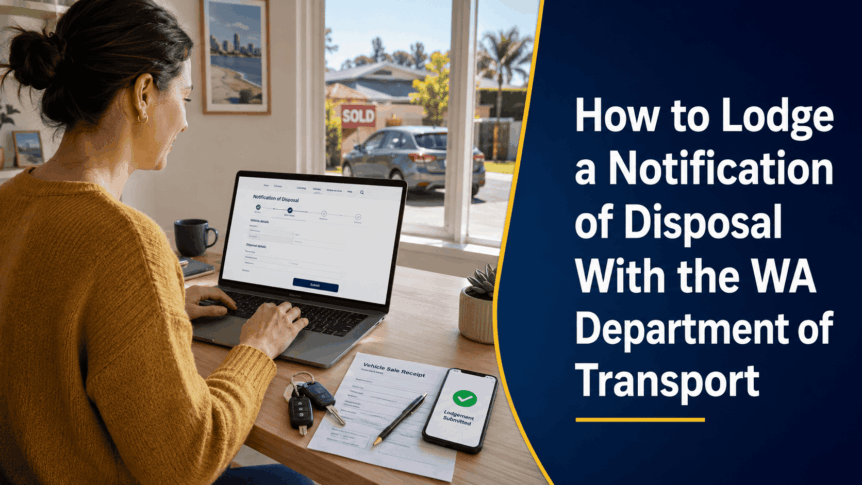
Person lodging a WA vehicle notification of disposal online after selling a car

How to Lodge a Notification of Disposal With the WA Department of Transport (Step-by-Step)

KobyBlog

If you’ve just sold, wrecked, or handed over an accident car in Perth, one government step is easy to forget once the tow truck has left: lodging a Notification of Disposal with the Department of Transport and Major Infrastructure (DTMI) in Western Australia. It’s a short form, but skipping it can leave you legally responsible for a car you no longer own — including someone else’s fines. Here’s how it works, what to do with your plates, and how to claim back any licence fees.

Why Lodging the Disposal Notice Matters

In WA, the vehicle licence stays linked to your name until DTMI is told otherwise, no matter who is actually driving the car. If the new owner picks up parking fines, speed camera infringements, or toll charges before the transfer goes through, those notices are sent to the address on file — which is still yours. Lodging the seller’s notice promptly is what officially ends your responsibility for the vehicle from the date of sale.
This matters just as much for a car that is old and no longer worth re-registering as for a daily driver — even a car sold for scrap keeps a licence record in your name until you close it out.

What You’ll Need Before You Start

The seller’s notice is lodged using Form MR9 (Notification of Change of Ownership – Vehicle Licence Transfer). Before you begin, have these on hand:

  • The vehicle’s plate number, VIN or chassis number, and engine number
  • The date of sale and the sale price, or the market value if there is no sale
  • The buyer’s name and address
  • Your WA driver’s licence number
  • The current vehicle licence paper, so the details match DTMI’s records
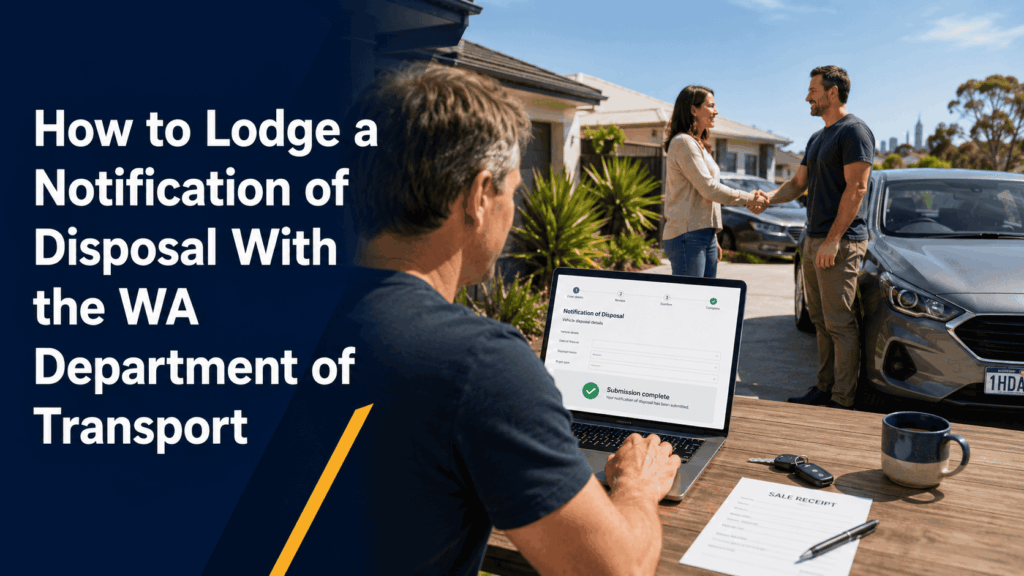
Vehicle papers and Form MR9 laid out to lodge a notification of disposal in WA

Step-by-Step: How to Lodge the Notification

  1. Complete the MR9 with the buyer. The seller and buyer fill in and sign the form together when the car changes hands. It separates into a seller’s copy (blue) and a purchaser’s copy (red).
  2. Lodge your seller’s copy within 7 days. This isn’t a suggested timeframe — DTMI can issue an infringement if the seller’s notice isn’t submitted within seven days of the sale.
  3. Choose how to submit it. Lodge online through a free DoTDirect account at transport.wa.gov.au, in person at a DTMI service centre or regional agent, or by post to Driver and Vehicle Services, GPO Box R1290, Perth WA 6844.
  4. Give the buyer their copy and the licence paper. The purchaser’s copy (red), plus the current vehicle licence paper, lets them complete their side. The buyer then has 14 days to lodge their part and pay the transfer fee and duty.
  5. Keep proof. Hold on to your receipt or a copy of the lodged form. If a fine or dispute comes up later, that is your evidence the car stopped being yours on the date of sale.

If you’re selling to a licensed wrecker rather than a private buyer, the yard handles its side of the paperwork, but the seller’s notice is still yours to lodge — confirm whether they will submit it and hand your plates in for you. For your own situation, DTMI is on 13 11 56.

What Happens to Your Number Plates

What you do with the plates depends on where the car is going.

Sold to another driver: standard state or district plates stay with the vehicle and pass to the new owner as part of the licence transfer. You don’t take them off. The exception is personalised or custom plates — to keep those, remove them before the sale and arrange replacement plates with DTMI.

Sold for wrecking or salvage: the car isn’t going back on the road, so the licence is cancelled rather than transferred. If the vehicle is already on the Written-Off Vehicle Register, DTMI cancels the licence automatically and the plates must be returned within 28 days — a licensed wrecker will often send them back on your behalf, but confirm it. If the car is still licensed when you sell it, take the plates off yourself and hand them in at a DTMI service centre or post them back with a note.

Claiming Back Your Licence Fees

If the car still had registration left on it, you are usually entitled to a pro-rata refund of the licence fees for the unused period. You apply to DTMI once the licence is cancelled. If the car was written off, the refund can be backdated to the accident date if you supply the crash report or an insurer’s letter confirming it. The compulsory third-party component, Motor Injury Insurance, is refunded on the same basis.

Does It Matter If the Car Is Written Off or Not Running?

No. The disposal notice process is the same whether the car runs perfectly, sits dead in the driveway, or is already on the written-off vehicle register. What changes is how the sale happens — a written-off car goes for parts or scrap rather than to another driver.

If the car has been written off, check whether it can still be driven in WA before you arrange the sale, since that decides whether it has to be towed.

Condition and make don’t change the paperwork, but they do affect what a buyer will pay. A common make like a Kia has steady demand for used parts, while a rare model might only be worth its scrap metal.
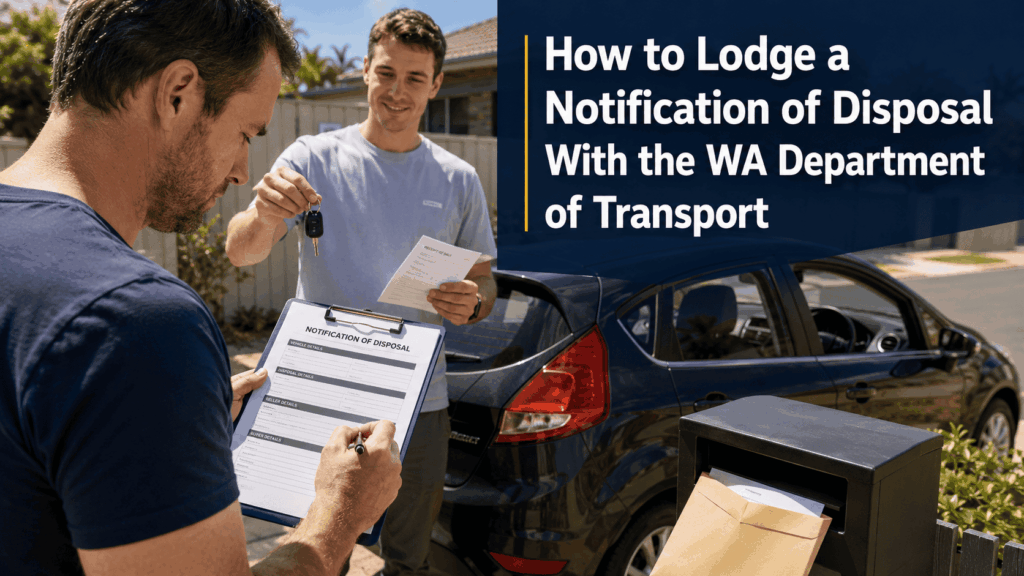
Non-running car in a Perth driveway waiting to be sold and towed for wrecking

A Simpler Way to Handle the Sale

If the car is old, damaged, or not worth the effort of a private sale, a car removal service takes the paperwork pressure off. Cash For Cars Perth buys vehicles in any condition — running or not, deregistered, written off, or accident, fire, or flood damaged — and can walk you through the MR9 step at collection.

Towing is free across the Perth metropolitan area, from Ardross and the riverside suburbs to the outer metro, often the same day. Payment is sorted before the vehicle leaves, and you will just need valid photo ID — it doesn’t have to be in the registered owner’s name, though having the vehicle licence paper handy makes lodging your MR9 afterwards much simpler. If you would rather not deal with a private sale at all, you can arrange a free quote and pickup on 0420 262 651.

Frequently Asked Questions

How long do I have to lodge the notification after selling my car?

Seven days from the date you stop being the owner. The buyer then has 14 days to lodge their side and pay the transfer fee and duty. Lodging late can attract an infringement, so it is best done straight away.

Do I still need to lodge it if I sold the car to a wrecker?

Yes. Selling for scrap or salvage doesn’t remove the seller’s obligation to notify DTMI. Many wreckers will lodge the notice and return your plates for you, but ask before you assume it is handled.

Can I get money back on my registration?

Usually, yes. If there was unused registration on the car, you can apply to DTMI for a pro-rata refund of the licence fees once the licence is cancelled. For a written-off car, the refund can be backdated to the accident date if you provide proof of when it happened.

What happens if I don’t lodge the notification?

The licence stays in your name, so any fines, tolls, or infringements the new owner runs up are sent to you. You may also face a penalty for not notifying DTMI within seven days.

Do I keep my number plates?

Standard plates stay with a car that is sold to another driver. If the car is going for wrecking, the plates are returned to DTMI. Only personalised or custom plates can be kept, and those need to come off before the sale.

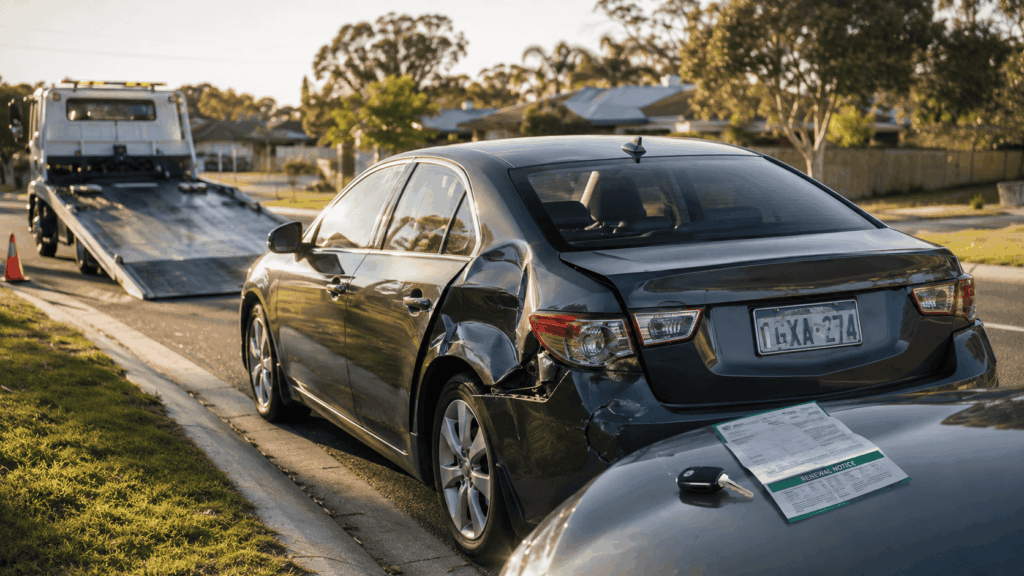
Number plates and vehicle licence paperwork for a written-off car in Western Australia

What Happens to Your Rego and CTP After a Car Accident in WA?

KobyBlog

If your car has been in an accident, dealing with the vehicle itself is usually the straightforward part. The paperwork that follows — what happens to your registration (rego) and your Compulsory Third Party cover — catches a lot of Perth owners out, mainly because the rules aren’t spelled out anywhere obvious. This is separate from lodging a Notification of Disposal, which only comes into play once you’ve actually sold or handed the vehicle over. Before that point there’s a different set of steps to work through, and getting them right can put money back in your pocket.

Rego and CTP Are Bundled Together in WA

Unlike states where registration and CTP are billed separately by different providers, Western Australia rolls them into a single vehicle licence fee. The CTP component is called Motor Injury Insurance, and it’s a compulsory condition of licensing a vehicle. It’s managed by the Insurance Commission of Western Australia, while the Department of Transport and Major Infrastructure (DTMI) collects the premium as part of each licence renewal, whether you pay for 3, 6 or 12 months. Because the two are paid together, cancelling your vehicle licence cancels the Motor Injury Insurance at the same time — there’s nothing separate to close off.

What Happens to the Licence After a Write-Off

A vehicle licence doesn’t always cancel itself after a crash, and which path applies depends on how the write-off is handled.

If the car is written off through insurance

When an insurer or self-insurer reports a vehicle as written off, it’s recorded on the Written-off Vehicle Register. Once that happens, DTMI cancels the vehicle licence and sends the registered owner written notice, and the number plates have to be returned within 28 days. Your insurer or the wrecker taking the vehicle will often return the plates on your behalf, so it’s worth confirming who’s doing that before the car is collected.

If you’re not going through insurance

If the car is uninsured, or you’ve simply decided it isn’t worth repairing, nothing happens automatically. You need to cancel the licence yourself to stop it renewing and to claim back what you’ve already paid.

Cancelling the vehicle licence

To cancel a WA vehicle licence you either surrender the number plates at a DTMI service centre or regional agent, or post them back to DTMI with a note explaining why they’re being returned.

Claiming a refund on the unused portion

Once the licence is cancelled you can apply for a pro-rata refund of the licence fees for the balance of the remaining licence period, using an Application for Refund (Form C2). The Motor Injury Insurance portion is refunded on the same pro-rata basis.

Here’s the detail that catches people out: the refund is normally calculated from the date the plates are returned, not the date of the accident. If weeks pass between the crash and the paperwork, that gap can cost you. The fix is simple — submit a copy of the accident report, or a letter from your insurer confirming the date of loss, and the refund can be backdated to that date instead. It’s worth asking your insurer for that letter as a matter of course when a car is written off, even before you’ve decided what to do with it. A refund can also be held up by an unpaid transfer fee, a plate penalty or a fine suspension on the licence, so clear those first.

WA vehicle owner removing number plates to cancel the licence on a written-off car

This Is Not the Same as a Notification of Disposal

It’s easy to run these two together, but cancelling your licence and notifying DTMI that you’ve disposed of the vehicle are separate obligations. Cancelling the licence and claiming a refund deals with your rego and Motor Injury Insurance. A Notification of Disposal is lodged once you’ve actually sold, traded or handed the vehicle to someone else — including a wrecker — and it’s required whether or not you claimed a refund. If you’re not sure how that part works, our step-by-step guide to lodging a Notification of Disposal covers it.

There’s also a common myth worth clearing up: number plates don’t “stay with you” when a car changes hands. On a write-off, the licence is cancelled and standard WA plates are surrendered to DTMI, as above. On an ordinary sale of a car that’s still licensed, standard state or district plates stay with the vehicle and pass to the new owner in the transfer — you don’t remove them. The only plates you take off and keep are personalised or custom plates, and those need to be booked in with DTMI before the sale if you want to hold onto them.

What Affects a Written-Off Car’s Value

Once the paperwork is sorted, the practical question is what the car is actually worth. A few things matter most:

  • Extent of the damage — whether the chassis and structural rails are straight, or the damage is mostly cosmetic and mechanical.
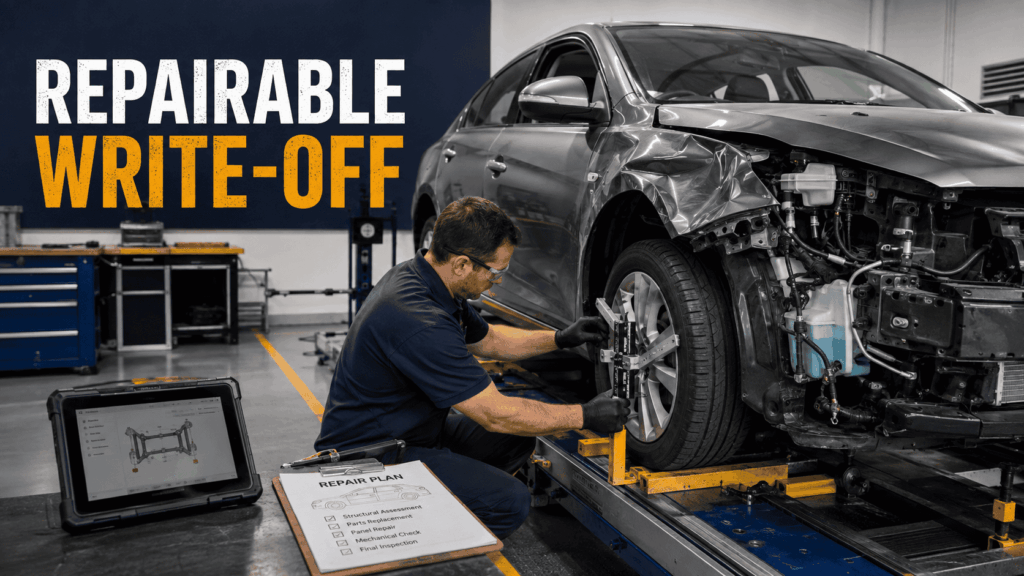
  • Write-off category — a repairable write-off usually holds more value than a statutory write-off, because more panels and parts stay usable and the car may still be economically repairable.
  • Make and model — common makes with strong used-parts demand, like a Jeep, Toyota or Holden, tend to attract better offers than a rare model nobody is breaking for spares.
  • Clear ownership — the vehicle can’t be stolen or still under finance, and it needs an intact chassis for a buyer to take it on legally.

Even a statutory write-off that will never drive again is worth something as parts and recyclable metal, and that’s what a licensed wrecker is paying for.

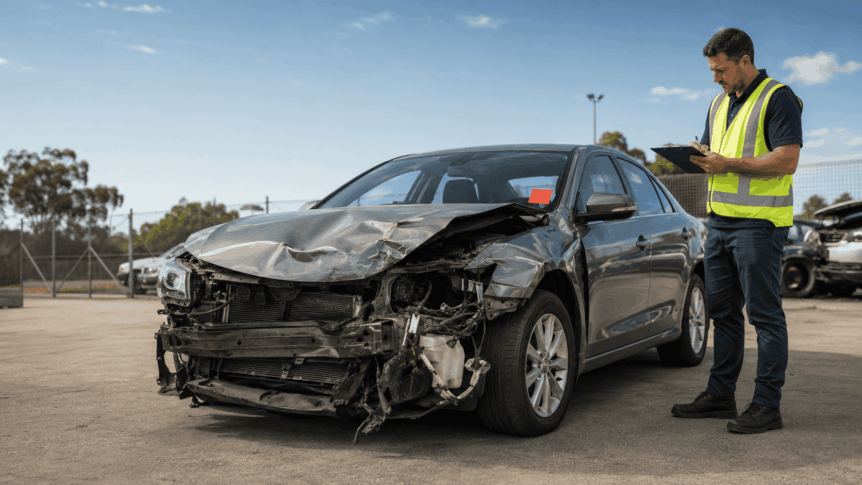
Assessor inspecting an accident-damaged car in a Perth yard to work out its salvage value

Selling an Accident-Damaged Car in Perth

With the licence and refund sorted, moving the car on is usually the simple part. A repairable write-off in good structural shape might be worth advertising privately; a statutory write-off, or anything non-running, is generally quicker to sell to a yard that buys accident-damaged cars and handles the tow. A buyer like that will take utes, trucks, vans and 4WDs in any condition — running or not, flood or fire affected, deregistered or written off — though not stolen cars, cars still under finance, or a body with no chassis.

Removal usually covers the Perth metro area, from the northern suburbs down through Applecross and the southern councils, though not as far as Bunbury, with free towing and often same-day pickup if you call before midday. Payment is sorted before the vehicle leaves your property, and all you need on hand is valid photo ID, which doesn’t have to belong to the registered owner.

Getting a Quote

If you’d rather the car was gone than deal with it any further, Cash For Cars Perth gives free quotes over the phone on 0420 262 651. Every vehicle is different, so the fairest way to find out what yours is worth is to talk through the details and have the figure confirmed before pickup.

Common Questions

Does my rego cancel automatically if my car is written off?

If the write-off goes through insurance and the vehicle is recorded on the Written-off Vehicle Register, DTMI cancels the licence and notifies you in writing — you don’t have to lodge anything. If you’re not claiming on insurance, the licence keeps running until you cancel it yourself.

How do I get back the unused part of my licence fee?

Cancel the licence by surrendering the plates, then lodge an Application for Refund (Form C2). You’re refunded on a pro-rata basis for the full remaining licence period, including the Motor Injury Insurance portion.

Can the refund be backdated to the day of the accident?

Yes. It’s normally calculated from the date the plates are returned, but if you include a copy of the accident report or a letter from your insurer confirming the date of loss, it can be backdated to that date.

Do I keep the number plates after a write-off?

No. Standard WA plates are surrendered to DTMI within 28 days of the licence being cancelled, and your insurer or the wrecker will often return them for you. Only personalised or custom plates are removed and kept, and that has to be arranged with DTMI before the vehicle goes.

Damaged car in a Perth driveway being sold without a roadworthy certificate in WA

Do You Need a Roadworthy Certificate to Sell a Damaged Car in WA?

KobyBlog

If you’ve got a damaged, unregistered or barely-running car sitting in the driveway due to an accident, it’s fair to wonder whether you need to get it inspected before you can legally sell it. In some states the answer is yes, and it can be an expensive step for a car that’s already on its way to the wreckers. In Western Australia, the rules work differently.

The Short Answer: No, WA Doesn’t Require One

Unlike Victoria, Queensland, the ACT and the Northern Territory, Western Australia does not require a roadworthy certificate — sometimes called a safety certificate — before a private sale can go ahead. If the vehicle is already licensed in WA, the licence can be transferred to the new owner without any inspection. There’s no mechanic’s sign-off to arrange and nothing extra to attach to the paperwork. The Department of Transport puts the responsibility for checking a car’s condition on the buyer, not the seller, and that applies whether the car runs perfectly, has accident, flood or fire damage, or doesn’t start at all.

An inspection only comes into it in specific cases: vehicles brought in from interstate, licences that have lapsed by more than three months, and vehicles coming off a written-off record. A straightforward private sale of a currently licensed car isn’t one of them.

The one thing worth doing is being upfront. If you’re advertising to a private buyer, describe the damage honestly — private sales carry no statutory warranty, but a misleading ad can still land you in a dispute.

What You Still Need to Do When Selling

Not needing a roadworthy certificate doesn’t mean there’s no paperwork. A few things apply to every sale in WA, damaged or not:

  • Lodge a notification of disposal. Within seven days of the sale you have to tell the Department of Transport you’re no longer the owner and give the buyer’s name and address, either online through DoTDirect or by lodging the seller’s copy of the vehicle transfer form (MR9). This is what takes the car out of your name — miss it and you can still be linked to the new owner’s fines or infringements, and late lodgement can attract a penalty.
  • Have photo ID ready. Whoever hands the car over needs to prove who they are. It doesn’t have to be the registered owner, but ID is expected as part of a proper handover.
  • Clear any finance first. Money still owing on the car has to be paid out before it can be sold. A quick Personal Property Securities Register (PPSR) check, using the VIN, will show any finance owing and whether the car is recorded as written off.

What Happens to the Number Plates

This is the detail people most often get wrong. Standard WA number plates stay with the vehicle and pass to the new owner as part of the licence transfer — you don’t take them off. The only time plates come off is when they’re personalised or custom plates you want to keep, and then you have to remove them and arrange replacement plates with the Department of Transport before the sale goes through.

Seller completing a WA notification of disposal form after selling a damaged car

What If the Car Is Written Off, Deregistered or Barely in One Piece?

This is where a lot of Perth owners get stuck. A private buyer usually wants something they can drive away and register, not a car with fire damage, a written-off history or missing panels. That narrows the market a long way, even though nothing in the law stops you from selling it.

That’s usually where a licensed car removal or wrecking yard comes in. They’re set up to buy exactly what private buyers won’t touch: running or not, accident-damaged, flood or fire-damaged, deregistered, or headed to the wreckers. A few categories are off-limits everywhere, though — stolen vehicles, cars still under finance, and bare bodies without a chassis generally can’t be sold until those issues are sorted.

What Affects a Damaged Car’s Value

If you’re trying to work out what a damaged car is worth, a few things matter more than others:

  • Make and model. A common car or work ute — an Isuzu D-Max, a Corolla, a Hilux — is worth more for parts alone, because the demand for those parts is still there.
  • How complete it is. A car missing its engine or transmission is worth less than one that’s all there, even if neither runs.
  • Extent of the damage. Cosmetic damage costs less value than structural, fire or flood damage.
  • Weight and metal content. Most badly damaged cars are recycled for parts and scrap steel, so the weight of recoverable metal plays a part in what a yard can offer.

Damaged car being assessed for its salvage and scrap value at a Perth wrecking yard

Selling to a Licensed Wrecker vs a Private Sale

For a car in good working order, a private sale usually fetches more, as long as you have time to advertise and field calls. For a damaged, non-running or written-off vehicle it rarely works out — the pool of buyers is small, and the notification of disposal still has to be lodged either way. Many Perth owners in that situation use a licensed car removal or wrecking yard instead: the car’s condition isn’t a barrier to the sale, and the yard handles the tow, usually free and same-day, right across the metro area from the northern suburbs out to Anketell in the south.

If you’d rather skip the private-sale hassle, Cash For Cars Perth buys damaged, written-off and non-running vehicles in any make across the Perth metro area — call 0420 262 651 for a condition-based quote.

Common Questions

Do you need a roadworthy certificate to sell a car privately in WA?

No. WA doesn’t require a roadworthy or safety certificate to transfer a vehicle that’s already licensed in the state. The buyer is responsible for checking the car’s condition before purchase.

When does a car need an inspection in WA?

When it’s being licensed here from interstate, when the licence has lapsed by more than three months, and when it’s coming off a written-off record. A normal private sale of a currently licensed car doesn’t need one.

What paperwork do I need to sell a damaged car in WA?

Lodge a notification of disposal within seven days of the sale with the buyer’s name and address, have photo ID ready at the handover, and clear any finance owing. A PPSR check on the VIN confirms the finance and written-off status.

Do the number plates stay with the car when I sell it in WA?

Standard WA plates stay on the vehicle and transfer to the new owner, so you don’t remove them. To keep a personalised or custom plate, arrange replacement plates with the Department of Transport before the sale.
Mechanic inspecting a repaired car at a Perth vehicle examination station

How Much Does a Roadworthy Inspection Cost in Perth After Repairs?

KobyBlog

If your car has just come out of repairs after an accident, storm damage, or a WA Police yellow sticker, getting it road-legal again usually means one more step: a vehicle inspection. In WA this is officially a vehicle examination, and it confirms a repaired car is safe to drive and can be licensed again. Here’s what it involves, what it costs, and when it makes more sense to sell the car than keep paying for inspections.

What WA Calls a “Roadworthy” (And When You Need One)

Western Australia doesn’t use the term “roadworthy certificate” the way some eastern states do. Here it’s a vehicle examination, carried out by an authorised inspector at an Authorised Inspection Station (AIS) — a private business working on behalf of the Department of Transport and Major Infrastructure (DTMI). Highly modified, oversized or high-risk vehicles go to the DTMI examination centre at Kelmscott instead.

You’ll generally need one if:

  • Your car has been given a yellow sticker (vehicle defect notice) for a safety defect
  • You’re re-licensing a repairable write-off
  • You’ve modified the engine, body or structural components
  • You’re licensing a vehicle in WA for the first time, or bringing an unlicensed car back onto the road

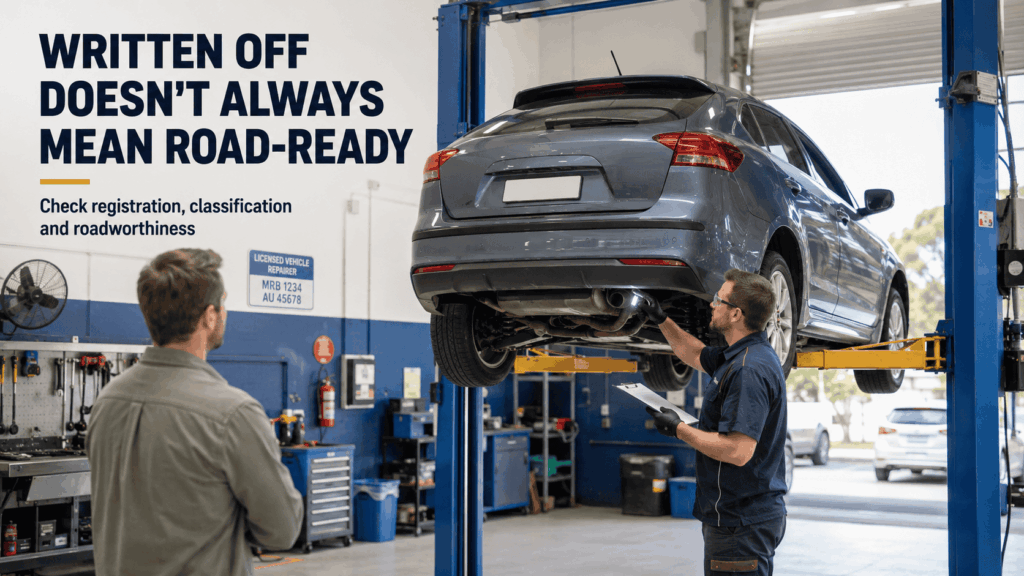
Passing the examination is what restores your licence — finishing the repairs alone doesn’t. A repairable write-off actually needs two checks: first with an authorised written-off vehicle inspector, then an identity and roadworthy inspection at an AIS.

Authorised inspector checking a vehicle at a WA Authorised Inspection Station

What Does It Cost After Repairs?

There’s no single government-set price. AIS inspection fees aren’t regulated by DTMI — each station sets its own, benchmarked to a regional price index, so what you pay depends on the station, its location and the type of vehicle. A re-inspection after a failed check is charged separately, on top of the first fee. The practical move is to ring a few stations near you and compare before booking.

What affects the price

  • Vehicle type and weight — heavier vehicles and light trucks cost more to inspect than a standard passenger car
  • Extent of the repairs — structural or chassis work needs a more thorough look than cosmetic panel repairs
  • Which station you use — AIS providers set their own fees
  • Re-inspection vs first attempt — a second visit is a separate charge

If the Car Doesn’t Pass

If your vehicle fails, you’ll get a notice listing what needs fixing and a limited window to repair it and return before the result lapses. An inspection pass is only valid for about three months, so there’s no point doing it long before you’re ready to license the car. For a vehicle that’s already had one repair bill, a second round of work plus another inspection fee can turn a quick fix into an expensive exercise — especially on an older car.

Owner reading a failed vehicle inspection notice next to an older car in Perth

When It’s Not Worth Fixing

This is where a lot of Perth owners do the maths: repair quote, inspection fee and likely re-inspection fee against what the car is worth once it’s back on the road. On an older vehicle, or one with a history of mechanical trouble, the cost of a fresh pass can come close to — or beyond — what an accident-damaged car would sell for anyway.

What it’s worth as-is depends heavily on the make. A common Perth vehicle like an Isuzu D-Max or a mainstream sedan holds better salvage value because there’s steady demand for the parts; a rare model can be worth less broken than you’d expect.

You don’t need a roadworthy to sell for wrecking

Sell to a licensed wrecker or car removal yard rather than a private buyer and none of this applies — no current inspection, no passed examination, not even working registration. Wreckers buy vehicles for parts and scrap metal, so a yellow sticker, a failed inspection or a lapsed licence doesn’t stop the sale.

A private sale is the exception: there, a buyer will usually want a current inspection or will knock the cost of getting one off their offer. Whether you need a roadworthy to sell a damaged car in WA comes down to who you’re selling to.

Selling in WA — A Couple of Rules to Know

Two WA details catch people out when selling a damaged or unwanted car:

  • Standard plates stay with the vehicle. Ordinary WA plates transfer to the new owner with the licence — you don’t remove them. Only personalised or custom plates are different: exchange those at a DTMI service centre before the sale if you want to keep them.
  • Lodge a notification of disposal within seven days. Tell DTMI you’ve stopped being the owner, with the buyer’s name and address, within seven days of the sale. Failing to do so results in a penalty.

You’ll also need valid photo ID. It doesn’t have to match the registered owner’s name, which helps if you’re selling for a family member or handling a deceased estate.

Getting a Cash Offer Instead of Paying for Repairs

If the numbers don’t favour fixing the car, Cash For Cars Perth buys vehicles in any condition — running, non-running, accident-damaged, flood or fire-damaged, deregistered or written off. We’re based at a licensed wrecking yard at 5 Hantke Place, Welshpool, and cover the whole Perth metro area, from the northern suburbs down to Anketell on the southern edge (not as far as Bunbury or the South West). Most cars are picked up free the same day, often within two to three hours if you call before midday, and payment is sorted before the vehicle leaves your property.

We can’t take stolen vehicles, cars still under finance, or bodies without a chassis. Just about everything else — utes, trucks, vans and 4WDs included — is fine.

Get a Quote Before You Book Another Inspection

Before you pay for a re-inspection or another repair bill, find out what the car is worth as it sits. Call 0420 262 651 for a free, no-obligation quote or to ask about same-day pickup. We’re open Monday to Friday, 7:30am to 5:00pm and Saturday, 7:30am to 2:00pm, closed Sundays and public holidays.

Common Questions

How long is a WA vehicle inspection valid?

Generally about three months, so it’s best not to have it done long before you’re ready to license the vehicle.

Who sets the inspection fee?

The inspection station, not the government. AIS fees aren’t regulated by DTMI, they vary by provider and region, and a re-inspection is a separate charge. Ring a few stations to compare.

Do I need to pass an inspection to sell a car for wrecking?

No. Licensed wreckers and car removal yards buy vehicles that have failed an inspection, carry a yellow sticker or have no current registration. A private sale is different.

What happens to my number plates when I sell?

Standard WA plates stay with the vehicle and transfer to the new owner. Only personalised or custom plates need separate handling — exchange them at a DTMI service centre before the sale if you want to keep them.

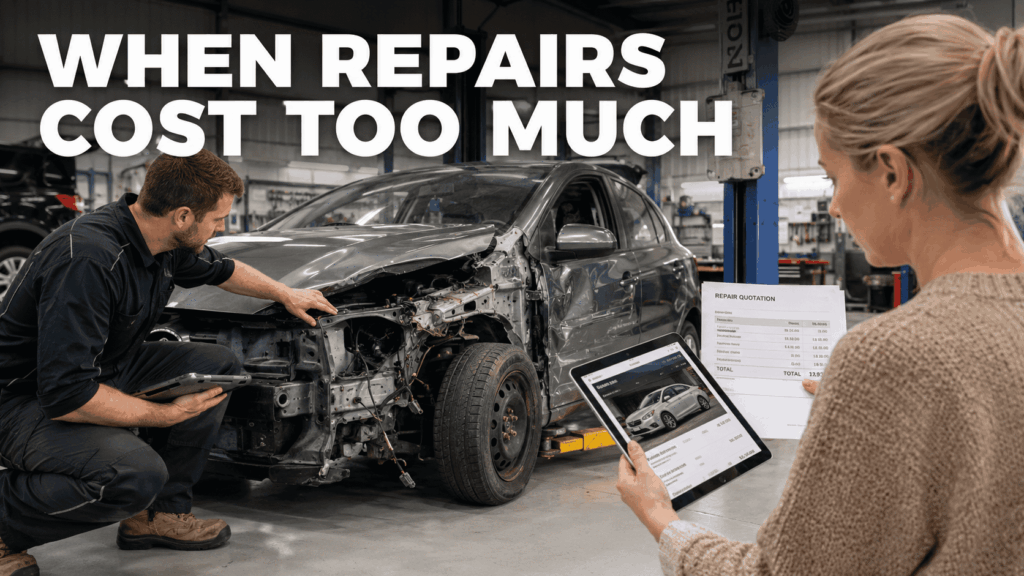
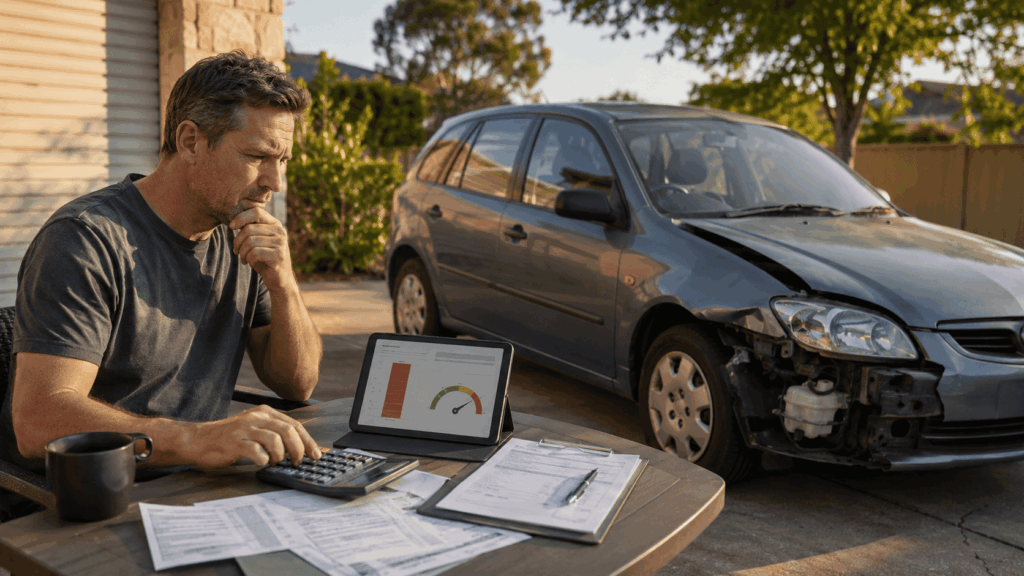
Perth driver weighing a smash repair quote against the value of an accident-damaged car

Is It Cheaper to Repair or Replace an Accident-Damaged Car?

KobyBlog

If your car has just come out of a smash, you’re probably staring down two quotes: one from the panel beater, and one from your own gut telling you the car might not be worth fixing. Repairing or replacing it is a decision a lot of Perth drivers face, and the right answer isn’t always obvious — it depends on the car’s age, what it’s worth, and how bad the damage really is under the panels. Here’s a practical way to work it out.

What Actually Determines Whether Repair Makes Sense

Before the repair quote even lands, it helps to know what pushes that number up or down.

Age and kilometres

Older cars with high kilometres are worth less to begin with, so a smaller repair bill is enough to tip them into “not worth it” territory. A quote that comes to a small fraction of the car’s value is an easy yes. The same quote against a car worth only a little more than the repair itself is a much harder call.

Type and extent of damage

Cosmetic panel damage is usually straightforward to price. Structural damage — a bent chassis rail, a damaged firewall, airbag deployment, or anything affecting the crumple zones — is where costs climb quickly, and where an insurer is more likely to write the car off rather than approve repairs.

Parts availability

Common makes with parts readily available in WA — a Hyundai or similar mainstream model — tend to be cheaper and quicker to repair. Less common imports, older models, or cars where parts have to come from interstate or overseas can blow out both the cost and the timeframe, even when the repair is technically possible.

Assessor examining structural damage on an accident-damaged car to work out the repair cost

A Simple Decision Framework

A rule of thumb used by a lot of insurers and mechanics: once the repair cost reaches around 50–70% or more of the car’s current market value, replacing it usually makes more financial sense than repairing it. It’s not a hard rule, but it’s a reasonable place to start.

Working through an example

Say the repair quote comes back at roughly two-thirds of what the car is currently worth on the used market. That’s right in the zone where it’s worth pausing. Now add the things that usually get left out of the mental maths:

  • Time off the road while it’s being repaired
  • The risk of hidden damage once the panels come off
  • Whether the repaired car’s resale value fully recovers, or carries a damage history
  • Rental or alternative transport in the meantime

Weigh those in and a repair that looked borderline on paper can turn out to be the more expensive option. If that same quote were only a quarter of the car’s value, it would clearly be worth doing. The maths only works if you’re honest about what the car is actually worth now — not what you paid for it, or what it’s worth to you.

What Happens If Your Car Is Written Off in WA

If your insurer declares the car a total loss, or you decide to walk away from repairs yourself, a few WA-specific things are worth knowing.

A statutory write-off is a vehicle “damaged so severely it can never be made safe or roadworthy” — it can’t be re-licensed and is only good for parts and scrap. A repairable write-off is a total loss on cost rather than safety, and “may be repaired and relicensed, provided [it meets] all inspection, repair, and licensing requirements”. Either way, the write-off stays on the car’s history and shows up on a vehicle history check, which drags on resale value.

On the paperwork side:

  • Standard number plates stay with the vehicle and pass to the new owner during the licence transfer — you don’t take them off. If you have personalised or custom plates you want to keep, arrange that with the Department of Transport before the sale.
  • Lodge a notification of disposal. Once you’ve sold or disposed of the car, you have to tell the Department of Transport within seven days and give the new owner’s name and address. A penalty applies if you don’t.

These steps apply whether the car goes to a private buyer, back to the insurer, or to a wrecker.

Owner signing over a written-off car with number plates and registration paperwork in WA

If Replacement Wins Out

Once you’ve decided repair isn’t worth it, the question becomes what to do with the accident-damaged car. Selling it as-is to a car removal service is usually faster and less hassle than a private sale, especially if it isn’t driveable. What you’re offered depends on:

  • The make, model and age of the vehicle
  • How extensive the damage is, and whether it still runs
  • Whether it’s complete — missing parts reduce the value
  • Current scrap metal and used-parts market conditions, which move over time

A removal service will generally take accident or storm-damaged cars, utes, vans, trucks and 4WDs in any condition, running or not, including cars that are already written off. Stolen vehicles, cars still under finance, and bodies without a chassis are the main things that can’t be taken, and you’ll need photo ID to complete the sale.

Removal is free and usually available the same day if you call before midday, right across the Perth metro area — from Alkimos and Two Rocks in the north down to the southern coastal suburbs.

Common Questions

What repair-cost percentage means a car isn’t worth fixing?
There’s no fixed threshold for a private decision, but once the repair quote reaches roughly 50–70% of the car’s current market value, replacing it usually makes more sense. Factor in hidden damage, time off the road, and the damage history the car carries afterwards.

Does a repaired car lose value even after a proper repair?
Usually, yes. A car with a recorded accident or repair history tends to sell for less than an equivalent car with a clean history, even when the work is done well. That gap is part of the real cost of repairing.

Can I sell the car myself if the insurer has written it off?
If you take the payout, the insurer normally keeps the wreck and handles disposal. If you keep the car instead, it can only be sold as a written-off vehicle and the write-off stays on its history, so expect that to affect the price.

Is it worth repairing a car just to sell it?
Rarely. The extra you’d get on the sale has to beat the repair cost plus the value still lost to the damage history. Most people come out ahead selling the car damaged and letting the buyer decide.

Working Out Where You Stand

There’s no single number that settles it — you’re weighing the repair quote against a realistic value for the car, the risk of hidden damage, and how long you can go without it. If the numbers are close and you’re leaning towards replacing it, it’s worth finding out what the car is worth as-is first. Cash For Cars Perth gives free valuations over the phone on 0420 262 651, Monday to Friday 7:30 AM to 5:00 PM and Saturday 7:30 AM to 2:00 PM.

How to Read a Smash Repair Quote and Know When It's Not Worth It

How to Read a Smash Repair Quote (and Know When It’s Not Worth It)

KobyBlog

A smash repair quote is one of those documents that looks straightforward until you actually try to read it. It’s usually a page or two of trade terms, part numbers, and labour hours, with a total at the bottom that either seems reasonable or makes your stomach drop. If you’ve just received one and you’re trying to decide whether to go ahead or walk away, here’s how to make sense of what you’re looking at — and when the numbers are quietly telling you the car isn’t worth fixing.

What’s Actually in the Quote

Most repair quotes are broken into the same broad categories. Once you know what each one covers, the total is far less mysterious.

Parts

This is usually the biggest line item, especially for newer or less common vehicles — panels for a mainstream Toyota are cheaper and quicker to source than for a low-volume import. A quote should say whether parts are genuine (from the manufacturer), aftermarket, or reconditioned. Genuine parts cost more but are the safest choice for anything structural or safety-related. If the quote doesn’t specify, ask — the difference in both price and quality can be significant.

Labour

Charged by the hour, and the rate varies between repairers. A good quote splits the hours into panel work, mechanical work, and reassembly, so you can see where the time is actually going instead of staring at one lump figure.

Paint and materials

Covers prepping, blending, and clear-coating the repaired panels so they match the rest of the car. Paint work across a full panel or several adjoining panels adds up quickly, and colour-matching an older or faded finish takes extra time.

Sublet work

Some jobs — wheel alignments, auto electrical, windscreen and glass replacement — get sent to a specialist rather than done in-house. These usually appear as a single sublet amount rather than an itemised breakdown, which is normal, but it’s fair to ask what’s included.

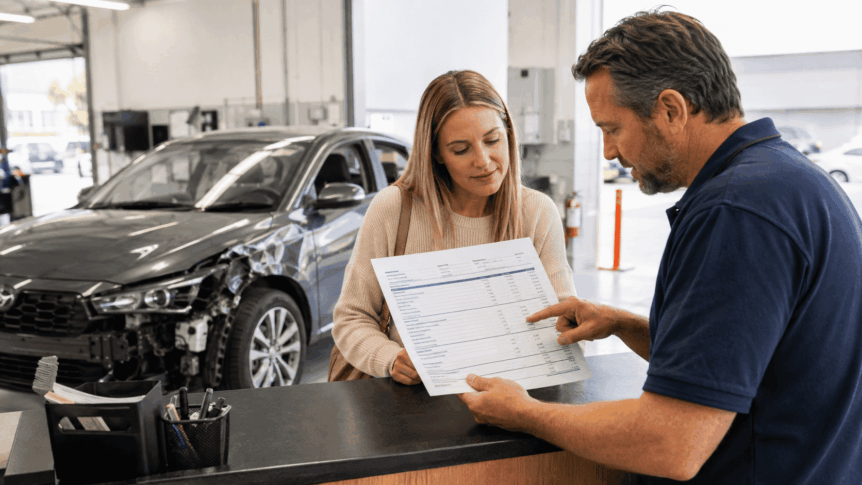
Breakdown of a smash repair quote showing parts, labour, paint and sublet costs

The Comparison That Actually Matters

The quote total on its own doesn’t tell you much. What matters is how that figure compares to what the car was worth in its pre-damage condition. Insurers use roughly this ratio to decide whether to declare a write-off, and it’s a useful test even when there’s no insurance claim involved.

A rough way to think about it: if the repair cost is approaching — or past — what the car would sell for in good condition, you’re paying to restore something that still won’t be worth what you spent. On top of that, a repaired car carries an accident history from then on, and that usually makes it worth less on resale than an equivalent car with a clean record.

What decides the car’s actual value

  • Age and odometer reading
  • Make and model, and how much demand there is for it right now
  • Service history and mechanical condition before the damage
  • Whether it’s licensed (registered), and how much time is left on it
  • Condition of tyres, interior, and anything else a buyer would notice

It helps to get an honest sense of this figure before you look at the repair quote again, rather than after. It’s easy to anchor on the number the repairer gives you and lose sight of what the car is genuinely worth.

Signs the Quote Is Telling You to Sell, Not Repair

A few things in a quote — or in the assessment behind it — usually point toward selling rather than repairing:

  • Structural or chassis damage. Repairs involving the frame, chassis rails, or structural pillars are expensive, and depending on severity they can affect how the car handles or protects you in a future crash even after a proper repair.
  • The quote is a large share of the car’s value. There’s no fixed percentage, but the closer the repair cost gets to what the car is worth, the harder it is to justify.
  • Hidden damage turns up mid-repair. It’s common for a repairer to find more once panels come off — bent mounts, damaged wiring, a cracked rail. Ask whether the quote you’re holding is final or provisional.
  • Flood or fire damage. Even when the outside looks fixable, water and heat affect wiring, electronics, and corrosion protection in ways that keep causing faults long after the visible repair is done.
  • You’ve already spent money on this car. A run of repairs is worth factoring in — the smash might be the trigger, but it’s not always the only problem.

Selling an Unrepaired Car in WA: What’s Involved

If the numbers point toward selling — and especially if the accident only happened recently — there are a few WA-specific steps worth knowing before you hand the car over.

  • Lodge a notification of change of ownership. When you dispose of a vehicle in WA, you complete the Notification of Change of Ownership (form MR9) with the buyer and lodge the seller’s copy with the Department of Transport within seven days. Missing that window can attract a $100 infringement.
  • Deal with the plates. Standard WA number plates don’t automatically stay yours. If you want to keep them, remove them before the sale and ask the Department of Transport for replacements; otherwise the buyer is issued new plates.
  • Have your ID and ownership details ready. The transfer paperwork asks both parties to confirm their identity, so sort proof of ownership and identification before pickup.

Selling an unrepaired car in WA: number plates, notification of change of ownership and ID

Getting a Second Opinion Before You Decide

If you’re not sure whether a repair is worth it, it costs nothing to compare. Ask the repairer for a written, itemised quote if you don’t already have one, get a rough sense of the car’s pre-damage value, and then see what selling it unrepaired would bring instead. Sometimes the repair genuinely stacks up. Other times the smarter move is to sell the car as-is and put the money toward something that isn’t starting out with a repair bill already attached.

Every vehicle is different, so the fairest way to find out what yours is worth is to give us a call — we’ll price it on the details and confirm it before pickup. For a straightforward, no-obligation figure on your car, ute, truck, van, or 4WD in any condition, call Cash for Cars Perth on 0420 262 651. We can talk through what the vehicle is likely worth and arrange free pickup right across the Perth metro area — from our Welshpool yard out to the outer suburbs — usually the same day.

Frequently Asked Questions

Can I get my own smash repair quote instead of using the insurer’s?

Yes. You’re entitled to get your own quotes, and it’s worth having at least one itemised written quote to compare against the insurer’s assessment. If you aren’t making a claim at all, the choice of repairer is entirely yours.

What’s the difference between a repairable write-off and a statutory write-off in WA?

A repairable write-off can be repaired and re-licensed once it passes the required written-off vehicle inspection and meets repair standards. A statutory write-off has damage severe enough that it can never be re-licensed for road use in WA — it can only be used for parts or scrap. Either way, the classification is recorded permanently against the vehicle.

Should I go ahead with the repair if hidden damage is found partway through?

Ask for a revised quote before agreeing to any extra work. Damage found once panels are removed can push a borderline job well past the point where repairing makes financial sense, so it’s worth pausing to re-run the comparison.

Can I sell a car that’s partway through being repaired?

Yes, as long as you own it and it isn’t under finance. You’ll need the paperwork to transfer ownership, and it’s worth collecting any parts or paid-for items from the repairer first.

Can You Still Drive a Car After It's Been Written Off in WA

Can You Still Drive a Car After It’s Been Written Off in WA?

KobyBlog

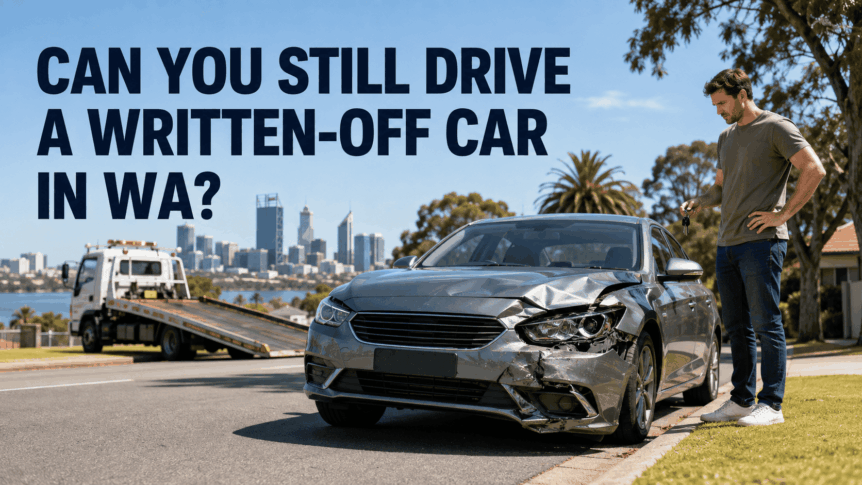
If your car has come back from the assessor marked “written off” due to an car accident, the first question is usually a practical one: can you still drive it? In Western Australia the answer is almost always no — at least not straight away. The moment a vehicle is added to the Written-Off Vehicle Register its licence is cancelled, and getting this wrong can mean fines and a voided insurance claim.

The short answer

No — not without a formal repair, inspection and re-licensing process first, and only if the car qualifies for it at all. WA sorts written-off vehicles into two categories, and only one of them has any legal path back onto the road.

Statutory write-off or repairable write-off?

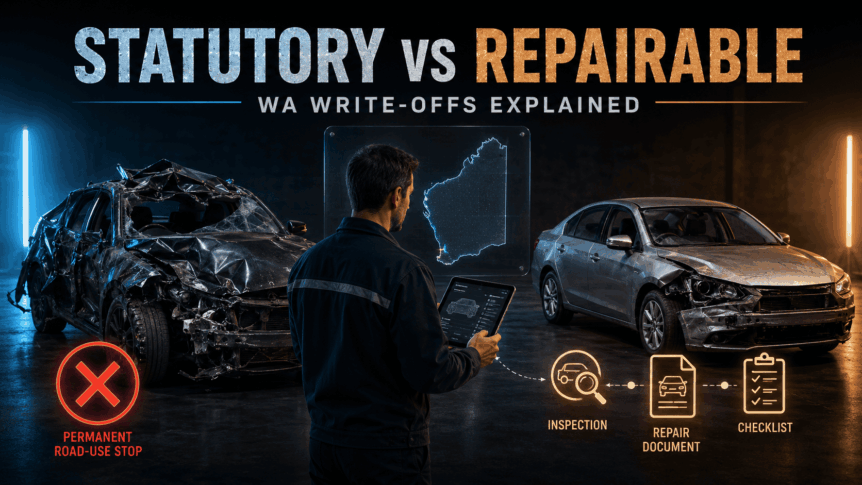
When an insurer or self-insurer reports a vehicle as written off, the Department of Transport records it on the Written-Off Vehicle Register (WOVR) as either a statutory write-off or a repairable write-off. That classification decides everything that follows. We’ve covered how the two categories differ in detail separately; here is what each one means for actually driving the car.

Statutory write-off

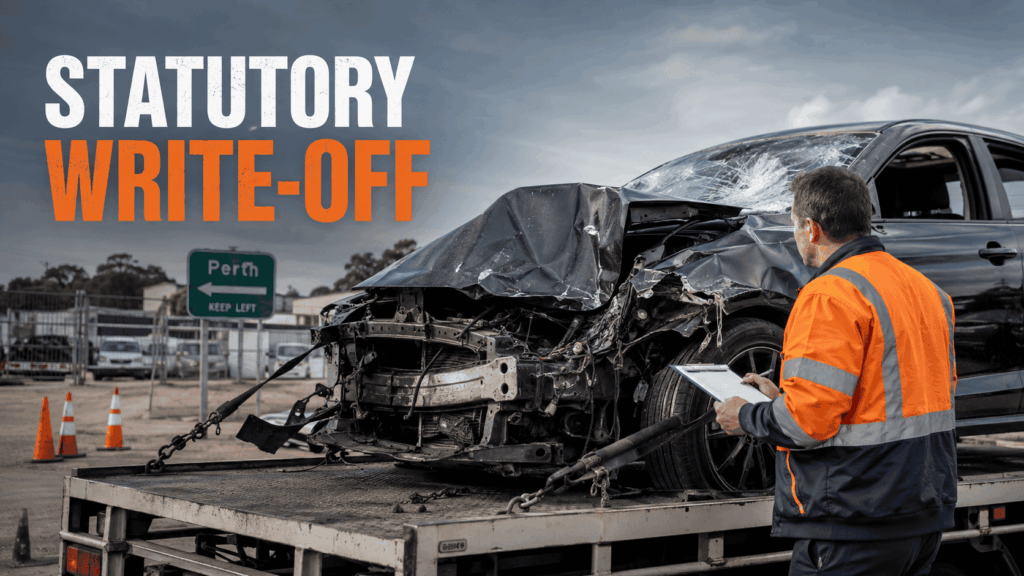
A statutory write-off is a vehicle damaged so severely it can never be made safe or roadworthy again. It can never be re-licensed or driven on the road again in WA, no matter what repairs are carried out. A written-off label is fixed to the car in a conspicuous position near the VIN, the vehicle’s identifier is defaced, and it is an offence to remove or deface that label. From that point a statutory write-off can only be sold under a statutory restriction that it be broken down for parts or scrap — nothing else.

Repairable write-off

A repairable write-off — sometimes just called a totalled car — is different. The damage didn’t meet the statutory threshold, so the car can, in principle, be repaired and re-licensed. The process is deliberately strict, though: the vehicle has to pass an inspection by an authorised written-off vehicle business before final trim, filler and paint go on, then an identity and roadworthy inspection at an Authorised Inspection Station once the work is finished. You need to keep every receipt for major parts and repairs, take photographs through the whole job, and supply airbag certification if the airbags were touched. Even after all of that and a successful re-licensing, the write-off history stays on the car’s record permanently and remains visible on the Personal Property Securities Register (PPSR).

Statutory write-off versus repairable write-off in WA

So can you drive it right now?

No. Once a vehicle is on the WOVR its registration is effectively cancelled, so neither category is legal to drive on a public road as things stand. A repairable write-off only becomes driveable again after it has been repaired, passed both inspections and been re-licensed with a fresh set of plates. Until then it stays off the road, and driving it risks fines and leaves you without valid insurance cover if anything happens.

Is it worth repairing a repairable write-off?

For a statutory write-off there is no decision to make. For a repairable write-off, the numbers often don’t work either. Between the two inspections, certified parts, airbag work and panel labour, many owners find the repair costs more than the car will be worth afterwards — and the permanent write-off record drags on resale value no matter how good the repair is. A few things decide what a written-off car is worth as it stands:

  • Make, model and age — parts for some vehicles stay in demand far longer than others.
  • How complete it is — a whole car with an intact chassis is worth more than a stripped shell.
  • Type of damage — front impact, fire, flood and mechanical failure each leave different parts salvageable.
  • Weight of recoverable metal — heavier vehicles return more, and a written-off truck such as a Kenworth carries real value in its driveline and steel.
  • Whether it still runs — not essential, but it can lift an offer.

What affects a written-off car's value in Perth

Selling a written-off car in WA: the paperwork

If you decide to move the car on rather than repair it, a few WA rules catch people out:

  • Notify the Department of Transport within 7 days of the sale that you are no longer the owner, and give the buyer’s name and address. Miss the deadline and a penalty applies.
  • Standard number plates stay with the vehicle in WA. If you have personalised or optional plates you want to keep, exchange them at a Department of Transport centre before the car is collected.
  • Photo ID is needed to complete the sale — it doesn’t have to be the registered owner’s, but someone has to produce one.

Selling it as it stands

Plenty of owners skip the repair route altogether and sell the car where it sits, statutory or repairable. Cash For Cars Perth is a licensed wrecking yard in Welshpool that buys written-off vehicles — along with accident-damaged, non-running and deregistered cars, utes, vans, trucks and 4WDs — as far south as Rockingham and right across the Perth metro area. Stolen cars and vehicles still under finance are the main things it can’t take.

If you would rather have the car gone than deal with inspections and paperwork, get in touch for a quote. Every vehicle is different, so the fairest way to find out what yours is worth is to give the team the details and let them price it before pickup.

Frequently asked questions

Can you drive a repairable write-off before it is repaired?

No. Its licence is cancelled as soon as it goes on the register and stays cancelled until the car has passed both required inspections and been formally re-licensed.

Can a statutory write-off ever go back on the road?

No. A statutory write-off can never be re-licensed or driven again in WA, regardless of repairs. It can only be used for parts or scrap metal.

How do I check whether a car is a written-off vehicle?

Run a paid search on the Personal Property Securities Register (PPSR) using the VIN. Any statutory or repairable write-off notification is recorded there permanently.

What inspections does a repairable write-off need?

Two: an inspection by an authorised written-off vehicle business before final paint and trim, then an identity and roadworthy inspection at an Authorised Inspection Station once repairs are finished.

Statutory Write-Off vs Repairable Write-Off in WA What's the Difference

Statutory Write-Off vs Repairable Write-Off in WA: What’s the Difference?

KobyBlog

If your insurer has declared your car a write-off after a crash, the next question is which kind. In Western Australia every written-off vehicle is recorded as either a statutory write-off or a repairable write-off, and the difference is not a technicality. One category can, in the right circumstances, be repaired and put back on the road. The other can never be registered again. Knowing which one applies to your car tells you whether repairing it is even legal, and who you are allowed to sell it to.

How WA classifies a written-off vehicle

When an insurer, self-insurer or licensed assessor decides a vehicle is a total loss, they must report it to the Department of Transport, which records it on the Written-Off Vehicle Register (WOVR). This applies to a motor vehicle, motorcycle, trailer or semi-trailer with a Maximum Rated Capacity of 4,500 kg or less that was manufactured within the last 15 years, measured to the date the damage happened. Older or heavier vehicles fall outside the scheme.

Once a car is on the WOVR its licence is cancelled. The registered owner is notified in writing, and the number plates have to be returned to the Department of Transport within 28 days. From that point the classification, statutory or repairable, decides what can happen next.

Statutory write-off

A statutory write-off is a vehicle damaged so badly it can never be made safe or roadworthy again. This is not a judgement about cost. It is a classification triggered by the nature and extent of the damage, and it is permanent: a statutory write-off can never be re-licensed or driven on a public road again in WA, no matter what repairs are carried out.

From that point the car may only be sold under a statutory restriction that limits it to parts or scrap through a licensed dismantler or wrecker. A written-off label is fixed to the vehicle in a conspicuous spot near the Vehicle Identification Number, the identifier itself is defaced, and it is an offence to remove or deface that label.

Repairable write-off

A repairable write-off is also a total loss, but for financial reasons rather than safety ones. It usually means the cost of repairs plus the salvage value adds up to more than the car was worth before the damage, while the damage itself stays below the statutory threshold. A car written off as a total loss on cost alone generally falls into this group.

These vehicles can be repaired and re-licensed, but the process is deliberately strict. The car must pass an inspection by an authorised written-off vehicle business before any final filler, trim or paint goes on, then an identity and roadworthy inspection at an Authorised Inspection Station once the work is finished. You need to keep receipts for all major parts and repairs, photograph the work as it goes, and provide airbag certification if the airbags were replaced. Even after a successful re-licensing, the write-off stays on the car’s history permanently and remains visible on a Personal Property Securities Register (PPSR) check. Our guide to whether you can still drive a written-off car covers what that means day to day.

How the classification is decided

The assessor is not just looking at panel damage. If the repair cost plus salvage value is higher than the car’s pre-accident market value, and the damage does not automatically qualify as statutory, the vehicle is recorded as repairable. Some damage forces a statutory classification on its own, regardless of cost, including severe structural damage and serious fire or flood damage.

Deciding whether to sell a statutory or repairable write-off in WA

What it means when you sell

The classification on the record controls who can buy the car and what they can do with it.

  • Statutory write-offs can only go to a licensed dismantler or wrecker for parts and scrap. You cannot sell one to a private buyer as a car they intend to register, because that is not legally possible.
  • Repairable write-offs have more options. A buyer with the time, skill and budget can repair and re-license the car, or you can sell it as it stands to a wrecker and skip the inspections and the parts hunting.

Either way, a buyer is entitled to know the car’s history. Anyone can check a vehicle’s write-off status with a PPSR search for a small fee, and being upfront about the classification avoids arguments later.

What a written-off car is worth

Two write-offs of the same make and model rarely fetch the same amount. The main factors are:

  • Extent of the damage and how much of the car is still usable.
  • Make, model and age — a popular model such as a Jeep or similar 4WD tends to have parts that stay in demand longer.
  • What is salvageable — an engine, gearbox and straight panels are worth far more than a stripped shell.
  • Scrap metal prices, which move up and down over time.

Every vehicle is different, so the fairest way to find out what yours is worth is to give a buyer the details and let them price it before pickup.

Paperwork for selling a written-off car in Perth, WA

Paperwork when you sell in WA

A few WA rules catch sellers out, whether the car is a statutory or repairable write-off:

  • Notify the Department of Transport within 7 days that you are no longer the owner, and give the buyer’s name and address. Miss the deadline and a $100 infringement can apply.
  • Standard number plates stay with the vehicle. Only personalised or optional plates can be kept, and you have to exchange them at a Department of Transport centre for ordinary plates before the car is collected.
  • Photo ID is needed to complete the sale. It does not have to be the registered owner’s, but someone has to produce one.

If you would rather not take on the inspections and paperwork, a licensed wrecking yard can take the car where it sits, from Bedfordale to the coast and across the Perth metro area. Cash For Cars Perth buys both statutory and repairable write-offs on 0420 262 651.

Frequently asked questions

Can a statutory write-off ever go back on the road?

No. A statutory write-off can never be re-licensed or driven on a public road again in WA, regardless of what repairs are done. It can only be used for parts or scrap.

Can I repair a repairable write-off myself and re-register it?

Yes, in principle. The car has to pass an inspection by an authorised written-off vehicle business before final paint and trim, then an identity and roadworthy inspection at an Authorised Inspection Station. You also need to keep parts receipts, photos of the repair, and airbag certification where relevant.

Does the write-off stay on the car’s record after it is repaired?

Yes. The write-off history is permanent and shows on a PPSR check for the life of the vehicle, even after a repairable write-off has been re-licensed.

What happens to my number plates?

When the car is written off, the plates must be returned to the Department of Transport within 28 days. On a normal sale, standard plates stay with the vehicle; only personalised or optional plates can be retained, by exchanging them before the sale.
Insurance Write-Off vs Uninsured Damage: What It Means for Your Car’s Value

KobyBlog

If your car has been damaged – whether in a crash, an accident, a flood, a fire, or just years of wear – one of the first questions that comes up is whether it’s been through an insurance assessment or not. That single detail changes a lot about what happens next, including how much your car is worth and how straightforward it is to sell.

Here’s what the distinction actually means, and how it affects your options if you’re thinking about selling a damaged or unwanted vehicle in Perth.

Write-Off vs Uninsured Damage: What’s the Difference?

An insurance write-off happens when an insurer assesses a damaged vehicle and decides it isn’t worth repairing – usually because the cost of fixing it is close to, or more than, what the car is worth, or because the damage is severe enough to affect safety or structural integrity. Once a car is formally written off, that status is recorded against the vehicle, and it affects how the car can be registered and sold from that point on.

Uninsured damage is different. If you didn’t have comprehensive cover, or you chose not to make a claim, the car simply carries damage with no formal write-off assessment attached. It might be in exactly the same physical condition as a written-off car, but legally and administratively it’s treated differently.

Statutory vs Repairable Write-Offs

In WA, write-offs generally fall into two categories:

  • Statutory write-off – the damage is severe enough (structural, fire, flood, or similar) that the vehicle can never be registered again, even if it’s technically repairable.
  • Repairable write-off – the insurer has assessed it as uneconomical to fix, but the vehicle could potentially be repaired and re-registered after passing the required inspections.

If you’re not sure which category your car falls into, your insurer or the WA Department of Transport can confirm the status attached to your vehicle.

What Actually Determines Your Car’s Value

Whether your car has a write-off status or just undisclosed damage, a few things tend to matter most when it comes to what someone will pay for it:

  • Extent of the damage – cosmetic damage affects value far less than structural, mechanical, or fire and flood damage.
  • Whether it runs – a non-running vehicle is still worth something for parts and scrap metal, just less than a running one.
  • Make and model – some vehicles hold parts value better than others, regardless of condition.
  • Completeness – a car missing its engine, transmission, or other major components is worth less than one that’s intact.
  • Write-off status itself – a statutory write-off can never be re-registered, so its value is essentially for parts and scrap rather than as a driveable car.

Neither an insurance write-off nor uninsured damage automatically means a car is worthless. Even vehicles that will never be driven again usually have value in their metal, parts, and components – which is exactly what a licensed wrecking yard is set up to recover.

Selling a Written-Off or Damaged Car in WA

A few WA-specific rules are worth knowing before you sell:

Number Plates Stay With You

In Western Australia, number plates are assigned to the owner, not the vehicle. When you sell your car, the plates stay with you – they don’t transfer with the sale.

Lodge a Notification of Disposal

After selling, you’re required to lodge a Notification of Disposal with the WA Department of Transport. This officially removes the vehicle from your name and protects you from any liability connected to it after the sale.

What You’ll Need

To sell your car, you’ll need valid photo ID. You don’t have to be the registered owner listed on the paperwork, but you do need to be able to prove who you are.

What Cash For Cars Perth Can and Can’t Buy

We buy cars, utes, trucks, vans, and 4WDs of any make or condition – running or not, accident-damaged, flood or fire-damaged, deregistered, or written off (statutory or repairable). We pay up to $9,999 depending on the vehicle.

There are a few things we can’t purchase: stolen vehicles, cars still under finance, and vehicle bodies without a chassis. If you’re unsure whether your situation fits, it’s easiest to just give us a call and describe the vehicle.

How the Process Works

We operate a licensed wrecking yard at 5 Hantke Place, Welshpool, where vehicles are dismantled and recycled properly. Once we’ve given you a quote over the phone, we can usually arrange free same-day towing – often within two to three hours if you call before midday. Payment is made in cash or by instant OSKO bank transfer, before the car leaves your property, so there’s no waiting around for funds to clear.

We cover the entire Perth metro area, though we don’t service Bunbury or areas further south.

Get a Quote

Whether your car is a statutory write-off, a repairable write-off, or just carrying damage you never made a claim on, it’s worth finding out what it’s actually worth before you decide what to do with it. Call 0420 262 651 for a free quote, or get in touch to arrange same-day pickup. We’re open Monday to Saturday, 7:30 AM to 6:00 PM.

What to Do in the First 24 Hours After a Car Accident in Perth

What to Do in the First 24 Hours After a Car Accident in Perth

KobyBlog

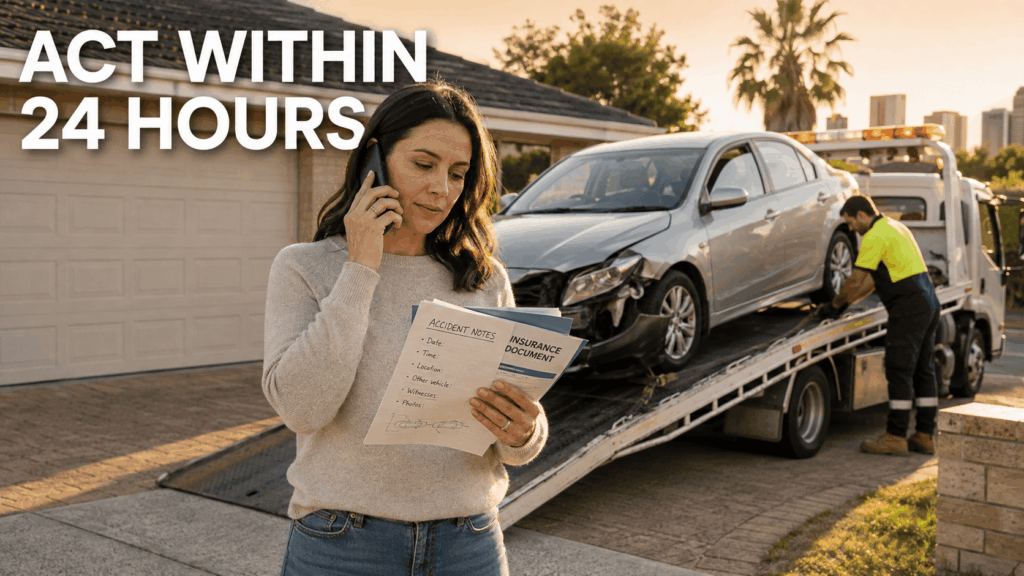
The hour or two after a car accident is when clear thinking is hardest and the decisions carry the most weight. What you photograph, who you call and where the car ends up all shape how the insurance claim and any later sale play out. Here’s a practical order of events for the first day, before you get anywhere near the “repair or sell” question.

Right After the Crash: Safety First

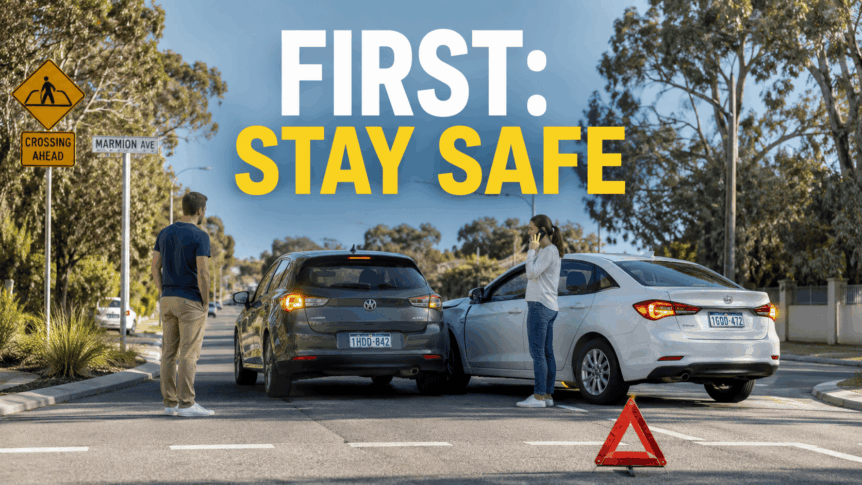
If it’s safe to do so, move the vehicles out of the traffic lane and switch on your hazard lights. Check yourself and everyone else involved for injuries before you give the car a second thought.

Call 000 straight away if:

  • Anyone is hurt
  • A vehicle is blocking traffic and can’t be moved
  • There’s a fuel leak or any risk of fire

Even in a minor knock, stay calm and don’t argue about fault at the scene. Working out who was responsible is what insurers, and if it comes to it police reports, are for.

Exchanging Details and Documenting the Scene

Once everyone is safe, swap the following with the other driver:

  • Full name and phone number
  • Vehicle registration number
  • Insurer, if they know it

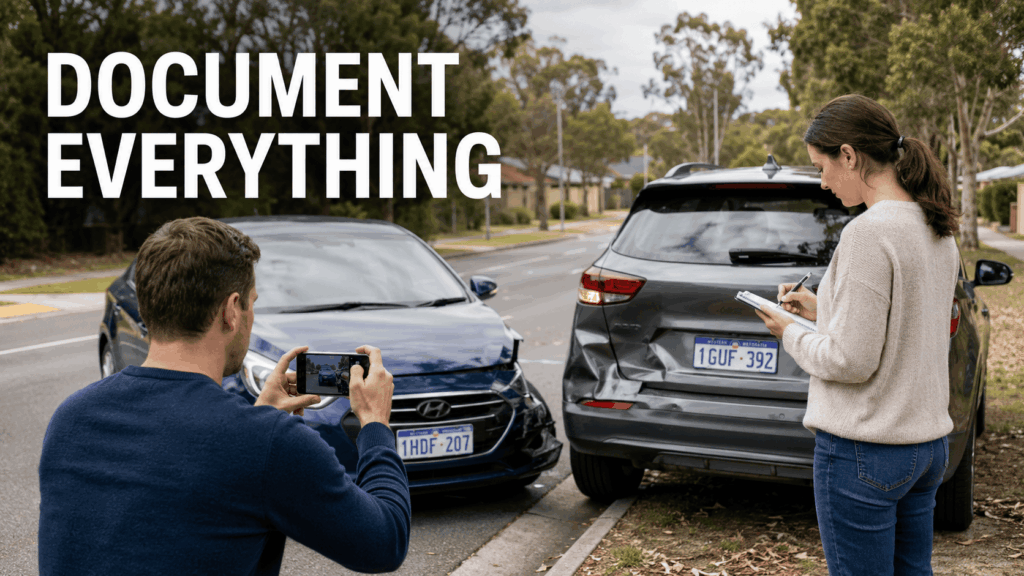
Then photograph everything while it’s in front of you: the damage to both cars, their position on the road, skid marks, and any signs or signals nearby. If anyone saw what happened, ask for their number too. Those photos do real work later, both for your claim and for getting an accurate read on the car’s value if you end up selling it as it stands.

When You Need to Report the Crash to Police

In Western Australia you must report a crash to police if someone is injured, if the total damage to all vehicles and property involved comes to more than $3,000, or if the other party or a damaged-property owner isn’t there to take your details. When you’re not sure, report it anyway. You can lodge it through the WA Police online crash reporting facility rather than waiting on the phone.

Two drivers exchanging details and photographing the damage after a car accident in Perth

Contacting Your Insurer

Tell your insurer as soon as you reasonably can, ideally the same day. They’ll want the details and photos you’ve already gathered, and they’ll tell you whether the car has to be seen by an assessor or an approved repairer before it’s moved. If the car isn’t drivable, don’t assume the towing is on you: check what your policy covers first, because some insurers arrange it directly.

What Happens to the Car Next

After it’s assessed, the repairer or insurer will class the car as either repairable or a write-off. Several things feed into that decision, and into what the car is worth if you’d rather sell it than fix it:

  • Age and odometer reading
  • How much of the damage is structural rather than cosmetic
  • Cost and availability of parts for that make and model
  • Whether the airbags went off
  • The general condition of the car before the crash

Parts supply swings this more than people expect. For a discontinued make like Holden, a single hard-to-source panel or module can push a borderline repair over the line into write-off territory. Even so, a car doesn’t have to be a total write-off to be worth more sold than repaired, and what a damaged car is actually worth tends to come down to the same list above.

An accident-damaged car being assessed as repairable or a write-off

If You Sell Instead of Repairing: the WA Paperwork

Two things catch WA sellers out. First, standard WA number plates stay with the vehicle, not with you, so there’s nothing to unscrew before handover; only personalised or optional plates can be kept, and that has to be arranged by exchanging them at a Department of Transport centre before the sale. Second, once the car is sold you have seven days to tell the Department of Transport that you’ve ceased to be the owner and to give the buyer’s name and address. Leave that undone and any later fines or infringements can still find their way back to you.
Weighing Up Repair vs Sell

If the repair estimate is near or above what the car is worth, or you simply don’t want to be without a car for weeks, selling it in its current state is usually the practical call. Before deciding, it’s worth reading the repair quote closely to see how much of it is genuine structural work and how much is replaceable panels and trim.

Access matters as well. A damaged car that can’t be driven needs a tow, and most car removal buyers build that into their offer and collect from wherever the car is sitting. A local operator working from a Welshpool base, for instance, can usually reach a car anywhere in the Perth metro area the same day.

If selling turns out to make more sense, we buy cars, utes, vans, 4WDs and trucks across Perth in any condition, accident-damaged or already written off, and cover the towing. Call 0420 262 651 and we’ll talk you through what happens next. Our phones are open Monday to Friday 7:30 am to 5 pm and Saturday 7:30 am to 2 pm.

Common Questions

Do I have to call the police after a minor crash in Perth?

Only when someone is injured, when the total damage across everyone involved is more than $3,000, or when the other driver or a property owner isn’t there to take your details. Below that, reporting is optional, though it’s still worth doing through the WA Police online crash reporting facility if fault is likely to be disputed.

Can I sell my car before the insurer has assessed it?

If you’re making a claim, let the insurer finish its assessment first; the policy usually requires it and the car may need to stay where it is. If you’re not claiming, you can sell whenever you like.

Who pays for towing an accident-damaged car?

Check your insurance first, since many policies cover towing after a crash. If you’re selling to a car removal buyer instead, the tow is normally included in the offer at no extra cost.

What’s the one piece of paperwork I can’t skip?

Telling the Department of Transport within seven days of the sale that you’ve ceased to be the owner, along with the buyer’s name and address. That’s what formally ends your responsibility for the car.