
What's Hiding in a Minor Accident

What’s Hiding in a “Minor” Accident: Hidden Damage That Costs Thousands

KobyBlog

A tap in a car park, a rear-ender at the lights, a scrape reversing out of a driveway — the damage often looks straightforward at first. Then the repair quote arrives and the number bears no resemblance to what you expected. If your car has been through a minor accident, here’s why putting it right can cost so much more than it looks, and how to tell when the repair is no longer worth it.

Why a small dent rarely tells the whole story

Modern cars are built to absorb impact in specific, engineered ways. Bumpers, crumple zones and mounting brackets are designed to flex or crush so the force of a collision doesn’t reach the cabin. That’s good for safety, but it also means damage often travels further into the vehicle than anything you can see from the outside — even in a knock that looks like a light scuff.

A repairer assessing the car properly has to look past the dented panel and check what sits behind and beneath it: brackets, wiring looms, the radiator support, and in some cases the chassis or subframe itself.

What’s commonly hiding under the surface

Structural and chassis damage

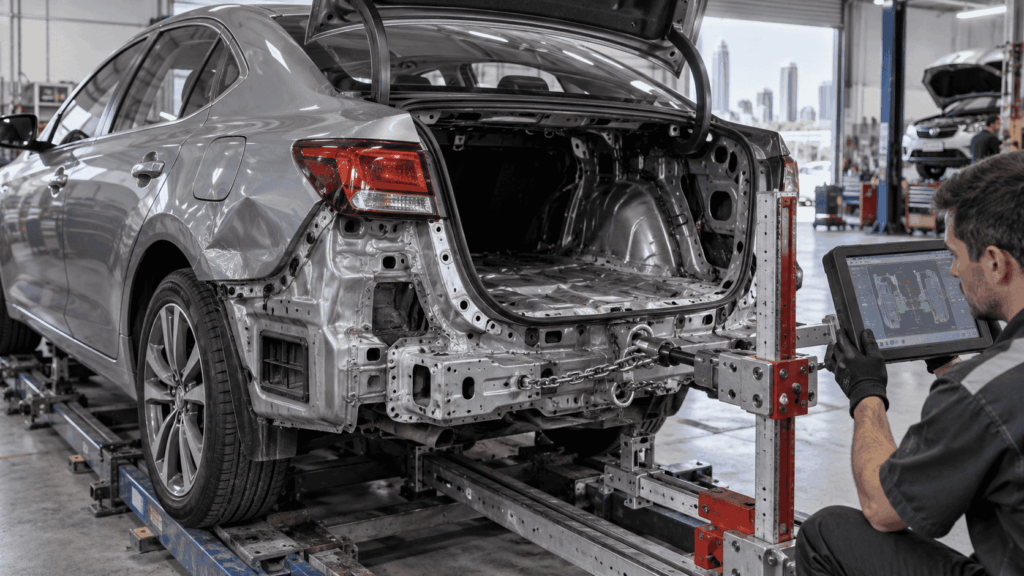
Even a low-speed impact can push a chassis rail or subframe out of alignment by a few millimetres. That’s often enough to affect wheel alignment, tyre wear and the way the car tracks down the road, and it usually can’t be spotted without putting the car on a hoist or running a proper alignment check. Significant structural damage also has to be repaired and signed off before the car can safely go back on the road.

Sensors and electronics

Late-model cars carry a growing number of sensors behind the bumpers and around the cabin — parking sensors, radar for adaptive cruise control, cameras for lane-keep assist. A bumper pushed in even slightly can knock these out of calibration or damage the connectors feeding them. Recalibrating the safety systems on a late-model Kia or a European car after a repair takes specialised equipment, and it’s a cost most owners don’t see coming.

Mechanical and cooling system damage

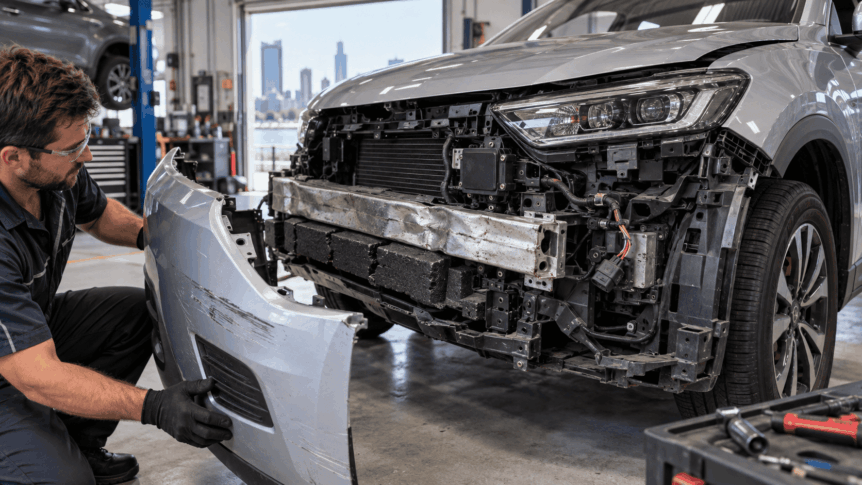
Front-end knocks are notorious for this. The radiator, air-conditioning condenser and the coolant and intercooler lines are often stacked directly behind the bumper. A hit that barely marks the paint can still crack a radiator or split a hose, and the car may drive normally for days or weeks before it starts to overheat.

Paint matching and panel blending

On a car with any age or sun fading, matching fresh paint to the surrounding panels usually means blending into the adjacent panels too, not just spraying the one that was damaged. That widens the job and the labour hours attached to it.
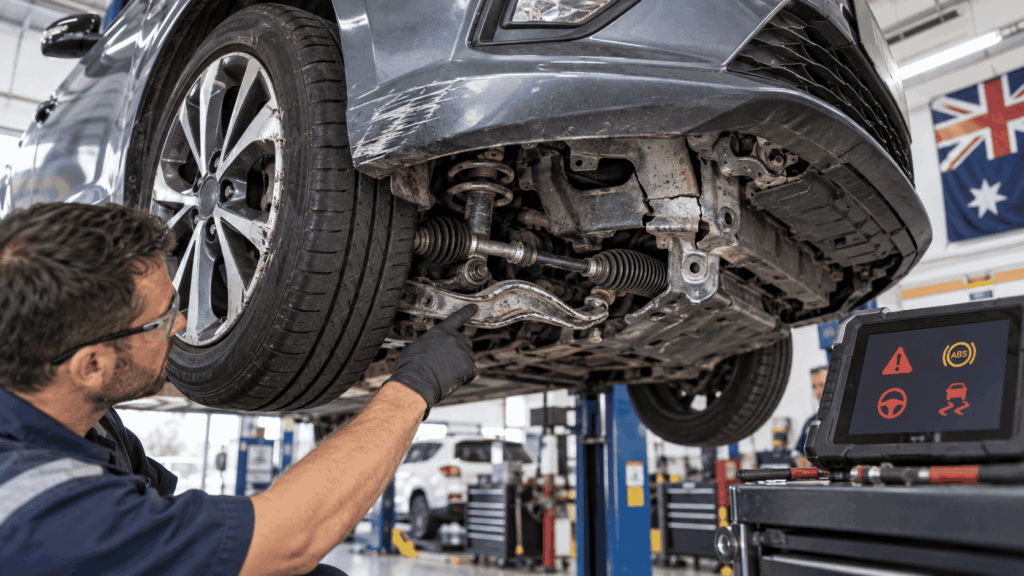
Radiator, sensors and brackets hidden behind a car bumper that has been damaged in a minor collision

Why the quote keeps growing once the repairer looks closer

Most quotes start as an estimate based on what’s visible. Once the panel comes off and the repairer can see the mounting points, wiring and structural members underneath, the scope of the work tends to grow rather than shrink. Genuine parts for newer vehicles can be back-ordered or expensive, labour rates reflect specialised skills like recalibration, and any rust or earlier repairs uncovered along the way get added to the bill too.

For an older car, this is often the point where the sums stop adding up. Once the repair bill approaches what the car would be worth fixed, owners are really weighing up whether repairing or replacing the car is the smarter move.

Signs it might be time to sell rather than repair

  • The repair quote is close to, or more than, the car’s market value
  • There’s chassis, subframe or other structural damage
  • The car has already been written off by an insurer
  • Parts are hard to source, or the wait stretches into months
  • You were already planning to replace the car anyway

Selling a damaged car in WA — what to check first

If you decide to sell rather than repair, a few WA-specific details are worth knowing before the car leaves your driveway.

  • Standard plates normally stay with the car. In WA, general-issue state or district plates stay on the vehicle and pass to the new owner. If you want to keep them, you have to remove them before the sale and arrange replacement plates through the Department of Transport. If the car is going to a licensed wrecker as a write-off, its licence is cancelled once it’s recorded as written off, so it’s common to take the plates off and hand them back at a DoT centre — any unused licence fee may be refunded.
  • You need to notify the change of ownership. After you sell, lodge a Notification of Change of Ownership – Vehicle Licence Transfer (MR9) with the Department of Transport within 7 days, recording the buyer’s name and address. Failure to do so will result in a penalty being applied.
  • Have photo ID on hand. Whoever hands the car over needs valid photo identification at collection. It doesn’t have to be the registered owner, but someone with ID needs to be there.

Most buyers also won’t take a car that’s stolen, still under finance, or stripped back to a shell with no chassis, so it’s worth checking where you stand on all three before ringing around.
Checklist for selling an accident-damaged car in WA, covering number plates, change-of-ownership notification and photo ID

Frequently asked questions

Can I keep driving a car with hidden accident damage?

If the car drives and stops normally it may seem fine, but hidden structural or cooling damage can worsen with use — a cracked radiator that leads to overheating, or an alignment problem that wears tyres unevenly. Have it inspected before you rely on it for anything more than a short trip.

Will my insurer pay for damage found after the repair starts?

Often yes, if it relates to the same accident. Reputable repairers lodge a supplementary claim when they uncover extra damage once the panel is off, and your insurer may send an assessor back to inspect it. Damage unrelated to the accident, or pre-existing wear and rust, generally isn’t covered.

How do I know if the damage is structural?

You usually can’t tell by eye. A repairer will put the car on a hoist and measure key points against the manufacturer’s specifications, or run a chassis alignment check. Uneven panel gaps, doors that don’t shut cleanly, or the car pulling to one side after a knock are all reasons to get it measured.

Do I need a roadworthy certificate to sell a damaged car in WA?

Not to sell it to a licensed wrecker or car removal service. A roadworthy or inspection matters when a vehicle is being re-licensed or transferred for road use, not when it’s being sold for dismantling or repair.

Is a repairable write-off worth buying back and fixing?

Sometimes, but it has to pass the required write-off inspections before it can be licensed again, and the write-off stays on the car’s history permanently, which affects resale. Get the full inspection and repair cost in writing before deciding.

The bottom line

A minor accident is rarely as minor as the first look suggests, and the only way to know what you’re dealing with is a proper inspection that checks behind the panels. Once you have a repair figure, compare it honestly against what the car is worth and what you were planning to do with it anyway.

If the numbers point to selling, Cash for Cars Perth buys accident-damaged and written-off cars in any condition and dismantles them at its licensed yard in Welshpool. For a quote based on your car’s details, call 0420 262 651.
5 Signs Your Crashed Car Isn't Worth Fixing

5 Signs Your Crashed Car Isn’t Worth Fixing

KobyBlog

A crash doesn’t always total a car in the way people expect. Sometimes the damage looks alarming but the repair is straightforward. Other times a minor-looking knock turns into a repair quote that makes no financial sense at all. Working out which situation you’re in — before you commit to fixing the car — can save you weeks of back-and-forth with a panel beater and money you won’t get back.

If you’re a Perth car owner staring down a repair estimate right now, here are five signs worth paying attention to, along with what actually drives the value of an accident-damaged car and what your options look like if you decide fixing it isn’t worth it.

1. The repair quote is close to (or higher than) the car’s value

This is the most common reason a car gets written off, and it’s the simplest thing to check yourself. Get a repair quote, then work out what the car would realistically sell for in its pre-accident condition — not what you paid for it, not what you feel it’s worth, but what a buyer would actually hand over. If the quote comes in above roughly 60–70% of that figure, most insurers will write the car off as uneconomical to repair. If your insurer doesn’t, it’s still worth asking yourself the same question they would.

Why this matters more on older cars

A newer car can absorb a big repair bill and still be worth fixing, because there’s plenty of market value underneath it. An older car with the same dollar amount of damage often isn’t — there’s simply less value left to recover, so the repair eats most or all of what the car is worth.

Comparing a smash repair quote against a car’s market value to decide whether it is worth fixing

2. The damage reaches the chassis or structural frame

Panel damage is largely cosmetic. Chassis or structural damage is a different problem. Once the frame is bent, twisted or cracked, the repair isn’t about panels and paint any more — it’s about realigning the structure that the suspension, steering and safety systems all bolt to. That work is expensive and slow, and even when it’s done properly, some buyers and insurers treat the car differently for the rest of its life once a structural repair is on its record.

3. Your insurer has already written it off

If your insurer has assessed the car and declared it a total loss, that’s a strong signal on its own — the call is made on repair cost versus market value, not sentiment. In WA, a written-off vehicle is recorded as either repairable or statutory (non-repairable), and that classification decides what you’re allowed to do with the car afterwards: a statutory write-off can never be registered again, while a repairable write-off can be, but only after specific inspections. Either way, once that call is made the practical question becomes how to sell the car as-is rather than whether to fix it.

4. Parts are hard to source, or prices have jumped

Some models — older ones, grey imports, low-volume variants — have parts supply that thins out over time. If your panel beater is quoting weeks of delay waiting on a part, or pricing panels and components well above what you’d expect, that adds real cost and time on top of the base repair. It also helps to know how to read the repair quote itself, so you can see which line items are driving the total and whether the shop has quoted new, used or aftermarket parts.

5. You’ve lost confidence in the car’s safety

This one isn’t financial, but it counts. If you’re hesitant to put your kids in the car, or you’re not convinced the repair fully addressed what happened in the crash, that hesitation is worth listening to. A car you don’t trust isn’t doing its main job, whatever the numbers say.

What actually affects a damaged car’s value

Once you’ve decided fixing isn’t the right move, it helps to understand what a damaged car is actually worth to a buyer. A common, high-volume make — a Subaru, for instance — with a strong local parts following will usually draw more interest damaged than a rare model that no one stocks parts for. Beyond the badge, these are the things that move the figure:

  • Make and model demand — some vehicles hold parts and resale value far better than others, even damaged.
  • Extent and location of the damage — a hit to the rear with a healthy engine and gearbox is worth more than the same damage that’s taken out the drivetrain.
  • Whether it still runs and drives — a running car is generally worth more than one that has to be towed, though non-runners are still bought and sold every day.
  • Completeness — missing parts, a stripped interior or a body with no chassis all pull the value down, and some buyers won’t take a chassis-less body at all.
  • Scrap and parts market conditions — metal and used-parts prices move around, so it’s worth getting a current quote rather than relying on a figure from a year ago.

What to expect if you sell an unrepairable car in Perth

If the checklist points toward selling rather than repairing, the process for a damaged or written-off car in Perth is usually simpler than people expect. A removal service will ask a few questions about the make, model and extent of the damage, give you a price over the phone, and — if you accept — arrange to tow the car away, often the same day. Payment is normally made on collection.

This covers running and non-running cars, accident damage, flood and fire damage, deregistered cars and write-offs. It generally doesn’t cover stolen vehicles, cars still under finance, or a body with no chassis — those need to be sorted out before a sale can go ahead.

Selling an unrepairable accident-damaged car to a Perth car removal service

A few WA rules to sort out first

Before the car leaves, two WA rules are worth knowing so there are no surprises:

  • Number plates. Standard WA plates normally stay with the vehicle when it’s sold. If you want to keep yours, you have to remove them before the sale and arrange replacement plates through the Department of Transport. If the car is a write-off headed for a wrecker, take the plates off before pickup and return them to a Department of Transport centre — any unused portion of the licence fee may be refunded.
  • Change of ownership. Once you’ve handed the car over, lodge a notification of change of ownership with the Department of Transport within seven days, recording the buyer’s name and address. The Department’s guidance puts it plainly: “Failure to do so will result in a penalty being applied.”

You’ll also need valid photo ID to complete the sale. It doesn’t have to be the registered owner’s ID, but whoever is selling the car has to be able to produce one.

The bottom line

Any one of these signs is a reason to pause; two or more together usually means the car isn’t worth fixing. If you’ve worked through them and repairing doesn’t stack up, Cash For Cars Perth buys accident-damaged, written-off and non-running vehicles across Thornlie and the wider Perth metro area. Every car is different, so the fairest way to find out what yours is worth is to call the team on 0420 262 651 and get a price on the details.

Frequently asked questions

How do I know if my car is a write-off?

Compare the repair quote with what the car would sell for in good condition. If the repair is more than about 60–70% of that value, an insurer will usually write it off, and it’s a fair rule of thumb even if you’re not claiming. An insurer’s total-loss assessment is the clearest confirmation you’ll get.

Is a car with structural damage ever worth repairing?

Sometimes, but the bar is high. Structural repairs are costly and slow, they need specialist equipment to get right, and the car carries the repair on its history afterwards, which affects resale. On an older or mid-value car, structural damage usually tips it past the point of being worth fixing.

Can I sell a car the insurer has written off?

Yes. Once the insurer has settled the total loss, the payout is yours, and so is the wreck if you chose to retain it. A repairable or statutory write-off can be sold to a wrecker or removal service as-is — the write-off classification stays on the vehicle’s record and passes to the next owner.

Do the number plates stay with a written-off car when I sell it?

Standard WA plates normally stay with a vehicle, but a write-off is the exception: the licence is cancelled once the car is recorded as written off, so there’s nothing to transfer. Take the plates off before pickup and return them to a Department of Transport centre. A personalised or custom plate needs a separate transfer or retention request.

What is a crashed car worth if it’s not worth fixing?

It depends on the make and model, how bad the damage is, whether it still runs, and current scrap and parts prices. A late-model car with rear-end damage and a good drivetrain can still be worth a reasonable amount; a stripped or structurally damaged older car much less. Get a current quote rather than working from an old figure.

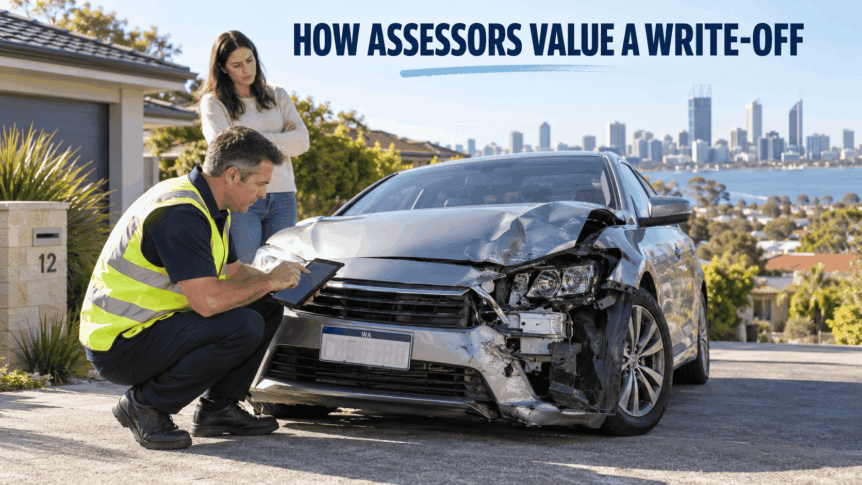
How Insurance Assessors Value a Written-Off Car in WA

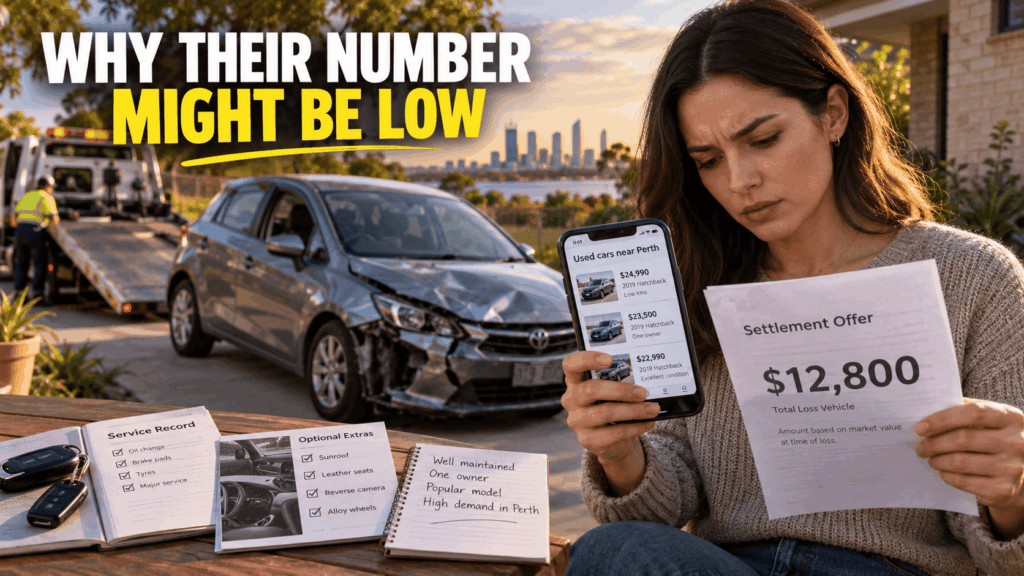
How Insurance Assessors Value a Written-Off Car in WA (And Why Their Number Might Be Low)

KobyBlog

If your car has been written off after an accident in Perth, the number your insurer puts on it can feel like it came out of nowhere. Knowing how the figure is built – and where it tends to fall short – makes it easier to decide whether to accept the payout, negotiate, or look at what an accident-damaged car is actually worth to a buyer instead.

How insurance assessors calculate your payout

When a car is written off, most WA insurers settle on either an agreed value or a market value basis, depending on the policy you hold. The two produce very different numbers, so it is worth checking your policy schedule first.

Agreed value

If you nominated an agreed value when you took out the policy, that is generally what you are paid, regardless of what the car would sell for at the time of the claim. The figure is locked in when the policy is written or renewed, so it can sit above or below the current market. Agreed value is more common on newer, modified, or higher-value vehicles.

Market value

Most everyday comprehensive policies use market value. The assessor estimates what your car would have sold for, second-hand, in the Perth market, the day before the accident. To land on that figure they usually look at:

  • Comparable listings and recent sales for the same make, model, year, and variant
  • Odometer reading and overall condition
  • Service history, where you can produce it
  • Modifications and aftermarket parts, which are often valued separately or not counted at all
  • Industry valuation guides such as Redbook or Glass’s Guide

From that market value the insurer then deducts any excess, and if you keep the wreck rather than hand it over, it also subtracts what it reckons the salvage is worth.

How a WA insurer builds a written-off car payout: market value minus excess and salvage

Why the assessor’s number often feels low

There are a few predictable reasons a settlement offer can undershoot what you believe the car was worth:

  • Valuation guides lag the market. They are refreshed periodically rather than in real time, so a model that has climbed in demand over the past year can still be priced on older data.
  • Comparable sales are chosen conservatively. Assessors tend to work off the middle of the range rather than the top asking prices, and private-sale ads are not always weighted the same as dealer listings.
  • Recent spending is not automatically counted. New tyres, a fresh battery, a recent service – none of it lifts the offer unless you produce the receipts and ask for it to be reconsidered.
  • Salvage is deducted up front. If you keep the car, the insurer reduces the payout by what it estimates a salvage buyer would pay for the wreck, and that estimate is rarely generous.

You are generally entitled to challenge a market value assessment. Gather comparable ads for the same car, get a written valuation if the amount justifies the cost, and put your case in writing. The insurer does not have to accept your figure, but a reasoned case backed by evidence is often enough to move the offer.

What happens to the car after a total loss in WA

In Western Australia a written-off vehicle is recorded by the Department of Transport on the Written-Off Vehicles Register as either a statutory write-off – damage severe enough that it can never be made safe and roadworthy again – or a repairable write-off, which is a total loss on cost but can, in principle, be repaired and re-licensed after passing the required inspections. That call is made by the assessor, and the distinction between a statutory and a repairable write-off decides what the car can ever be used for again.

Once a vehicle is listed on the register its licence is cancelled, so a few things follow if you keep it rather than signing it over:

  • Standard WA number plates normally stay with a vehicle and pass to the next owner, but a write-off is the exception. With the licence cancelled there is nothing to transfer, so the plates should be removed and returned to a Department of Transport centre, where any unused portion of the registration may be refunded.
  • Personalised or custom plates are handled separately – you keep the right to them, but you need to lodge the relevant retention or transfer form with the Department of Transport.
  • If you sell or dispose of the car, notify the Department of Transport that you are no longer the owner within seven days, recording the buyer’s name and address on the change-of-ownership form (MR9). Failing to do so can result in a penalty.
  • A statutory write-off cannot be re-registered under any circumstances, which leaves wrecking or parting it out as the only real options.

Insurer payout versus cash from a wrecker

If the settlement leaves you holding the wreck – or the car was never insured, or the damage was not quite enough to claim on but still is not worth fixing – the alternative is selling it directly to a licensed wrecker.

A wrecker is not working from the same valuation guides as an insurer. The offer is built from what the car is worth broken down rather than driven away:

  • Usable parts still in demand: engine, gearbox, panels, lights, electronics, wheels
  • The weight and scrap-metal content of the shell once it is stripped
  • How complete the car is, and whether it has already been picked over
  • Make and model, because used-parts demand varies a lot between brands

That last point cuts both ways. Holden is the clearest example: with the brand gone from the local market, new panels are harder to source, which is part of why an insurer writes these cars off sooner, yet the same scarcity means a wrecker pays well for clean used parts. For many older or written-off cars sitting in a driveway, a wrecker’s figure is simpler to act on than chasing a top-up from the insurer – and for a statutory write-off, often the more realistic measure of what the car is worth now.
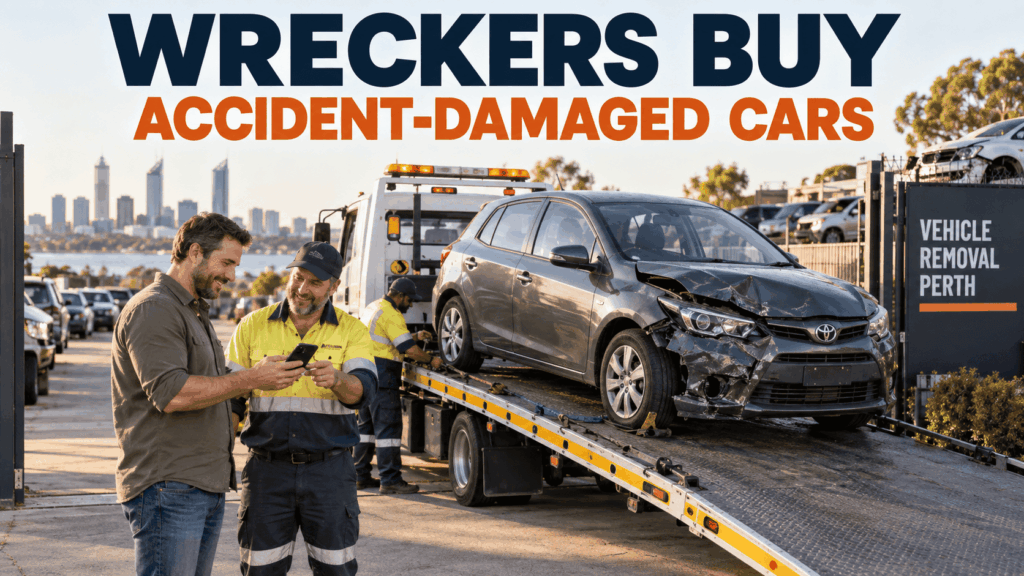
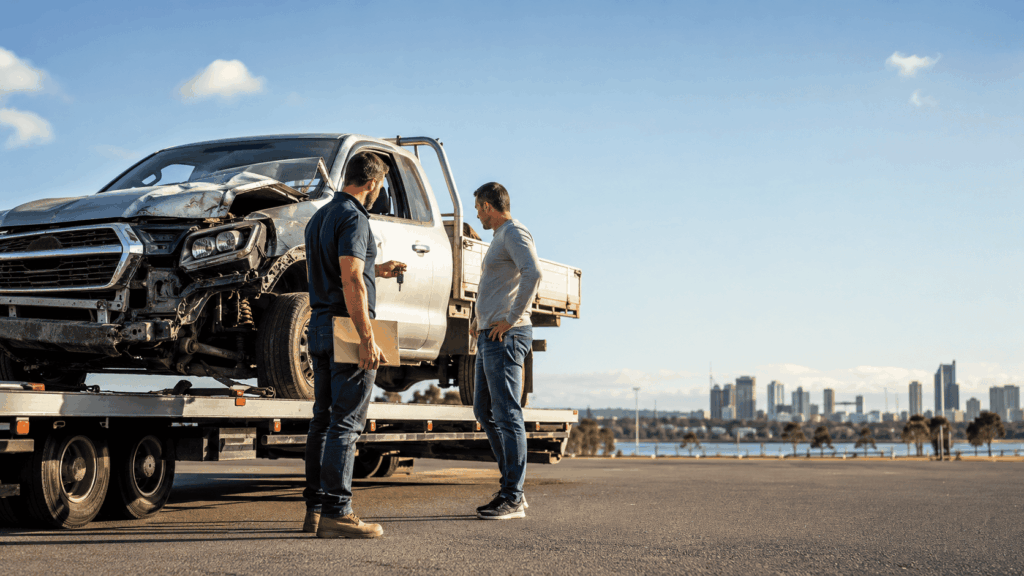
Comparing an insurer total-loss payout with a cash offer from a licensed Perth wrecker

What you need to sell a written-off or damaged car in WA

Selling a written-off car does not take much paperwork. Have photo ID ready – you do not have to be the registered owner, but the buyer needs to sight it to complete the sale – along with any registration papers or write-off documentation you still have, though a sale can usually proceed without them. Take the plates off before the car is collected and set them aside for the Department of Transport, and lodge the change-of-ownership notification once it is gone.

Weighing the payout against a cash offer

If the insurer’s figure still looks light once you have checked comparable sales and the excess and salvage deductions, it is worth getting a second number to compare rather than accepting the first offer by default. A wrecker prices the car on parts and scrap rather than a guide, so the two measure the same car in different ways.

Cash For Cars Perth buys written-off and accident-damaged cars across the Perth metro area, from Maddington through to the northern suburbs, and can give you a no-obligation figure to compare against the insurer’s offer – call 0420 262 651.
Frequently asked questions

How do insurers decide what a written-off car is worth in WA?

On an agreed-value policy the payout is the figure set when you took out or renewed the cover. On a market-value policy the assessor estimates what the car would have sold for second-hand in Perth just before the accident, using comparable listings, condition, service history and industry guides, then subtracts your excess and any salvage value if you keep the car.

Can I dispute the insurer’s valuation?

Yes. You can challenge a market-value assessment by supplying evidence – comparable advertisements for the same make, model and year, or a written valuation – that supports a higher figure. The insurer does not have to accept it, but a documented case often moves the offer.

What is the difference between a statutory and a repairable write-off?

A statutory write-off is too badly damaged to ever be made roadworthy again and can never be re-registered. A repairable write-off is a total loss on cost, but it can be repaired and re-licensed if it passes the inspections the Department of Transport requires. The assessor assigns the category.

Do the number plates stay with a written-off car when I sell it?

No. Standard plates normally stay with a vehicle, but a write-off has its licence cancelled, so there is nothing to transfer. Take the plates off and return them to a Department of Transport centre, where any unused registration may be refunded. Personalised plates are kept or transferred using a separate form.

Is a wrecker’s offer usually higher or lower than the insurer’s payout?

It depends on the car. A wrecker prices it on usable parts and scrap value rather than market value, so for a late-model car with a small agreed-value gap the insurer may pay more, while for an older car or a statutory write-off the wrecker’s figure is often closer to what the vehicle is actually worth. Getting both numbers is the only way to know.

Private Sale vs Wrecker Who Actually Buys a Car With Accident History

Private Sale vs Wrecker: Who Actually Buys a Car With Accident History?

KobyBlog

If your car has been in a crash, sat outside since a flood, or simply won’t start any more, you’ve probably weighed up whether to sell it privately or just call a wrecker. The honest answer depends on how bad the damage is — but for most accident-affected cars in Perth, a private sale turns out slower and less certain than owners expect, and the gap widens the worse the damage gets.

Why private buyers hesitate on damaged cars

Private buyers on Gumtree or Facebook Marketplace are usually after something they can drive away and register the same day, or at least a car with one clear, fixable fault. Accident history changes that calculation. Even when the damage looks purely cosmetic, buyers start asking the questions they can’t easily answer for themselves: was it written off, is the chassis straight, will it pass a roadworthy? A car with accident history sits in a smaller market from the moment it’s listed, and the buyers who stay interested tend to be cautious ones.

What puts private buyers off

  • Uncertainty about structural or safety damage they can’t see
  • The cost and paperwork of getting a written-off vehicle re-registered
  • Paying a mechanic or panel beater to inspect the car before they commit
  • Finance won’t be approved against a car with accident history, so the buyer pool narrows to people paying cash

None of this makes a damaged car unsellable privately. It just means fewer interested buyers, longer negotiations, and lower offers, because buyers price in their own uncertainty. Once a car is genuinely written off, deregistered, or fire or flood affected, most private buyers drop out completely — they can’t legally or practically put it back on the road.

Reasons private buyers avoid cars with accident history in Perth

Where a wrecker fits into the picture

A licensed wrecking yard isn’t buying the car to drive it. It’s buying it for parts, metal, or both, and that changes what matters. A wrecker doesn’t care whether the panels line up or whether the airbags have gone off. What counts is what’s recoverable — engine, gearbox, body panels, electronics and other parts with resale value — plus the scrap value of the shell.

That’s why a yard can put a firm number on a car that’s been sitting unsold online for weeks, including written-off and non-running cars a private buyer wouldn’t go near. A licensed Perth wrecking yard will quote on accident-damaged, flood or fire-damaged, deregistered and written-off vehicles — cars, utes, vans, trucks and 4WDs — anywhere across the metro area.

What a wrecker won’t buy

The list of what a yard can’t take is short:

  • Stolen vehicles
  • Cars still under finance
  • A body with no chassis

If your car falls into one of those, sort it out first — pay out the finance, for instance — before you approach any buyer, private or trade.

What actually affects the price a wrecker will pay

Two cars with similar accident history can still attract very different offers. A few practical things drive it, and it’s worth knowing what wreckers look for before you start negotiating.

  • Make and model — common cars with strong local demand for used parts are worth more
  • What survived — an engine or gearbox that came through the accident intact adds real value
  • Size and metal weight — utes and 4WDs scrap for more than a small hatchback
  • Completeness — a car stripped of major parts is worth less than one that’s whole but simply won’t run

Because those variables move the number so much, a yard quotes per car rather than off a price list. Every vehicle is different, so the fairest way to find out what yours is worth is to give a yard the details and let them price it on the day.

What a Perth wrecker looks at when pricing an accident-damaged car

The WA paperwork you still need to handle

Whether the car goes to a private buyer or a wrecking yard, a few WA rules apply once it changes hands.

  • Number plates. Standard WA plates stay with the vehicle and pass to the new owner unless you take them off before the car is collected and ask the Department of Transport for replacement plates. On a written-off car the registration is already cancelled, so remove the plates and hand them back — you may be owed a refund on the unused registration.
  • Notice of disposal. Lodge a notification of change of ownership (form MR9) with the Department of Transport within seven days of handing the car over, recording the buyer’s or yard’s name and address. The DoT’s guidance is blunt: “failure to do so will result in a penalty being applied.”
  • Photo ID. A licensed yard has to sight photo ID from whoever is selling the car. It doesn’t have to be the registered owner’s ID, but someone has to produce one.

Skipping the notice of disposal is the common mistake, and it can leave you on the hook for a car you no longer own — infringements and registration included. Do it the day the car leaves.

What to expect if you go with a wrecker

The wrecker route is usually faster, mostly because there’s no negotiation cycle and no waiting on a buyer to arrange finance or a pre-purchase inspection. Once you accept a quote, the yard arranges towing and pays on collection, and most Perth yards tow at no charge within the metro area.

Cash For Cars Perth works out of Welshpool, in Perth’s south-east, and covers the metro area from there — Cannington and the south-eastern suburbs are a short run down the highway, and the outer suburbs are a scheduled pickup. A licensed yard dismantles and recycles the car rather than putting it back on the road.

Which option makes sense for your car?

It comes down to condition and how much time you have. If the car still drives, the damage is cosmetic, and you’re not in a hurry, a private sale can get you a fair price — a late-model Land Rover with a straight chassis and a sound engine is worth advertising and waiting for the right buyer. If it’s written off, non-running, or has structural, fire or flood damage, a wrecker is the more realistic option and usually the quicker one. The closer your car is to that second description, the less a private listing is likely to achieve.

If you want to know what your car is worth as it stands, call Cash For Cars Perth on 0420 262 651 or ask for a quote online — it’s free, and there’s no obligation to accept.

Frequently asked questions

Can you sell a car with accident history privately in WA?

Yes. There’s no law against it, provided you disclose the history honestly. The practical catch is a smaller buyer pool and lower offers, because buyers can’t get finance against the car and are wary of damage they can’t see.

Will a wrecker buy a written-off car?

Yes. A licensed yard buys written-off, deregistered and non-running cars because it wants parts and metal, not a car to re-register. A statutory write-off that can never legally return to the road is still worth money dismantled.

Do I have to tell a private buyer the car was in an accident?

Yes. Knowingly hiding accident or write-off history from a private buyer can make the sale voidable and expose you to a misrepresentation claim. A wrecker doesn’t rely on that disclosure, but it’s still worth being upfront.

What happens to my number plates?

Standard WA plates stay with the car and transfer to the new owner unless you remove them before collection and arrange replacements with the Department of Transport. On a written-off car, take the plates off and return them, since the registration is already cancelled.

How quickly can a wrecker pick the car up?

Usually within a day or two across the Perth metro area, and often the same day for a straightforward job. With no inspection or finance delay, once you accept a quote it is only a matter of scheduling the tow.

Will Selling My Accident Car Affect My Insurance Claim

Will Selling My Accident Car Affect My Insurance Claim?

KobyBlog

If your car has been in an accident and you’re weighing up whether to repair it or sell it, one question trips up a lot of Perth car owners: will selling the car affect your insurance claim? The honest answer is that it depends on where you are in the claims process. Get the order of events right and there’s usually no conflict at all. Get it wrong and you can delay your payout, or breach your policy terms without meaning to.

Why Timing Is the Key Factor

Most comprehensive car insurance policies in Australia give the insurer certain rights over a damaged vehicle once a claim is lodged, particularly if the car is assessed as a total loss — also called a write-off. Selling at the wrong moment can cut across those rights, whether you’re selling privately or to a yard that buys accident-damaged cars. The safest approach is always to speak to your insurer before you sell, but knowing which stage you’re at tells you what they’re likely to say.

You Haven’t Lodged a Claim Yet

If you haven’t made a claim and don’t intend to — the damage is minor, the excess isn’t worth it, or the car is old and you’d rather just move it on — you’re generally free to sell it like any other vehicle. There’s no claim in progress for a sale to interfere with. Just be upfront with the buyer about the car’s condition and history, since misrepresenting accident damage can create problems of its own.

You’re Partway Through a Claim

This is where most of the confusion happens. If you’ve already reported the accident and your insurer is assessing the vehicle, selling it before that process is finished can complicate or even void your claim. The insurer typically needs to inspect the car, confirm the extent of the damage, and decide whether it’s repairable or a total loss before you do anything with it. Contact your insurer, ask directly whether you’re allowed to sell, and get any approval in writing.

The Insurer Has Already Settled as a Total Loss

Once an insurer pays out a total loss claim, ownership of the wreck usually passes to them, not you — so it isn’t yours to sell, and they’ll arrange disposal through their own salvage network. The payout is based on the car’s market value just before the accident, and it’s worth understanding how insurance assessors reach that figure, because it isn’t always as high as owners expect. If instead your insurer offers a reduced settlement in exchange for you keeping the wreck — a “retained salvage” arrangement — that’s different, and you’re then free to sell the vehicle as its legal owner.

Where you are in the insurance claims process when you sell an accident-damaged car

What WA Law Requires When You Sell a Damaged or Written-Off Car

Once you’re clear to sell — whether the car was never claimed on, or you’ve kept the wreck after a settlement — there are a couple of Western Australian requirements worth knowing.

Notification of Disposal

After you sell or dispose of any vehicle in WA, you must lodge a Notification of Disposal (form MR9) with the Department of Transport within seven days, recording the new owner’s name and address. This takes your name off the vehicle’s record and protects you from fines, tolls or other liabilities that come up after the car has changed hands. Failing to lodge it can result in a penalty.

What Happens to the Number Plates

Contrary to what a lot of people expect, standard number plates in WA stay with the vehicle. On a normal sale they pass to the new owner as part of the licence transfer, so you don’t take them off. If you want to keep your plates, you have to remove them and arrange replacement plates before the sale goes through. Personalised or optional plates left on the car will also transfer to the buyer unless you exchange them at a licensing centre first.

What Affects the Value of an Accident-Damaged Car

If you’re getting quotes from wreckers or car removal companies, a few things typically influence what’s offered:

  • Extent of the damage — whether the engine, transmission and other major components are still usable
  • Make and model — parts demand varies a lot between common and less common vehicles
  • Completeness — a car missing panels, its engine or interior parts is worth less than one that’s intact apart from the accident damage
  • Whether it has a chassis — a body shell with no chassis generally can’t be bought, as it can’t be legally identified or dismantled the same way
  • Finance owing — if there’s still money owed on the car, that has to be cleared or disclosed before a sale can go ahead

As a rule, a common make like a Mitsubishi tends to hold its value better as a damaged car than a rarer model, simply because there’s a bigger market for the parts.

What affects the value of an accident-damaged car in Perth

Selling a Written-Off or Accident-Damaged Car in Perth

Once you’ve confirmed with your insurer (if a claim is involved) that you’re free to sell, the process itself is straightforward. At Cash For Cars Perth we buy accident-damaged, flood- and fire-damaged, deregistered and written-off vehicles across the Perth metro area, in any condition. The main things we can’t take are stolen vehicles, cars still under finance and bodies without a chassis.

You don’t have to be the registered owner to sell a car, but you do need valid photo ID — worth knowing if the vehicle is still in a partner’s or family member’s name after a claim. Removal is free, and for larger or non-drivable vehicles it helps to say where the car is parked and how accessible it is when you call.

Getting the Order Right

In short: if there’s no claim, or your insurer has confirmed you’re free to sell, you can go ahead without complication. If a claim is still open, check with your insurer first and get it in writing. Once you’ve got the green light, selling a damaged car is no harder than selling any other — the paperwork is a single form, and the plates are the only thing you might need to sort out beforehand.

We’re based at 5 Hantke Place in Welshpool, a short run down the highway from Midland, Cannington and the eastern suburbs, and we cover the wider Perth metro area.

If you’re ready for a quote, or just want to talk through your specific situation, call 0420 262 651 and we’ll walk you through it.

Frequently Asked Questions

Can I sell my car while my insurance claim is still open?

Not without checking with your insurer first. While a claim is being assessed, the insurer needs to inspect the car and decide whether it’s repairable or a total loss. Selling it in the meantime can hold up or void the claim. Ask for permission and get it in writing.

Does selling the car before the assessment void my claim?

It can. If the insurer can’t inspect the vehicle, they may not be able to verify the damage or settle the claim, and some policies treat disposing of the car without consent as a breach. If the assessment is done and you have written approval, selling it is usually fine.

Who owns the car after a total loss payout?

Usually the insurer. Once they’ve paid a total loss settlement, the wreck becomes theirs and goes through their salvage process. The exception is a retained salvage arrangement, where you take a smaller payout and keep the car — then you can sell it yourself as the legal owner.

Do I have to tell a buyer the car has been in an accident?

Yes. Misrepresenting the condition or history of a car can leave you exposed later. In any case, a professional buyer assesses the damage themselves, and if the car has been written off that status is recorded against it and shows on a PPSR check.

What paperwork do I need to sell a written-off car in WA?

The main one is the Notification of Disposal (form MR9), lodged with the Department of Transport within seven days of the sale with the buyer’s name and address. Standard plates stay with the vehicle unless you remove them and get replacements before selling.

Can I sell the car if there’s still finance owing on it?

Only once the finance is dealt with. The loan is secured against the car and shows on a PPSR check, so the amount owing needs to be paid out, or the sale arranged so the financier is paid directly. Be upfront about it — a buyer will find the encumbrance anyway.

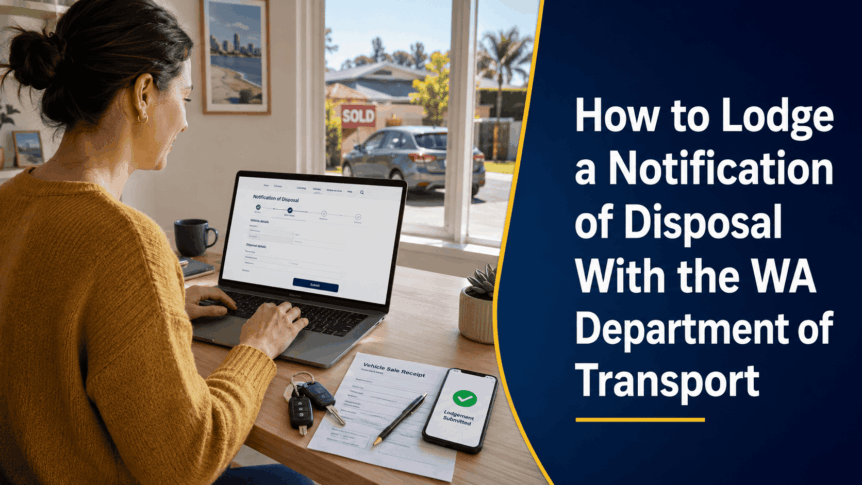
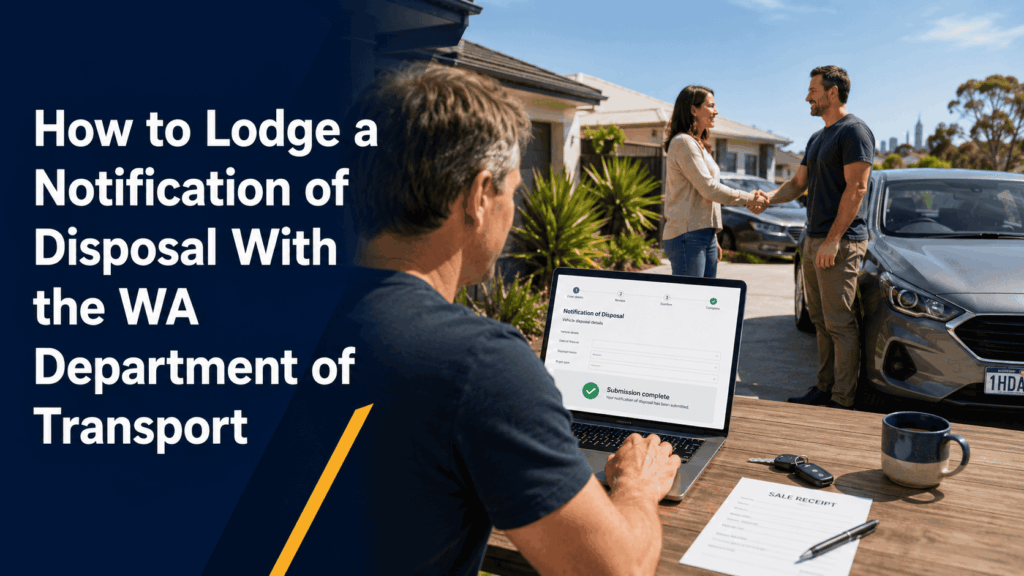
Person lodging a WA vehicle notification of disposal online after selling a car

How to Lodge a Notification of Disposal With the WA Department of Transport (Step-by-Step)

KobyBlog

If you’ve just sold, wrecked, or handed over an accident car in Perth, one government step is easy to forget once the tow truck has left: lodging a Notification of Disposal with the Department of Transport and Major Infrastructure (DTMI) in Western Australia. It’s a short form, but skipping it can leave you legally responsible for a car you no longer own — including someone else’s fines. Here’s how it works, what to do with your plates, and how to claim back any licence fees.

Why Lodging the Disposal Notice Matters

In WA, the vehicle licence stays linked to your name until DTMI is told otherwise, no matter who is actually driving the car. If the new owner picks up parking fines, speed camera infringements, or toll charges before the transfer goes through, those notices are sent to the address on file — which is still yours. Lodging the seller’s notice promptly is what officially ends your responsibility for the vehicle from the date of sale.
This matters just as much for a car that is old and no longer worth re-registering as for a daily driver — even a car sold for scrap keeps a licence record in your name until you close it out.

What You’ll Need Before You Start

The seller’s notice is lodged using Form MR9 (Notification of Change of Ownership – Vehicle Licence Transfer). Before you begin, have these on hand:

  • The vehicle’s plate number, VIN or chassis number, and engine number
  • The date of sale and the sale price, or the market value if there is no sale
  • The buyer’s name and address
  • Your WA driver’s licence number
  • The current vehicle licence paper, so the details match DTMI’s records

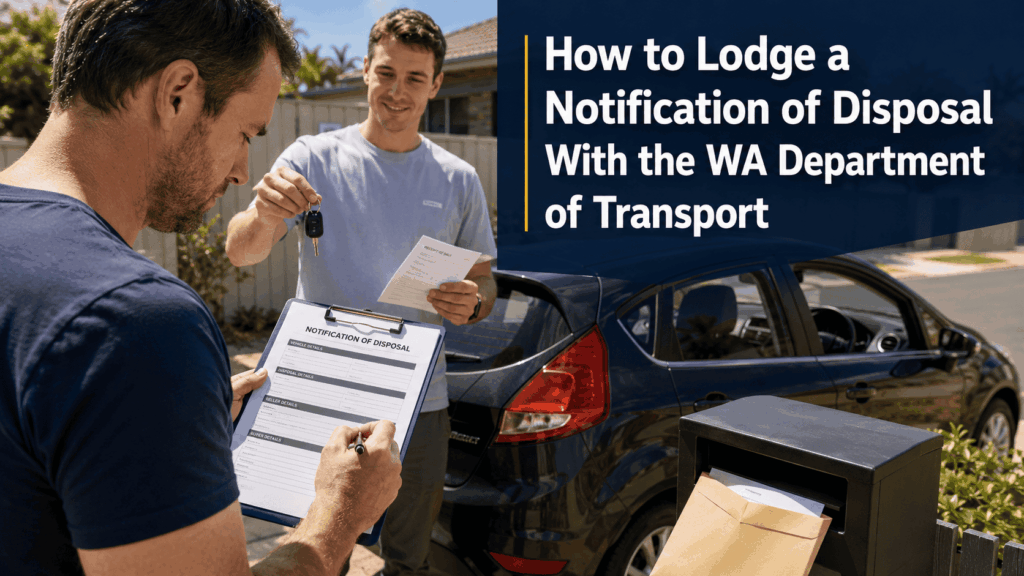
Vehicle papers and Form MR9 laid out to lodge a notification of disposal in WA

Step-by-Step: How to Lodge the Notification

  1. Complete the MR9 with the buyer. The seller and buyer fill in and sign the form together when the car changes hands. It separates into a seller’s copy (blue) and a purchaser’s copy (red).
  2. Lodge your seller’s copy within 7 days. This isn’t a suggested timeframe — DTMI can issue an infringement if the seller’s notice isn’t submitted within seven days of the sale.
  3. Choose how to submit it. Lodge online through a free DoTDirect account at transport.wa.gov.au, in person at a DTMI service centre or regional agent, or by post to Driver and Vehicle Services, GPO Box R1290, Perth WA 6844.
  4. Give the buyer their copy and the licence paper. The purchaser’s copy (red), plus the current vehicle licence paper, lets them complete their side. The buyer then has 14 days to lodge their part and pay the transfer fee and duty.
  5. Keep proof. Hold on to your receipt or a copy of the lodged form. If a fine or dispute comes up later, that is your evidence the car stopped being yours on the date of sale.

If you’re selling to a licensed wrecker rather than a private buyer, the yard handles its side of the paperwork, but the seller’s notice is still yours to lodge — confirm whether they will submit it and hand your plates in for you. For your own situation, DTMI is on 13 11 56.

What Happens to Your Number Plates

What you do with the plates depends on where the car is going.

Sold to another driver: standard state or district plates stay with the vehicle and pass to the new owner as part of the licence transfer. You don’t take them off. The exception is personalised or custom plates — to keep those, remove them before the sale and arrange replacement plates with DTMI.

Sold for wrecking or salvage: the car isn’t going back on the road, so the licence is cancelled rather than transferred. If the vehicle is already on the Written-Off Vehicle Register, DTMI cancels the licence automatically and the plates must be returned within 28 days — a licensed wrecker will often send them back on your behalf, but confirm it. If the car is still licensed when you sell it, take the plates off yourself and hand them in at a DTMI service centre or post them back with a note.

Claiming Back Your Licence Fees

If the car still had registration left on it, you are usually entitled to a pro-rata refund of the licence fees for the unused period. You apply to DTMI once the licence is cancelled. If the car was written off, the refund can be backdated to the accident date if you supply the crash report or an insurer’s letter confirming it. The compulsory third-party component, Motor Injury Insurance, is refunded on the same basis.

Does It Matter If the Car Is Written Off or Not Running?

No. The disposal notice process is the same whether the car runs perfectly, sits dead in the driveway, or is already on the written-off vehicle register. What changes is how the sale happens — a written-off car goes for parts or scrap rather than to another driver.

If the car has been written off, check whether it can still be driven in WA before you arrange the sale, since that decides whether it has to be towed.

Condition and make don’t change the paperwork, but they do affect what a buyer will pay. A common make like a Kia has steady demand for used parts, while a rare model might only be worth its scrap metal.
Non-running car in a Perth driveway waiting to be sold and towed for wrecking

A Simpler Way to Handle the Sale

If the car is old, damaged, or not worth the effort of a private sale, a car removal service takes the paperwork pressure off. Cash For Cars Perth buys vehicles in any condition — running or not, deregistered, written off, or accident, fire, or flood damaged — and can walk you through the MR9 step at collection.

Towing is free across the Perth metropolitan area, from Ardross and the riverside suburbs to the outer metro, often the same day. Payment is sorted before the vehicle leaves, and you will just need valid photo ID — it doesn’t have to be in the registered owner’s name, though having the vehicle licence paper handy makes lodging your MR9 afterwards much simpler. If you would rather not deal with a private sale at all, you can arrange a free quote and pickup on 0420 262 651.

Frequently Asked Questions

How long do I have to lodge the notification after selling my car?

Seven days from the date you stop being the owner. The buyer then has 14 days to lodge their side and pay the transfer fee and duty. Lodging late can attract an infringement, so it is best done straight away.

Do I still need to lodge it if I sold the car to a wrecker?

Yes. Selling for scrap or salvage doesn’t remove the seller’s obligation to notify DTMI. Many wreckers will lodge the notice and return your plates for you, but ask before you assume it is handled.

Can I get money back on my registration?

Usually, yes. If there was unused registration on the car, you can apply to DTMI for a pro-rata refund of the licence fees once the licence is cancelled. For a written-off car, the refund can be backdated to the accident date if you provide proof of when it happened.

What happens if I don’t lodge the notification?

The licence stays in your name, so any fines, tolls, or infringements the new owner runs up are sent to you. You may also face a penalty for not notifying DTMI within seven days.

Do I keep my number plates?

Standard plates stay with a car that is sold to another driver. If the car is going for wrecking, the plates are returned to DTMI. Only personalised or custom plates can be kept, and those need to come off before the sale.

Number plates and vehicle licence paperwork for a written-off car in Western Australia

What Happens to Your Rego and CTP After a Car Accident in WA?

KobyBlog

If your car has been in an accident, dealing with the vehicle itself is usually the straightforward part. The paperwork that follows — what happens to your registration (rego) and your Compulsory Third Party cover — catches a lot of Perth owners out, mainly because the rules aren’t spelled out anywhere obvious. This is separate from lodging a Notification of Disposal, which only comes into play once you’ve actually sold or handed the vehicle over. Before that point there’s a different set of steps to work through, and getting them right can put money back in your pocket.

Rego and CTP Are Bundled Together in WA

Unlike states where registration and CTP are billed separately by different providers, Western Australia rolls them into a single vehicle licence fee. The CTP component is called Motor Injury Insurance, and it’s a compulsory condition of licensing a vehicle. It’s managed by the Insurance Commission of Western Australia, while the Department of Transport and Major Infrastructure (DTMI) collects the premium as part of each licence renewal, whether you pay for 3, 6 or 12 months. Because the two are paid together, cancelling your vehicle licence cancels the Motor Injury Insurance at the same time — there’s nothing separate to close off.

What Happens to the Licence After a Write-Off

A vehicle licence doesn’t always cancel itself after a crash, and which path applies depends on how the write-off is handled.

If the car is written off through insurance

When an insurer or self-insurer reports a vehicle as written off, it’s recorded on the Written-off Vehicle Register. Once that happens, DTMI cancels the vehicle licence and sends the registered owner written notice, and the number plates have to be returned within 28 days. Your insurer or the wrecker taking the vehicle will often return the plates on your behalf, so it’s worth confirming who’s doing that before the car is collected.

If you’re not going through insurance

If the car is uninsured, or you’ve simply decided it isn’t worth repairing, nothing happens automatically. You need to cancel the licence yourself to stop it renewing and to claim back what you’ve already paid.

Cancelling the vehicle licence

To cancel a WA vehicle licence you either surrender the number plates at a DTMI service centre or regional agent, or post them back to DTMI with a note explaining why they’re being returned.

Claiming a refund on the unused portion

Once the licence is cancelled you can apply for a pro-rata refund of the licence fees for the balance of the remaining licence period, using an Application for Refund (Form C2). The Motor Injury Insurance portion is refunded on the same pro-rata basis.

Here’s the detail that catches people out: the refund is normally calculated from the date the plates are returned, not the date of the accident. If weeks pass between the crash and the paperwork, that gap can cost you. The fix is simple — submit a copy of the accident report, or a letter from your insurer confirming the date of loss, and the refund can be backdated to that date instead. It’s worth asking your insurer for that letter as a matter of course when a car is written off, even before you’ve decided what to do with it. A refund can also be held up by an unpaid transfer fee, a plate penalty or a fine suspension on the licence, so clear those first.

WA vehicle owner removing number plates to cancel the licence on a written-off car

This Is Not the Same as a Notification of Disposal

It’s easy to run these two together, but cancelling your licence and notifying DTMI that you’ve disposed of the vehicle are separate obligations. Cancelling the licence and claiming a refund deals with your rego and Motor Injury Insurance. A Notification of Disposal is lodged once you’ve actually sold, traded or handed the vehicle to someone else — including a wrecker — and it’s required whether or not you claimed a refund. If you’re not sure how that part works, our step-by-step guide to lodging a Notification of Disposal covers it.

There’s also a common myth worth clearing up: number plates don’t “stay with you” when a car changes hands. On a write-off, the licence is cancelled and standard WA plates are surrendered to DTMI, as above. On an ordinary sale of a car that’s still licensed, standard state or district plates stay with the vehicle and pass to the new owner in the transfer — you don’t remove them. The only plates you take off and keep are personalised or custom plates, and those need to be booked in with DTMI before the sale if you want to hold onto them.

What Affects a Written-Off Car’s Value

Once the paperwork is sorted, the practical question is what the car is actually worth. A few things matter most:

  • Extent of the damage — whether the chassis and structural rails are straight, or the damage is mostly cosmetic and mechanical.
  • Write-off category — a repairable write-off usually holds more value than a statutory write-off, because more panels and parts stay usable and the car may still be economically repairable.
  • Make and model — common makes with strong used-parts demand, like a Jeep, Toyota or Holden, tend to attract better offers than a rare model nobody is breaking for spares.
  • Clear ownership — the vehicle can’t be stolen or still under finance, and it needs an intact chassis for a buyer to take it on legally.

Even a statutory write-off that will never drive again is worth something as parts and recyclable metal, and that’s what a licensed wrecker is paying for.

Assessor inspecting an accident-damaged car in a Perth yard to work out its salvage value

Selling an Accident-Damaged Car in Perth

With the licence and refund sorted, moving the car on is usually the simple part. A repairable write-off in good structural shape might be worth advertising privately; a statutory write-off, or anything non-running, is generally quicker to sell to a yard that buys accident-damaged cars and handles the tow. A buyer like that will take utes, trucks, vans and 4WDs in any condition — running or not, flood or fire affected, deregistered or written off — though not stolen cars, cars still under finance, or a body with no chassis.

Removal usually covers the Perth metro area, from the northern suburbs down through Applecross and the southern councils, though not as far as Bunbury, with free towing and often same-day pickup if you call before midday. Payment is sorted before the vehicle leaves your property, and all you need on hand is valid photo ID, which doesn’t have to belong to the registered owner.

Getting a Quote

If you’d rather the car was gone than deal with it any further, Cash For Cars Perth gives free quotes over the phone on 0420 262 651. Every vehicle is different, so the fairest way to find out what yours is worth is to talk through the details and have the figure confirmed before pickup.
Common Questions

Does my rego cancel automatically if my car is written off?

If the write-off goes through insurance and the vehicle is recorded on the Written-off Vehicle Register, DTMI cancels the licence and notifies you in writing — you don’t have to lodge anything. If you’re not claiming on insurance, the licence keeps running until you cancel it yourself.

How do I get back the unused part of my licence fee?

Cancel the licence by surrendering the plates, then lodge an Application for Refund (Form C2). You’re refunded on a pro-rata basis for the full remaining licence period, including the Motor Injury Insurance portion.

Can the refund be backdated to the day of the accident?

Yes. It’s normally calculated from the date the plates are returned, but if you include a copy of the accident report or a letter from your insurer confirming the date of loss, it can be backdated to that date.

Do I keep the number plates after a write-off?

No. Standard WA plates are surrendered to DTMI within 28 days of the licence being cancelled, and your insurer or the wrecker will often return them for you. Only personalised or custom plates are removed and kept, and that has to be arranged with DTMI before the vehicle goes.

Damaged car in a Perth driveway being sold without a roadworthy certificate in WA

Do You Need a Roadworthy Certificate to Sell a Damaged Car in WA?

KobyBlog

If you’ve got a damaged, unregistered or barely-running car sitting in the driveway due to an accident, it’s fair to wonder whether you need to get it inspected before you can legally sell it. In some states the answer is yes, and it can be an expensive step for a car that’s already on its way to the wreckers. In Western Australia, the rules work differently.

The Short Answer: No, WA Doesn’t Require One

Unlike Victoria, Queensland, the ACT and the Northern Territory, Western Australia does not require a roadworthy certificate — sometimes called a safety certificate — before a private sale can go ahead. If the vehicle is already licensed in WA, the licence can be transferred to the new owner without any inspection. There’s no mechanic’s sign-off to arrange and nothing extra to attach to the paperwork. The Department of Transport puts the responsibility for checking a car’s condition on the buyer, not the seller, and that applies whether the car runs perfectly, has accident, flood or fire damage, or doesn’t start at all.

An inspection only comes into it in specific cases: vehicles brought in from interstate, licences that have lapsed by more than three months, and vehicles coming off a written-off record. A straightforward private sale of a currently licensed car isn’t one of them.

The one thing worth doing is being upfront. If you’re advertising to a private buyer, describe the damage honestly — private sales carry no statutory warranty, but a misleading ad can still land you in a dispute.

What You Still Need to Do When Selling

Not needing a roadworthy certificate doesn’t mean there’s no paperwork. A few things apply to every sale in WA, damaged or not:

  • Lodge a notification of disposal. Within seven days of the sale you have to tell the Department of Transport you’re no longer the owner and give the buyer’s name and address, either online through DoTDirect or by lodging the seller’s copy of the vehicle transfer form (MR9). This is what takes the car out of your name — miss it and you can still be linked to the new owner’s fines or infringements, and late lodgement can attract a penalty.
  • Have photo ID ready. Whoever hands the car over needs to prove who they are. It doesn’t have to be the registered owner, but ID is expected as part of a proper handover.
  • Clear any finance first. Money still owing on the car has to be paid out before it can be sold. A quick Personal Property Securities Register (PPSR) check, using the VIN, will show any finance owing and whether the car is recorded as written off.

What Happens to the Number Plates

This is the detail people most often get wrong. Standard WA number plates stay with the vehicle and pass to the new owner as part of the licence transfer — you don’t take them off. The only time plates come off is when they’re personalised or custom plates you want to keep, and then you have to remove them and arrange replacement plates with the Department of Transport before the sale goes through.

Seller completing a WA notification of disposal form after selling a damaged car

What If the Car Is Written Off, Deregistered or Barely in One Piece?

This is where a lot of Perth owners get stuck. A private buyer usually wants something they can drive away and register, not a car with fire damage, a written-off history or missing panels. That narrows the market a long way, even though nothing in the law stops you from selling it.

That’s usually where a licensed car removal or wrecking yard comes in. They’re set up to buy exactly what private buyers won’t touch: running or not, accident-damaged, flood or fire-damaged, deregistered, or headed to the wreckers. A few categories are off-limits everywhere, though — stolen vehicles, cars still under finance, and bare bodies without a chassis generally can’t be sold until those issues are sorted.

What Affects a Damaged Car’s Value

If you’re trying to work out what a damaged car is worth, a few things matter more than others:

  • Make and model. A common car or work ute — an Isuzu D-Max, a Corolla, a Hilux — is worth more for parts alone, because the demand for those parts is still there.
  • How complete it is. A car missing its engine or transmission is worth less than one that’s all there, even if neither runs.
  • Extent of the damage. Cosmetic damage costs less value than structural, fire or flood damage.
  • Weight and metal content. Most badly damaged cars are recycled for parts and scrap steel, so the weight of recoverable metal plays a part in what a yard can offer.

Damaged car being assessed for its salvage and scrap value at a Perth wrecking yard

Selling to a Licensed Wrecker vs a Private Sale

For a car in good working order, a private sale usually fetches more, as long as you have time to advertise and field calls. For a damaged, non-running or written-off vehicle it rarely works out — the pool of buyers is small, and the notification of disposal still has to be lodged either way. Many Perth owners in that situation use a licensed car removal or wrecking yard instead: the car’s condition isn’t a barrier to the sale, and the yard handles the tow, usually free and same-day, right across the metro area from the northern suburbs out to Anketell in the south.

If you’d rather skip the private-sale hassle, Cash For Cars Perth buys damaged, written-off and non-running vehicles in any make across the Perth metro area — call 0420 262 651 for a condition-based quote.

Common Questions

Do you need a roadworthy certificate to sell a car privately in WA?

No. WA doesn’t require a roadworthy or safety certificate to transfer a vehicle that’s already licensed in the state. The buyer is responsible for checking the car’s condition before purchase.

When does a car need an inspection in WA?

When it’s being licensed here from interstate, when the licence has lapsed by more than three months, and when it’s coming off a written-off record. A normal private sale of a currently licensed car doesn’t need one.

What paperwork do I need to sell a damaged car in WA?

Lodge a notification of disposal within seven days of the sale with the buyer’s name and address, have photo ID ready at the handover, and clear any finance owing. A PPSR check on the VIN confirms the finance and written-off status.

Do the number plates stay with the car when I sell it in WA?

Standard WA plates stay on the vehicle and transfer to the new owner, so you don’t remove them. To keep a personalised or custom plate, arrange replacement plates with the Department of Transport before the sale.

Mechanic inspecting a repaired car at a Perth vehicle examination station

How Much Does a Roadworthy Inspection Cost in Perth After Repairs?

KobyBlog

If your car has just come out of repairs after an accident, storm damage, or a WA Police yellow sticker, getting it road-legal again usually means one more step: a vehicle inspection. In WA this is officially a vehicle examination, and it confirms a repaired car is safe to drive and can be licensed again. Here’s what it involves, what it costs, and when it makes more sense to sell the car than keep paying for inspections.

What WA Calls a “Roadworthy” (And When You Need One)

Western Australia doesn’t use the term “roadworthy certificate” the way some eastern states do. Here it’s a vehicle examination, carried out by an authorised inspector at an Authorised Inspection Station (AIS) — a private business working on behalf of the Department of Transport and Major Infrastructure (DTMI). Highly modified, oversized or high-risk vehicles go to the DTMI examination centre at Kelmscott instead.

You’ll generally need one if:

  • Your car has been given a yellow sticker (vehicle defect notice) for a safety defect
  • You’re re-licensing a repairable write-off
  • You’ve modified the engine, body or structural components
  • You’re licensing a vehicle in WA for the first time, or bringing an unlicensed car back onto the road

Passing the examination is what restores your licence — finishing the repairs alone doesn’t. A repairable write-off actually needs two checks: first with an authorised written-off vehicle inspector, then an identity and roadworthy inspection at an AIS.

Authorised inspector checking a vehicle at a WA Authorised Inspection Station

What Does It Cost After Repairs?

There’s no single government-set price. AIS inspection fees aren’t regulated by DTMI — each station sets its own, benchmarked to a regional price index, so what you pay depends on the station, its location and the type of vehicle. A re-inspection after a failed check is charged separately, on top of the first fee. The practical move is to ring a few stations near you and compare before booking.

What affects the price

  • Vehicle type and weight — heavier vehicles and light trucks cost more to inspect than a standard passenger car
  • Extent of the repairs — structural or chassis work needs a more thorough look than cosmetic panel repairs
  • Which station you use — AIS providers set their own fees
  • Re-inspection vs first attempt — a second visit is a separate charge

If the Car Doesn’t Pass

If your vehicle fails, you’ll get a notice listing what needs fixing and a limited window to repair it and return before the result lapses. An inspection pass is only valid for about three months, so there’s no point doing it long before you’re ready to license the car. For a vehicle that’s already had one repair bill, a second round of work plus another inspection fee can turn a quick fix into an expensive exercise — especially on an older car.

Owner reading a failed vehicle inspection notice next to an older car in Perth

When It’s Not Worth Fixing

This is where a lot of Perth owners do the maths: repair quote, inspection fee and likely re-inspection fee against what the car is worth once it’s back on the road. On an older vehicle, or one with a history of mechanical trouble, the cost of a fresh pass can come close to — or beyond — what an accident-damaged car would sell for anyway.

What it’s worth as-is depends heavily on the make. A common Perth vehicle like an Isuzu D-Max or a mainstream sedan holds better salvage value because there’s steady demand for the parts; a rare model can be worth less broken than you’d expect.

You don’t need a roadworthy to sell for wrecking

Sell to a licensed wrecker or car removal yard rather than a private buyer and none of this applies — no current inspection, no passed examination, not even working registration. Wreckers buy vehicles for parts and scrap metal, so a yellow sticker, a failed inspection or a lapsed licence doesn’t stop the sale.

A private sale is the exception: there, a buyer will usually want a current inspection or will knock the cost of getting one off their offer. Whether you need a roadworthy to sell a damaged car in WA comes down to who you’re selling to.

Selling in WA — A Couple of Rules to Know

Two WA details catch people out when selling a damaged or unwanted car:

  • Standard plates stay with the vehicle. Ordinary WA plates transfer to the new owner with the licence — you don’t remove them. Only personalised or custom plates are different: exchange those at a DTMI service centre before the sale if you want to keep them.
  • Lodge a notification of disposal within seven days. Tell DTMI you’ve stopped being the owner, with the buyer’s name and address, within seven days of the sale. Failing to do so results in a penalty.

You’ll also need valid photo ID. It doesn’t have to match the registered owner’s name, which helps if you’re selling for a family member or handling a deceased estate.

Getting a Cash Offer Instead of Paying for Repairs

If the numbers don’t favour fixing the car, Cash For Cars Perth buys vehicles in any condition — running, non-running, accident-damaged, flood or fire-damaged, deregistered or written off. We’re based at a licensed wrecking yard at 5 Hantke Place, Welshpool, and cover the whole Perth metro area, from the northern suburbs down to Anketell on the southern edge (not as far as Bunbury or the South West). Most cars are picked up free the same day, often within two to three hours if you call before midday, and payment is sorted before the vehicle leaves your property.

We can’t take stolen vehicles, cars still under finance, or bodies without a chassis. Just about everything else — utes, trucks, vans and 4WDs included — is fine.

Get a Quote Before You Book Another Inspection

Before you pay for a re-inspection or another repair bill, find out what the car is worth as it sits. Call 0420 262 651 for a free, no-obligation quote or to ask about same-day pickup. We’re open Monday to Friday, 7:30am to 5:00pm and Saturday, 7:30am to 2:00pm, closed Sundays and public holidays.

Common Questions

How long is a WA vehicle inspection valid?

Generally about three months, so it’s best not to have it done long before you’re ready to license the vehicle.

Who sets the inspection fee?

The inspection station, not the government. AIS fees aren’t regulated by DTMI, they vary by provider and region, and a re-inspection is a separate charge. Ring a few stations to compare.

Do I need to pass an inspection to sell a car for wrecking?

No. Licensed wreckers and car removal yards buy vehicles that have failed an inspection, carry a yellow sticker or have no current registration. A private sale is different.

What happens to my number plates when I sell?

Standard WA plates stay with the vehicle and transfer to the new owner. Only personalised or custom plates need separate handling — exchange them at a DTMI service centre before the sale if you want to keep them.

Perth driver weighing a smash repair quote against the value of an accident-damaged car

Is It Cheaper to Repair or Replace an Accident-Damaged Car?

KobyBlog

If your car has just come out of a smash, you’re probably staring down two quotes: one from the panel beater, and one from your own gut telling you the car might not be worth fixing. Repairing or replacing it is a decision a lot of Perth drivers face, and the right answer isn’t always obvious — it depends on the car’s age, what it’s worth, and how bad the damage really is under the panels. Here’s a practical way to work it out.

What Actually Determines Whether Repair Makes Sense

Before the repair quote even lands, it helps to know what pushes that number up or down.

Age and kilometres

Older cars with high kilometres are worth less to begin with, so a smaller repair bill is enough to tip them into “not worth it” territory. A quote that comes to a small fraction of the car’s value is an easy yes. The same quote against a car worth only a little more than the repair itself is a much harder call.

Type and extent of damage

Cosmetic panel damage is usually straightforward to price. Structural damage — a bent chassis rail, a damaged firewall, airbag deployment, or anything affecting the crumple zones — is where costs climb quickly, and where an insurer is more likely to write the car off rather than approve repairs.

Parts availability

Common makes with parts readily available in WA — a Hyundai or similar mainstream model — tend to be cheaper and quicker to repair. Less common imports, older models, or cars where parts have to come from interstate or overseas can blow out both the cost and the timeframe, even when the repair is technically possible.

Assessor examining structural damage on an accident-damaged car to work out the repair cost

A Simple Decision Framework

A rule of thumb used by a lot of insurers and mechanics: once the repair cost reaches around 50–70% or more of the car’s current market value, replacing it usually makes more financial sense than repairing it. It’s not a hard rule, but it’s a reasonable place to start.

Working through an example

Say the repair quote comes back at roughly two-thirds of what the car is currently worth on the used market. That’s right in the zone where it’s worth pausing. Now add the things that usually get left out of the mental maths:

  • Time off the road while it’s being repaired
  • The risk of hidden damage once the panels come off
  • Whether the repaired car’s resale value fully recovers, or carries a damage history
  • Rental or alternative transport in the meantime

Weigh those in and a repair that looked borderline on paper can turn out to be the more expensive option. If that same quote were only a quarter of the car’s value, it would clearly be worth doing. The maths only works if you’re honest about what the car is actually worth now — not what you paid for it, or what it’s worth to you.

What Happens If Your Car Is Written Off in WA

If your insurer declares the car a total loss, or you decide to walk away from repairs yourself, a few WA-specific things are worth knowing.

A statutory write-off is a vehicle “damaged so severely it can never be made safe or roadworthy” — it can’t be re-licensed and is only good for parts and scrap. A repairable write-off is a total loss on cost rather than safety, and “may be repaired and relicensed, provided [it meets] all inspection, repair, and licensing requirements”. Either way, the write-off stays on the car’s history and shows up on a vehicle history check, which drags on resale value.

On the paperwork side:

  • Standard number plates stay with the vehicle and pass to the new owner during the licence transfer — you don’t take them off. If you have personalised or custom plates you want to keep, arrange that with the Department of Transport before the sale.
  • Lodge a notification of disposal. Once you’ve sold or disposed of the car, you have to tell the Department of Transport within seven days and give the new owner’s name and address. A penalty applies if you don’t.

These steps apply whether the car goes to a private buyer, back to the insurer, or to a wrecker.

Owner signing over a written-off car with number plates and registration paperwork in WA

If Replacement Wins Out

Once you’ve decided repair isn’t worth it, the question becomes what to do with the accident-damaged car. Selling it as-is to a car removal service is usually faster and less hassle than a private sale, especially if it isn’t driveable. What you’re offered depends on:

  • The make, model and age of the vehicle
  • How extensive the damage is, and whether it still runs
  • Whether it’s complete — missing parts reduce the value
  • Current scrap metal and used-parts market conditions, which move over time

A removal service will generally take accident or storm-damaged cars, utes, vans, trucks and 4WDs in any condition, running or not, including cars that are already written off. Stolen vehicles, cars still under finance, and bodies without a chassis are the main things that can’t be taken, and you’ll need photo ID to complete the sale.

Removal is free and usually available the same day if you call before midday, right across the Perth metro area — from Alkimos and Two Rocks in the north down to the southern coastal suburbs.

Common Questions

What repair-cost percentage means a car isn’t worth fixing?
There’s no fixed threshold for a private decision, but once the repair quote reaches roughly 50–70% of the car’s current market value, replacing it usually makes more sense. Factor in hidden damage, time off the road, and the damage history the car carries afterwards.

Does a repaired car lose value even after a proper repair?
Usually, yes. A car with a recorded accident or repair history tends to sell for less than an equivalent car with a clean history, even when the work is done well. That gap is part of the real cost of repairing.

Can I sell the car myself if the insurer has written it off?
If you take the payout, the insurer normally keeps the wreck and handles disposal. If you keep the car instead, it can only be sold as a written-off vehicle and the write-off stays on its history, so expect that to affect the price.

Is it worth repairing a car just to sell it?
Rarely. The extra you’d get on the sale has to beat the repair cost plus the value still lost to the damage history. Most people come out ahead selling the car damaged and letting the buyer decide.

Working Out Where You Stand

There’s no single number that settles it — you’re weighing the repair quote against a realistic value for the car, the risk of hidden damage, and how long you can go without it. If the numbers are close and you’re leaning towards replacing it, it’s worth finding out what the car is worth as-is first. Cash For Cars Perth gives free valuations over the phone on 0420 262 651, Monday to Friday 7:30 AM to 5:00 PM and Saturday 7:30 AM to 2:00 PM.